
When Your Ex Is Getting Married to Someone Else

Sometimes the news arrives as a wedding card passed around the family. Sometimes it is an engagement photo that appears without warning while you scroll late at night. However you learn of your ex getting married, it can feel as though a door you had kept slightly open has been closed firmly from the other side. People in North York and throughout the GTA come to me at this moment carrying shock, grief and, sometimes, a desperate hope that something can still be done. This guide speaks honestly to all of that. It looks at how to cope in the first days, why no genuine practitioner should offer a ritual to stop a wedding, whether to tell your ex how you feel, whether to attend if invited, and how to rebuild your life afterwards. Over forty years of practice I have performed many weddings and comforted many people who loved one of the two people at the altar. What I have learned is that respecting someone's choice to marry is not weakness. It is love in its most mature form, and it is also the beginning of your own freedom.
How do you cope when your ex is getting married?
Coping starts with letting the feeling be real. Shock, sadness, anger, jealousy and even relief are all normal reactions. In the first days, reduce exposure to wedding photos and family talk, keep up sleep and meals, and tell one trusted person how you feel. The news may reopen grief you thought had healed, and that is understandable.
Learning that an ex is marrying can trigger a second wave of grief. Even if you had moved on, an engagement can make the ending feel suddenly official. Many people describe a heavy, sleepless week, followed by days that come and go.
In the first days:
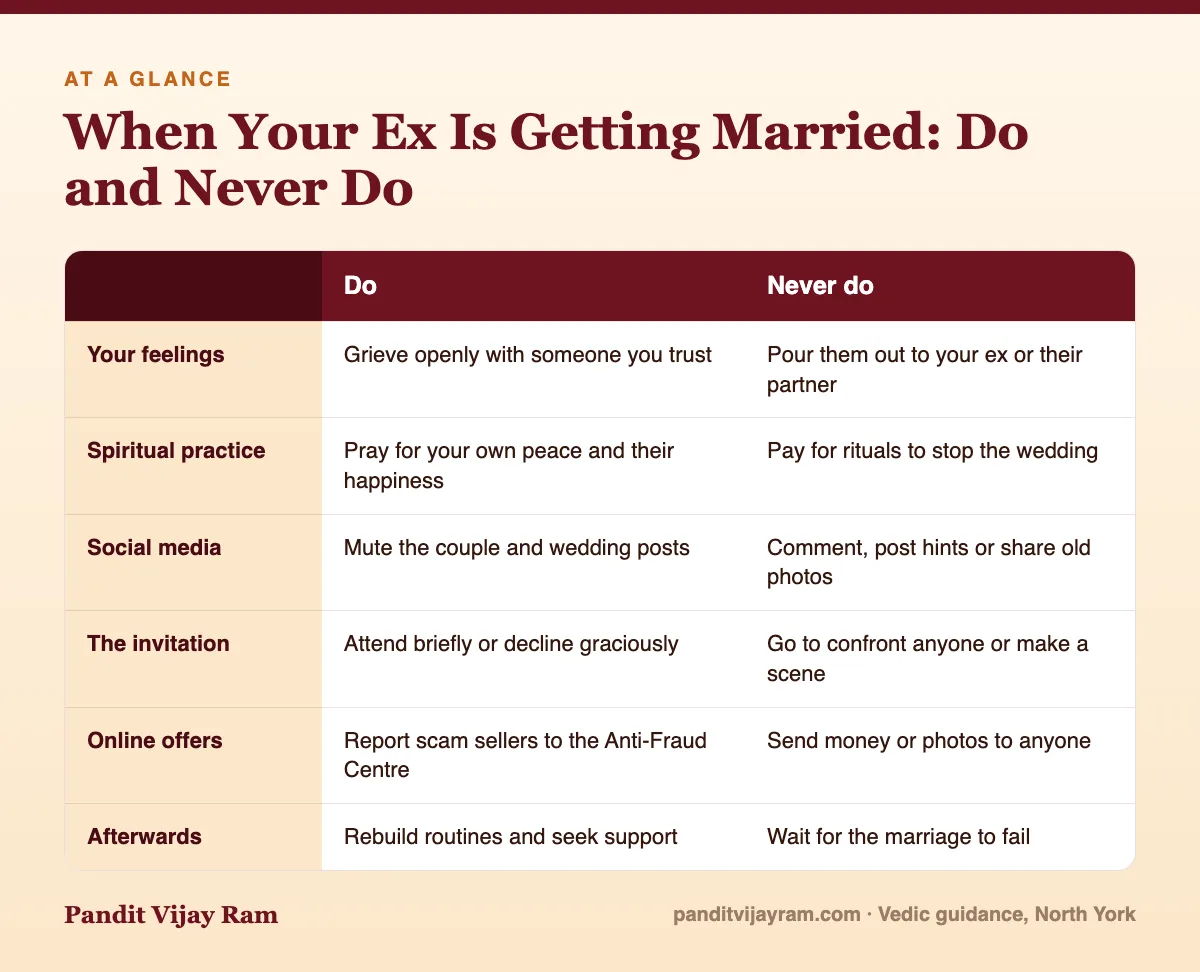
- Step back from social media. Mute the couple and mutual friends who post wedding preparations. You can unmute later.
- Protect your basics. Regular meals, water, a short walk outdoors and a set bedtime help the body carry the emotional load.
- Choose your confidant. One friend or relative who will listen without gossiping or criticising your ex.
- Expect triggers. Family functions, songs, shared places and wedding-season festivals may hit hard. Plan gentle company for those days.
- Write instead of sending. Put the feelings on paper. You do not have to show anyone.
In tight-knit diaspora communities, the wedding may be discussed at the temple, gurdwara or family gatherings. It is fine to say politely that you would rather not hear the details.
If your ex has been with their new partner for a while, our guide on when your ex has a new partner covers the earlier stage of this grief. Feelings that seem too heavy to manage deserve care too; our guide to mental health support for South Asian families lists culturally aware services.

Is there a ritual to stop an ex's marriage?
No honest practitioner should offer one, and I do not. A ritual to stop a wedding tries to override two people's free choice and harms the couple and both families. Advertisements promising to stop an ex's marriage are often scams that escalate fees and use fear. Acting to sabotage a wedding by any means can also be harassment.
Searches for ways to stop an ex's marriage are common, and online sellers are ready to exploit them. They promise mantras, photo rituals or tantric work to make the wedding collapse or the new partner leave. I want to be very clear: I refuse this work, without exceptions.
Why it is wrong:
- It denies free will. Your ex has chosen a partner. Vedic dharma does not permit using spiritual practice to force or break another person's commitment.
- It harms innocent people. The new partner, both families and any future children have done nothing to you.
- It brings karmic weight to the person who requests it, according to the tradition's own teaching on intention and harm.
- It does not lead where you hope. Even if a wedding were cancelled, it would not make your ex choose you.
Practical warning signs of a scam: guaranteed results, deadlines before the wedding date, requests for photos of the couple, and fees that rise each time the ritual supposedly needs more work. Our guide to fake love spell casters online explains these patterns, and the Canadian Anti-Fraud Centre takes reports.
Other forms of interference are equally harmful: contacting the fiancé, sending old messages or photos, or turning up at the ceremony. Sharing intimate images without consent is a criminal offence in Canada. If your ex is being pressured into this marriage against their will, that is a safety matter for police and specialist services, not for a rival's ritual.
Should you tell your ex you still love them before their wedding?
In almost every case, no. A last-minute declaration places a heavy burden on someone who has made a decision, can hurt their partner, and rarely changes the outcome. If you have something genuinely unfinished, such as an apology, it can usually be said briefly and without romantic meaning, or written privately and never sent.
Films are full of dramatic interruptions at the altar. Real life is different. A message saying you still love them, sent weeks before a wedding, usually lands as pressure. It may also be seen by the new partner, cause conflict in two families, and leave you with regret.
Ask yourself these questions before contacting your ex:
- What am I hoping will happen? If the honest answer is that they will call off the wedding, do not send it.
- Would I be comfortable if their partner read this? If not, it is not appropriate.
- Is this an apology I owe, or a confession I want to make? An apology can be given cleanly. A confession of love asks them to carry your feelings.
- Have they asked for no contact? If so, the answer is already clear.
If an apology is genuinely owed, our guide on how to apologise to an ex explains how to offer one without strings, and it is often kinder to do so well before or well after the wedding rather than during preparations.
For everything else, write a letter you never send. Read it aloud, perhaps before a lit lamp, and then burn it safely or keep it in a closed box. Many people find this simple act brings a surprising sense of release.
Should I go to my ex's wedding if I am invited?
Go only if you can attend calmly, wish the couple well sincerely and leave without drama. In close-knit families, where relatives are connected, a short, gracious appearance can be kind. If attending would reopen deep grief or tempt you to make a scene, a polite decline with a warm message or small gift is perfectly acceptable.
In many South Asian and Caribbean families, exes are connected through cousins, neighbours or the same temple community. An invitation may arrive simply because your families are close. That can make the decision feel complicated.
Consider attending if:
- Your relationship ended some time ago and you feel mostly at peace.
- Your absence would be noticed and cause awkwardness between families.
- You can bring a supportive friend or family member.
- You are confident you will not drink too much or say anything you would regret.
Consider declining if:
- The breakup is recent or still raw.
- You feel any urge to speak to your ex privately on the day.
- The new partner is uncomfortable with your presence.
- You suspect you would spend the event watching them rather than celebrating.
If you go, keep it short: attend the main ceremony, offer blessings and a modest gift, greet the elders and leave before the late celebrations. If you decline, a brief card wishing them a happy marriage is gracious. Either choice can be made with dignity.
Afterwards, give yourself a quiet evening. Weddings stir up many emotions, even for guests with no history. A short prayer at home, perhaps the Shanti mantra for peace, can help settle the mind before sleep.
How do you move on after your ex marries someone else?
Moving on means accepting the ending fully and turning attention back to your own life. Grieve without rushing, rebuild routines and friendships, avoid following the couple online, and consider counselling if sadness persists. In Vedic practice, praying sincerely for your ex's happiness can become a powerful act of release, freeing your heart for its own future.
Once the wedding has happened, the uncertainty is over, even if the sadness is not. Some people find that this actually helps; there is nothing left to wait for. Others feel a fresh grief. Both are normal.
Steps that help over the following months:
- Name the loss. You are grieving a person, a shared future and, sometimes, a version of yourself. Our guide to relationship grief explains why this takes time.
- Rebuild your days. Work, study, exercise, family and seva give structure while feelings settle.
- Stay off their pages. Honeymoon photos and anniversary posts reopen the wound.
- Talk to someone. A counsellor, a friend or your family doctor if low mood, poor sleep or appetite changes continue for weeks. In crisis, call or text 988.
The Vedic tradition offers a practice that sounds difficult but is deeply healing: praying for the happiness of the person who left. The prayer Sarve bhavantu sukhinah, may all beings be happy, can be said with your ex quietly in mind. It is not a ritual to change them. It is a way of loosening your own grip, a step towards vairagya, gentle detachment.
Our guide on moving on when you still love them goes deeper into acceptance. If you would like help understanding this season in your chart and choosing a prayer practice, a get ex love back consultation with me focuses on your healing, never on the couple's marriage.
The bottom line
When your ex is getting married, the kindest and wisest response is to let the wedding happen without interference, refusing any ritual or tactic meant to stop it. Allow yourself to grieve, step back from social media and lean on trusted people. Decide calmly about speaking up or attending, choosing dignity over drama. Over time, prayer for their happiness and steady care for your own life help release the bond.
Key takeaways
- Grief after an ex's engagement is normal, even long after the breakup.
- No genuine practitioner offers rituals to stop someone else's wedding.
- Last-minute declarations of love usually cause harm and rarely change anything.
- Attending the wedding is optional; a gracious decline is always acceptable.
- Praying for your ex's happiness can become a powerful act of release.