
Rebuilding Self-Worth After Rejection

Being left by someone you love can feel like a verdict. Their choice seems to say you were not enough: not attractive enough, not interesting enough, not worth staying for. That message can quietly spread into work, friendships and how you look in the mirror. Rebuilding self worth after rejection is possible, but it rarely happens by waiting. I speak with people in North York who are capable and loved by many, yet one person's departure has convinced them they are unlovable. This guide explains why rejection hits so hard, how to separate their decision from your value, and practical exercises that restore self-respect week by week. It also offers a devotional view from the Gita, which teaches that you must lift yourself by your own effort and never degrade yourself. In more than forty years of this work, I have found that people recover their footing fastest when they treat themselves the way they would treat a dear friend in the same pain. The page ends with clear signs that a counsellor or doctor should be part of your support.
Why does rejection hurt so much?
Rejection hurts because humans are wired to belong. Being pushed out of a close bond registers as a threat, and research on social rejection suggests it involves some of the same distress systems as physical pain. The mind then searches for a reason, and too often settles on the harshest one: something is wrong with me.
For most of human history, being cast out of the group was dangerous. Our nervous systems still react to rejection as an alarm. That is why it can bring a hollow stomach, tight chest and racing thoughts, even when you know logically that you will be fine.
Three things tend to make romantic rejection especially painful:
- It is personal. The person who knew you best has said no to you.
- It is often unexplained. A vague reason leaves room for self-blame to fill the gap.
- It is compared. If they move on quickly or date someone new, you may measure yourself against that person.
In many diaspora families, an extra layer appears. A broken engagement or a relationship that ended may be discussed by relatives, and the person left behind can feel judged twice, once by the partner and once by the community. The guide on heartbreak in South Asian families speaks to that pressure.
Understanding the pain as a normal alarm, not proof of failure, is the first step. You are not weak for hurting this much. You are human.

Does being rejected mean I'm not good enough?
No. Rejection means the relationship did not fit for that person at that time. People leave for reasons involving their own readiness, fears, family pressures, timing or changing needs. Their decision describes a mismatch, not your total value. Treating one person's choice as a final judgement gives it far more weight than it deserves.
Try this short exercise when the thought "I'm not good enough" appears. Write it at the top of a page, then answer four questions underneath.
- What is the evidence for this thought? Usually it is a single event: they left.
- What is the evidence against it? List people who value you, things you have done well, kindness you have shown.
- What else might explain their choice? Their timing, fears, family, a different idea of the future.
- What would I say to a friend who thought this? Write those words, then read them as if addressed to you.
This is a simple form of the thought-checking used in cognitive therapy. It does not argue you out of sadness. It prevents sadness from turning into a false belief about yourself.
Be careful with comparison. If your ex has a new partner, it can feel like proof that someone "better" was chosen. In reality, new relationships after a breakup happen for many reasons. The article on when an ex has a new partner explains why that comparison misleads you. Equally, resist the urge to prove your worth by trying to make them regret leaving. Growth that is for you, not for their reaction, is the theme of the honest truth about making an ex miss you.
How can I rebuild confidence after a breakup?
Rebuild confidence through small, kept promises to yourself. Choose one daily action you will reliably do, such as a morning walk, a cooked meal or ten minutes of prayer. Each kept promise is evidence that you can trust yourself. Add one new skill, steady time with people who value you, and kinder self-talk.
Confidence is less a feeling than a record of evidence. After rejection, the record feels erased. You rebuild it by adding new entries every day.
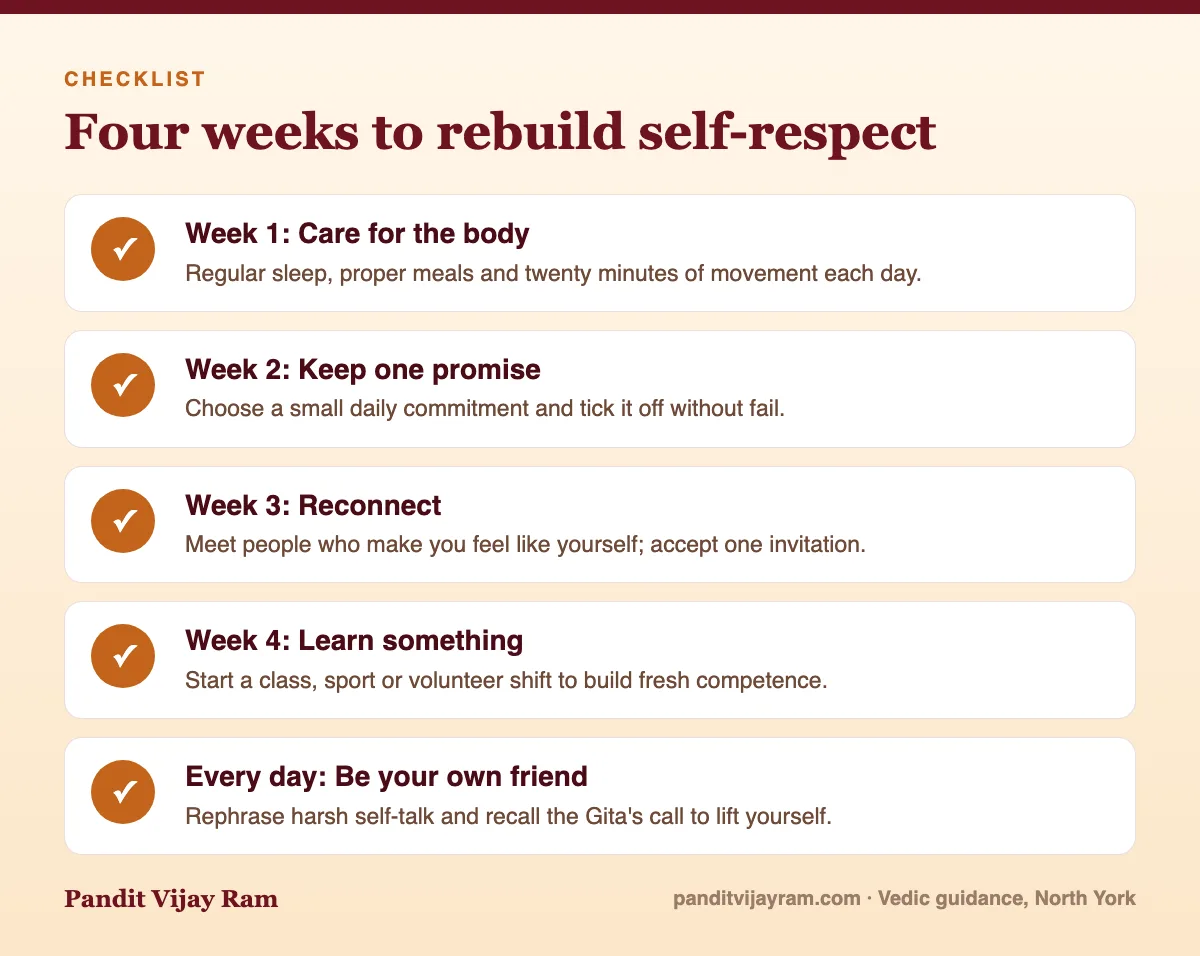
A four-week plan many people find manageable:
- Week one: the body. Sleep at a regular time, eat proper meals, move for twenty minutes. Rejection often makes people neglect themselves, which deepens the sense of being worthless.
- Week two: one promise. Pick one small daily commitment and keep it without fail. Tick it off on a calendar.
- Week three: connection. Arrange two meetings with friends or family who make you feel like yourself. Say yes to one invitation you would normally refuse.
- Week four: something new. Start a class, a volunteer shift, a language or a sport. New competence is powerful medicine for self-doubt.
Watch your self-talk. If you call yourself stupid, pathetic or unlovable, pause and rephrase as you would for a friend: "I'm hurting, and I'm doing my best." Psychologists call this self-compassion, and it is linked with steadier recovery than harsh self-criticism.
A structured journal helps track this progress. The companion guide on journaling and prayer after a breakup offers prompts for each stage.
What does Vedic teaching say about self-respect?
The Bhagavad Gita teaches that a person should lift themselves by their own effort and never degrade themselves, because the self can be its own best friend or its worst enemy. Vedic thought also holds that your deepest self, the atman, is not diminished by any person's approval or rejection.
The sixth chapter of the Gita contains a verse that many people in pain find steadying. It says, in essence: raise yourself by yourself; do not lower yourself; you alone are your friend, and you alone can become your enemy. After rejection, the enemy is often the inner voice that repeats the worst story. The friend is the voice that chooses to care for you anyway.
Ways to bring this into daily life:
- Each morning, light a lamp and read that verse, or simply say: "Today I will be my own friend."
- Remember the story of Hanuman, who forgot his own strength until Jambavan reminded him. Sometimes others remind us; sometimes we must remind ourselves.
- Offer your work and effort each day without measuring yourself by one person's response.
- Recite the Hanuman Chalisa or a short mantra for courage when self-doubt is strongest.
None of this replaces support from people or professionals. It gives the heart something solid to stand on while the rest of life is rebuilt. A kundli reading can show periods when confidence is naturally tested, which some people find helps them be patient with themselves. It shows tendencies, not a verdict on your future. For love-specific guidance, the love problem consultation is the gentler starting point.
When should I talk to a therapist about rejection?
Talk to a therapist when feelings of worthlessness last several weeks, affect work or sleep, or echo older rejections from childhood or past relationships. Therapy is also wise if you find yourself chasing people who treat you poorly. A doctor should be seen promptly if low mood deepens or thoughts of self-harm appear.
Some rejections touch an old wound. If a breakup brings back feelings from being overlooked as a child, compared with siblings, or left in earlier relationships, the pain may feel bigger than this one event. A therapist can help you untangle those layers.
Consider professional support if:
- You have felt worthless most days for more than two weeks.
- You avoid people or opportunities because you expect rejection.
- You keep returning to relationships where you are treated as less.
- You are drinking, gambling or using substances to dull the feeling.
- You notice thoughts that life is not worth living.
In Ontario, a family doctor can refer you, many workplaces have employee assistance programmes, and registered psychotherapists can be found through professional directories. The guide to finding relationship counselling in Toronto explains how to search. For culturally aware options, see the South Asian mental health guide for the GTA.
If you are in crisis, call or text 9-8-8 at any hour. If you are in immediate danger, call 911. Seeking help is an act of self-respect, not a sign that you have failed.
The bottom line
Self worth after rejection returns when you stop treating one person's choice as a final verdict. Rejection hurts because belonging matters, yet it usually reflects fit and timing rather than your value. Small kept promises, kind self-talk and the Gita's call to be your own friend rebuild confidence day by day. When worthlessness lingers or deepens, a therapist or doctor is part of self-respect.
Key takeaways
- Rejection triggers a real alarm in the body; hurting is not weakness.
- Their choice describes a mismatch, not your total worth.
- Confidence is rebuilt through small promises you keep to yourself.
- The Gita teaches you to lift yourself and be your own friend.
- Lasting worthlessness or dark thoughts call for professional help.