
Gochar: How Moving Planets Interact With Your Birth Chart

A friend forwards a video saying Saturn is changing signs and every Leo should brace for trouble. Your aunt says the same transit will bring you a house. Both cannot be right, and the noise leaves you more confused than before. This guide explains the gochar transit method the way a working astrologer actually uses it, for readers in North York and anywhere else. You will learn why transits are counted from the Moon rather than the Sun, which houses each planet is traditionally happy or unhappy in, how the ashtakavarga score changes the picture, and why a transit rarely does much unless your dasha agrees. There are no dates in this article and no forecasts for any sign. In more than forty years of reading charts I have watched people dread transits that passed quietly and ignore ones that mattered, simply because they read a generic sign column. A little method goes a long way.
What is gochar in Vedic astrology?
Gochar, from the Sanskrit for 'moving' or 'roaming', is the study of planets in their current positions compared with your birth chart. The birth chart is a fixed snapshot; gochar is the moving sky laid on top of it. Classical texts such as Phaladeepika give rules for which positions tend to support or strain a person.
Your kundli records where the nine grahas stood at the moment you were born. That map never changes. The planets themselves keep moving, each at its own pace, and gochar asks a simple question: where is each planet now, counted from key points in your chart?
The speed of each planet decides how much weight a transit carries. Roughly speaking:
- Moon spends about two and a quarter days in a sign, so its transits colour moods and single days.
- Sun, Mercury and Venus move through a sign in roughly a month, give or take, so they mark short phases.
- Mars usually stays about six weeks, much longer when it turns retrograde.
- Jupiter spends close to a year in a sign; see our guide on how Jupiter's yearly move is read.
- Saturn stays around two and a half years, which is why Sade Sati lasts about seven and a half.
- Rahu and Ketu move backwards through a sign in roughly eighteen months.
Slow planets set the background tone of a period; fast planets trigger the days within it. That is why serious readers pay most attention to Saturn, Jupiter and the nodes, and treat the Moon's daily movement as fine timing rather than a headline.

Why are transits counted from the Moon sign?
Vedic tradition treats the Moon as the mind and the lens through which a person experiences events, so most gochar rules count houses from the natal Moon sign, called Chandra lagna. Many astrologers also check transits from the ascendant, and the two views together give a fuller, more reliable reading than either alone.
Western newspaper columns are built on the Sun sign. Vedic gochar tables are built on the Moon sign, or rashi, because classical authors held that transits are felt through the mind. If you are unsure which sign your Moon occupies, our explainer on Moon sign versus Sun sign shows how to find it, and the zodiac and sign tools can help.
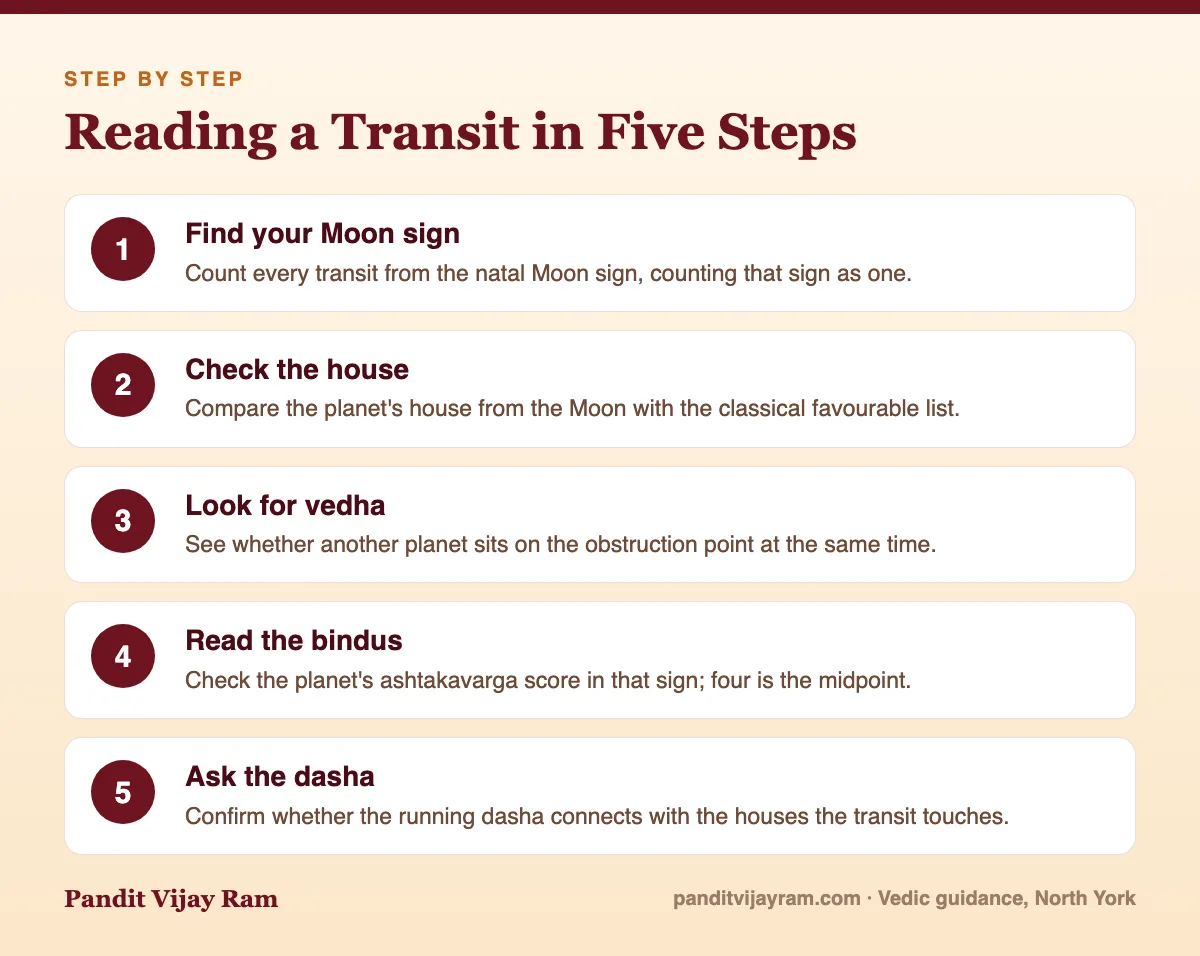
Counting is inclusive. If your Moon is in Cancer and Saturn moves into Aquarius, Saturn is in the eighth sign from your Moon, because you count Cancer as one. Every gochar rule is written this way, as a planet's distance from the Moon.
The ascendant still matters. The Moon shows how a transit feels; the lagna shows which concrete area of life it lands in, since house meanings are anchored there. A Saturn transit that is the eighth from your Moon but the tenth from your lagna may feel heavy while mainly loading your working life. A good reading names both and does not pretend one tells the whole story.
Some practitioners also look at transits over natal planets by exact degree, especially slow planets crossing the natal Moon, Sun or lagna degree. That refinement is useful, but it builds on the sign-based counting rather than replacing it.
Which houses are good for each planet in transit?
Classical gochar rules name favourable houses from the Moon for each planet. The 3rd, 6th and 11th are broadly supportive for the malefics Saturn, Mars, Rahu and Ketu. Jupiter is favoured in the 2nd, 5th, 7th, 9th and 11th. These are starting points, softened or blocked by vedha and ashtakavarga.
The table below follows the common classical lists. Texts differ slightly at the edges, so treat it as a frame, not a verdict.
- Sun: 3rd, 6th, 10th and 11th from the Moon.
- Moon: 1st, 3rd, 6th, 7th, 10th and 11th.
- Mars: 3rd, 6th and 11th.
- Mercury: 2nd, 4th, 6th, 8th, 10th and 11th.
- Jupiter: 2nd, 5th, 7th, 9th and 11th.
- Venus: most houses except the 6th, 7th and 10th.
- Saturn, Rahu and Ketu: 3rd, 6th and 11th.
Notice the 11th house appears for every planet. It is the house of gains, and traditional writers held that almost any planet passing through it brings some return on effort.
What vedha means. Each favourable position has a matching obstruction point, called vedha. If another planet is transiting that point at the same time, the good result is said to be blocked. For Jupiter, for example, a benefic transit in the 5th from the Moon is obstructed by a planet in the 4th. Classical rules exempt certain pairs, such as the Sun and Saturn, from obstructing each other. Vedha is one reason two people with the same Moon sign can have very different months.
How does ashtakavarga change transit results?
Ashtakavarga gives every sign a score of zero to eight points, or bindus, for each planet, based on the whole birth chart. A planet transiting a sign where it has many bindus tends to give better results; few bindus tend to weaken it. This personalises transits that generic Moon-sign tables treat identically.
Ashtakavarga literally means 'eightfold division'. For each of the seven visible planets, the chart is scored from eight reference points: the seven planets and the lagna. The result is a separate table per planet, called bhinnashtakavarga, plus a combined table, sarvashtakavarga, whose signs add up to a fixed total of 337.
Here is a working decision rule many astrologers use:
- Find the sign the slow planet is entering.
- Look up that planet's own bindus in that sign. Four is the midpoint.
- Five or more usually softens a difficult transit or strengthens a good one.
- Three or fewer usually makes even a favourable house feel thin.
- Check the sarvashtakavarga total for the same sign. Above about 28 is generally considered supportive.
Some readers go further and divide each sign into eight kakshyas of three degrees forty-five minutes, asking whether the planet's current slice carries a bindu. That fine timing is real in the texts, but it depends heavily on an accurate birth time and good software.
The point for ordinary readers is simple: a sign column cannot know your ashtakavarga. Two Virgos facing the same Saturn transit can have bindu scores of two and six, and very different years. A personal kundli reading brings this into view.
Do transits matter if my dasha does not support them?
Most Parashari astrologers treat the dasha as the main timer and gochar as the trigger. A transit can only deliver what the natal chart and the running dasha already promise. A strong Jupiter transit during a difficult sub-period usually gives relief rather than a windfall, and a hard Saturn transit during a supportive dasha is often milder.
A helpful way to picture it: the birth chart is the field, the dasha is the season, and the transit is the weather on a particular day. Rain in winter does not grow a crop. The same is true of a lovely transit that falls in the wrong period.
So a careful reader works in this order. First, what does the birth chart promise for this area of life? Second, which mahadasha and antardasha are running, and do those planets connect with the area in question? Our guides to the Vimshottari dasha system and to antardasha sub-periods explain this layer. Only then: is the current transit lighting up the same houses?
When all three agree, events tend to show. When the transit alone is pointing somewhere, the effect is usually mood, opportunity or pressure rather than a concrete event.
Honest limits. Transits do not decide whether you get a job, pass an exam or keep a relationship. Effort, health, skill and other people's choices weigh far more. Use gochar as a calendar of tendencies: a time to push, a time to consolidate, a time to rest. If a run of difficulties is wearing you down, practical steps come first, and only then something like graha shanti for a run of setbacks.
The bottom line
Gochar transit reading compares today's sky with your fixed birth chart, counted mainly from the Moon and checked from the lagna. Ashtakavarga scores and vedha points personalise what generic sign columns treat as identical. Above all, a transit acts through the dasha you are running and the promise of your own chart, not on its own.
Key takeaways
- Gochar is the current sky read against your birth chart, usually counted from the natal Moon.
- Slow planets such as Saturn, Jupiter and the nodes set the tone; fast planets mark days.
- The 3rd, 6th and 11th from the Moon are classically supportive for Saturn, Mars and the nodes.
- Ashtakavarga bindus can make the same transit easy for one person and heavy for another.
- Dasha is the main timer; a transit triggers only what the chart and period already promise.