
Jupiter Transit: How Guru's Yearly Move Is Read

Each time Jupiter changes sign, temples and video channels fill with predictions. Tamil families call it Guru Peyarchi, Hindi speakers say Guru gochar, and the message is often the same: this is your lucky year, or your hard one. If you have ever waited twelve months for a promised windfall that never came, you already know the problem. This article explains how a Jupiter transit is actually read, for clients here in North York and for anyone curious. We will cover why Jupiter takes about a year per sign, which positions from the Moon are classically helpful, how its special aspects spread its influence, what retrograde loops do, and why a 'lucky year' is a misleading idea. You will find no dates and no forecasts for any sign. Across more than forty years of practice I have found that people who understand Jupiter's real role stop gambling on it and start using it. That shift alone is worth the reading.
How long does Jupiter stay in one sign?
Jupiter takes just under twelve years to orbit the Sun, so it spends roughly a year in each zodiac sign. The exact stay varies. Retrograde loops, and a fast forward motion called atichara, can make Jupiter dip into the next sign briefly and return, or linger longer than usual in one sign.
Astronomers give Jupiter's orbital period as about 11.86 years. Seen from Earth, that becomes a slow walk through the twelve signs, close to one sign per year. The Sanskrit name Brihaspati, the guru of the gods, gives the planet its common title, Guru.
The 'one year' figure is an average, not a rule. Three things bend it:
- Retrograde periods. Jupiter appears to move backwards for around four months each year, when Earth overtakes it.
- Atichara. Traditional texts use this word for a fast stretch in which Jupiter crosses into the next sign early, sometimes returning before settling there.
- Sign boundaries. If a retrograde happens near the edge of a sign, Jupiter may sit in two signs within a single year.
Because of this, a reader needs the actual ingress and station points, not a rough calendar. Check a current ephemeris or a Toronto panchang set to the sidereal zodiac with the same ayanamsa as your chart. Mixing a tropical date with a sidereal chart is one of the most common reasons online Jupiter predictions miss.
For the general method behind all planetary movement, see our guide to how gochar transits are read. This post stays with Jupiter alone.

Which houses from the Moon are good for a Jupiter transit?
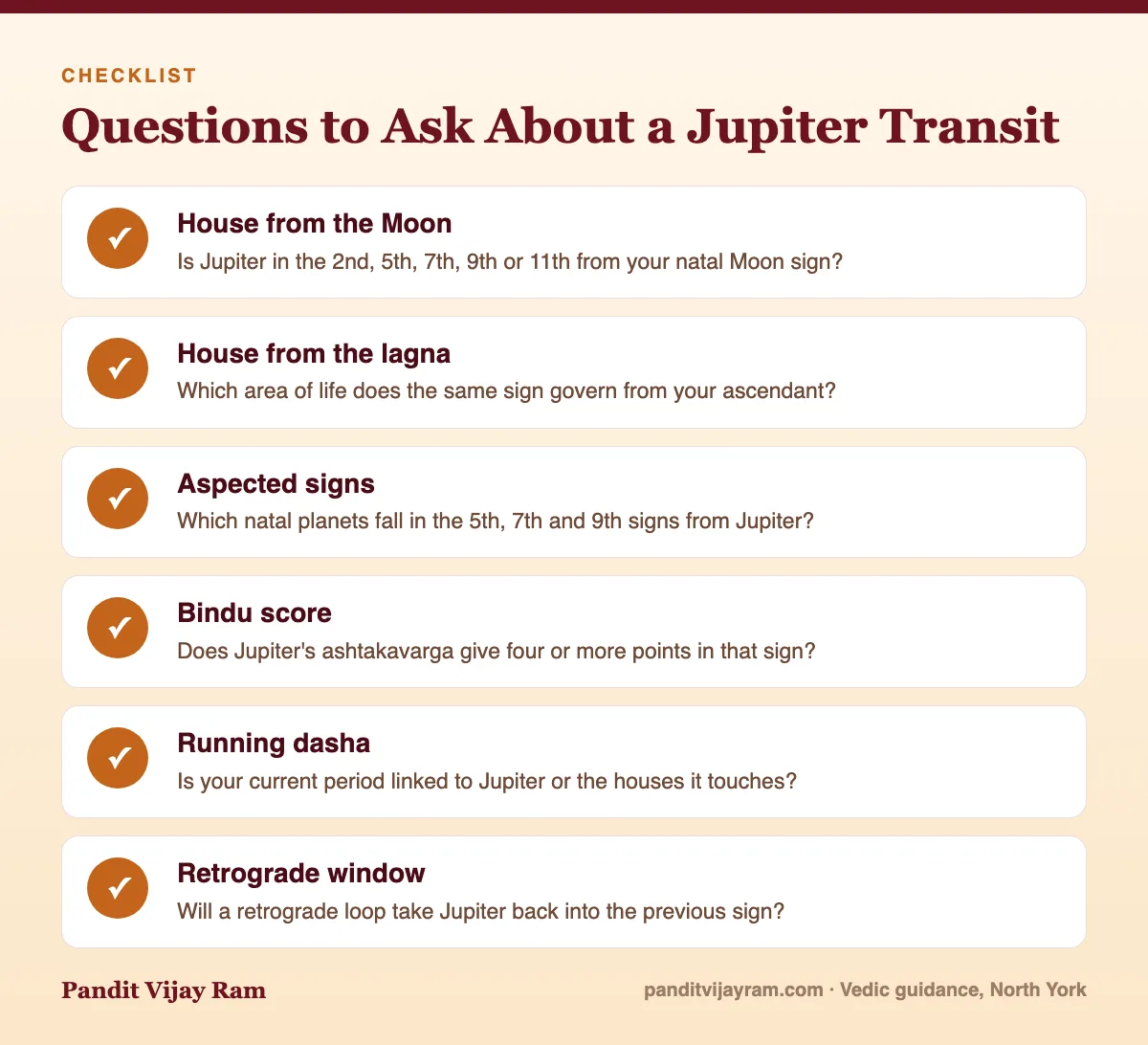
Classical texts call Jupiter's transit favourable in the 2nd, 5th, 7th, 9th and 11th houses counted from the natal Moon. The 1st, 3rd, 4th, 6th, 8th, 10th and 12th are traditionally described as less supportive. These lists describe tendencies and are always refined by ashtakavarga, vedha, and the strength of Jupiter in your birth chart.
Here is how traditional writers describe Jupiter moving through each position from the Moon, in plain terms.
- 1st (over the Moon): often described as a time of restlessness or relocation rather than gain.
- 2nd: family, savings and speech tend to feel supported.
- 3rd and 4th: effort may feel unrewarded; domestic matters can feel unsettled.
- 5th: children, study, creativity and good counsel are the classic themes.
- 6th and 8th: health, debts and hidden matters ask for care.
- 7th: partnerships, marriage talks and public dealings tend to open up.
- 9th: teachers, pilgrimage, faith and fortune are emphasised.
- 10th and 12th: changes in role or spending are the usual themes.
- 11th: gains, friendships and fulfilled wishes.
Notice how many 'difficult' positions there are. Seven of twelve is the majority of your life, which tells you the system was never meant to be read as lucky or unlucky years. It is a description of where Jupiter's attention falls.
The house from your lagna also matters. A Jupiter that is the 12th from your Moon but the 9th from your ascendant can be a period of spending on study, travel or a teacher, which many people value. A full kundli reading holds both views together.
What do Jupiter's 5th, 7th and 9th aspects do in transit?
Every planet aspects the 7th house from itself, and Jupiter also casts special aspects on the 5th and 9th. In transit, this means Guru influences four signs at once: the one it occupies and three others. Many astrologers consider these aspects as important as the occupied house, especially when they fall on your Moon, lagna or a key natal planet.
Parashari astrology gives Mars, Jupiter and Saturn extra aspects. Jupiter's are the 5th and 9th, both trine positions, which is one reason it is called the great benefic: its glance falls on the houses of merit and fortune counted from wherever it sits.
A practical way to use this:
- Note the sign Jupiter is entering.
- Count the 5th, 7th and 9th signs from it, inclusive.
- Ask which of your natal houses and planets sit in those four signs.
- Give extra weight if one of them holds your Moon, lagna, or the lord of your running dasha.
For example, if your natal Moon is in Libra and Jupiter enters Gemini, it is the 9th from your Moon by placement, and its 5th aspect lands on Libra itself. Two supportive signals point at the same mind.
A popular modern technique, often called the double transit, looks for times when both Jupiter and Saturn influence the same house by placement or aspect. Some practitioners use it to time marriage or a move. It is useful as a filter, but it was not a classical rule, and it should never be presented as a prediction. Our article on Saturn's mahadasha covers Saturn's own role in more depth.
Is a Jupiter transit really a lucky year?
No single year is lucky because of Jupiter alone. Jupiter tends to expand whatever it touches, including commitments and expenses. Its transit opens doors only where your birth chart and current dasha already hold the promise, and even then results depend on your effort, decisions and circumstances. Treat it as a supportive season, not a prize.
The 'lucky year' story persists because it is simple and hopeful. Here are the myths that come up most often in my consultations, and a fair response to each.
- 'Jupiter in my 11th means money is coming.' The 11th favours gains through effort and networks. It does not deliver income to someone who is not working towards it.
- 'Jupiter in my 7th means I will marry this year.' It can make partnership conversations easier. Marriage depends on two people, families and many choices that no transit makes.
- 'Jupiter in my 8th will hurt me.' Jupiter is protective even in difficult houses. The usual result is a need for care with health, joint finances or paperwork.
- 'I should wait for Jupiter before starting anything.' Waiting a year for a transit can cost more than it gives. Plan sensibly and use timing as a secondary guide.
If you have planned a major life step around a promised Jupiter year and it has not happened, that is not a sign of a curse. Look first at practical factors, then at your dasha; our guide to Jupiter's own mahadasha explains when Guru's period itself underperforms.
How can I make good use of a Jupiter transit?
Use a supportive Jupiter transit for learning, mentoring, planning and deepening commitments you already value. Use a difficult one for patience, consolidation and careful spending. Simple practices associated with Guru, such as Thursday prayer, study, respecting teachers and giving to education, are traditional supports that cost little and carry no risk.
Jupiter governs wisdom, teachers, children, dharma and growth. The most reliable way to work with its transit is to act in line with those themes rather than waiting for something to arrive.
During a favourable transit: enrol in the course you have postponed, seek a mentor, start conversations about family plans, or put structure into savings. These are the areas where people tend to notice Jupiter's support.
During a challenging transit: keep commitments modest, review spending, look after liver and weight-related health with your doctor's advice, and avoid overpromising. Jupiter's 'bad' positions are rarely dramatic; they usually ask you not to overextend.
Traditional supports include reciting a Guru mantra or the Vishnu Sahasranama on Thursdays, offering yellow items such as turmeric or chana dal, feeding cows, and donating books or school supplies. A yellow sapphire is sometimes suggested, but only after a chart check; our gemstone guidance explains why a stone should never be worn on a transit headline alone.
None of these practices change what the chart holds. They are ways of keeping your mind steady and aligned with Jupiter's values while the season passes.
The bottom line
A Jupiter transit is Guru's roughly yearly stay in one sign, read from your natal Moon and from the lagna. Its 5th, 7th and 9th aspects spread its influence across four signs, and its results always depend on your birth chart and running dasha. Treat any Jupiter transit as a season to learn, plan and consolidate, not as a promised lucky year.
Key takeaways
- Jupiter spends close to a year in each sign, but retrogrades and atichara change the exact stay.
- The 2nd, 5th, 7th, 9th and 11th from the Moon are the classical favourable positions.
- Jupiter's 5th, 7th and 9th aspects can matter as much as the sign it occupies.
- No transit creates luck by itself; it expands what the chart and dasha already promise.
- Study, mentoring, prayer and giving to education are low-risk ways to work with Guru.