
Upapada Lagna: The Jaimini Indicator for Marriage

Many people meet the term upapada lagna for the first time on an online chart where a small "UL" sits in one of the boxes. Nobody explains it, and a quick search turns up conflicting rules. In North York I am often asked whether the UL replaces the seventh house or is simply another way of saying the same thing. It is neither. This guide explains what the upapada is, why it comes from the twelfth house, how to calculate it step by step including the two exceptions that confuse most beginners, and how astrologers read it alongside the seventh house and the darakaraka. I will also be open about where schools of practice disagree, because the Jaimini method is terse and lineages fill the gaps differently. I have used arudha padas in more than forty years of chart work, and I have found the upapada most helpful as a second lens: it shows the marriage as a lived arrangement, while the seventh house shows the partner and the wish for partnership.
What is upapada lagna in Jaimini astrology?
Upapada lagna is the arudha, or reflected image, of the 12th house. Arudha padas show how a house manifests in the visible world, so the upapada describes marriage as a lived, social arrangement. It is also called gauna pada and is used mainly in Jaimini and arudha-based reading.
In arudha-based astrology, every house has a pada, a point that shows how that house's matters appear to others and take shape in daily life. The arudha of the first house is the familiar arudha lagna, your public image. The arudha of the twelfth house is the upapada, which literally means the pada next to, or just before, the arudha of the first.
Why the twelfth house? The twelfth governs the bed, private life, giving and sacrifice. Marriage in the Vedic view involves giving oneself to another and sharing a bed and a home. The twelfth is also the house that precedes the self, which fits the idea of a partner who walks beside you.
Arudha methods appear in the Jaimini Sutras and in the arudha chapters of the Brihat Parashara Hora Shastra. Modern lineages, especially those that teach Jaimini techniques in depth, use the upapada as a core marriage indicator.
It sits alongside, not in place of, the familiar tools:
- the seventh house and its lord for partnership in general,
- Venus as the natural significator of love and a wife, and Jupiter traditionally for a husband,
- the darakaraka, the Jaimini spouse significator,
- the navamsa (D9), the divisional chart of marriage.

How do you calculate upapada lagna?
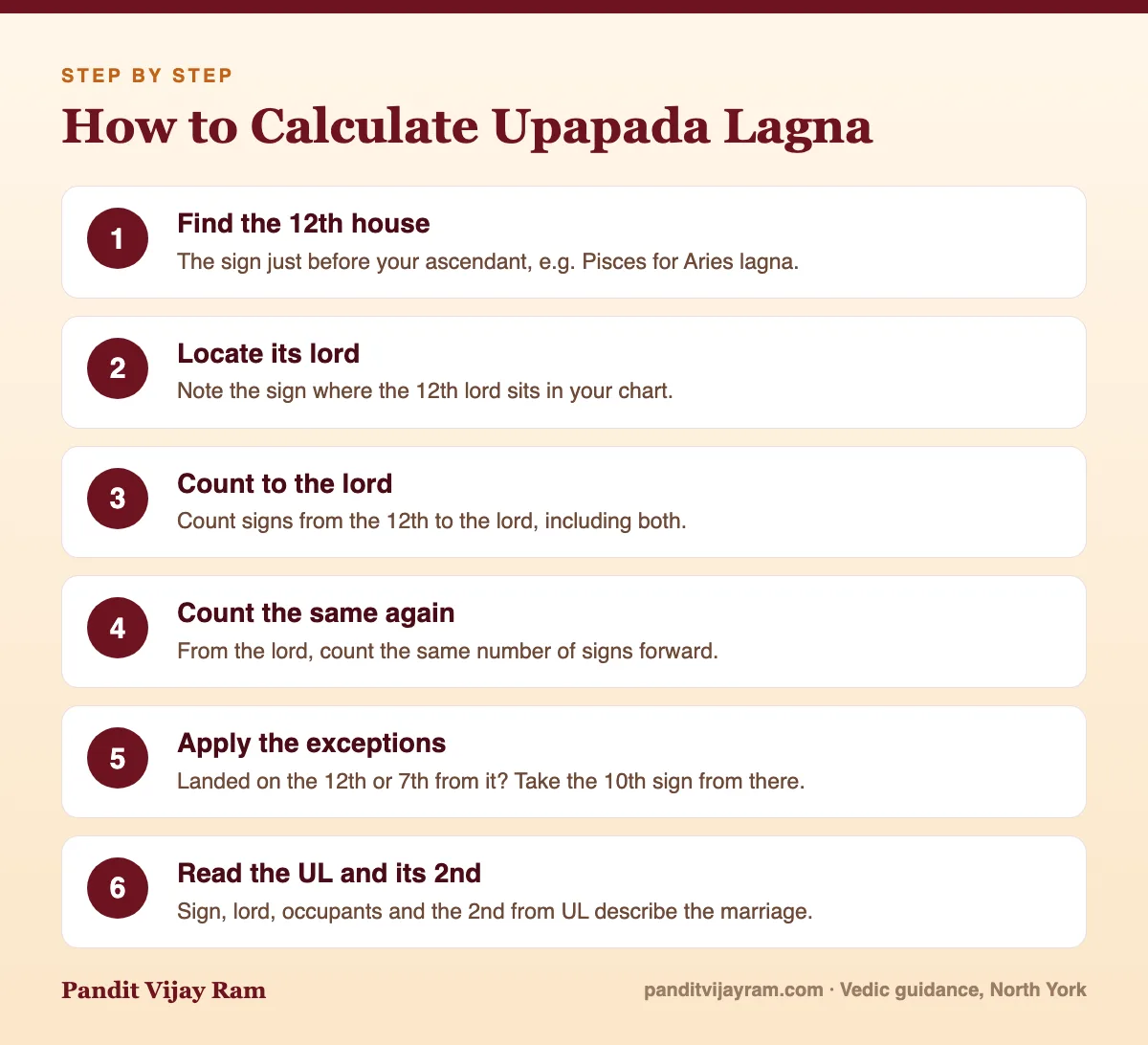
To calculate upapada lagna, count signs from the 12th house to its lord, then count the same number of signs onward from the lord. If the result lands on the 12th house itself or the 7th from it, take the 10th sign from that result instead. That final sign is the UL.
Here is the method step by step:
- Find the twelfth house. It is the sign just before your ascendant. For an Aries ascendant it is Pisces.
- Find its lord and where it sits. Pisces is ruled by Jupiter.
- Count from the twelfth to the lord, including both signs. If Jupiter is in Taurus, Pisces is one, Aries two, Taurus three.
- Count the same number again from the lord. Taurus one, Gemini two, Cancer three. The UL is Cancer.
- Apply the two exceptions. If the count lands on the twelfth sign itself, or on the seventh sign from it, move to the tenth sign from where you landed.
Worked exception: for the same Aries chart, suppose Jupiter is in Gemini. Pisces to Gemini is four signs. Four from Gemini lands on Virgo, which is seventh from Pisces. The tenth from Virgo is Gemini, so the UL is Gemini. If Jupiter sat in Pisces itself, the count would land on Pisces, and the tenth from Pisces, Sagittarius, becomes the UL. The upshot is that the UL never falls in the twelfth or sixth house of a chart.
Dual lords. Scorpio has Mars and Ketu as co-lords, and Aquarius has Saturn and Rahu. Texts give rules for choosing the stronger lord, and lineages apply them differently, so two good astrologers may place the UL in different signs. Most practitioners count forward through the zodiac, following Parashara; a few lineages use other counting conventions.
What does upapada lagna show about marriage?
The upapada lagna describes the nature of the marriage and how it appears to the world. Its sign and lord suggest the spouse's background and style, planets in it add colour, and the 2nd house from the UL is read for how the marriage is sustained over time.
A reader usually works through the UL in layers:
- The sign of the UL. A fire sign may describe an active, outspoken partnership; an earth sign, a practical and settled one. This is broad colour, not destiny.
- Planets in the UL. Jupiter here is traditionally read as a respected or principled spouse. Venus adds affection and comfort. Saturn may add age, duty or delay. Rahu may suggest an unconventional match or a different cultural background.
- The lord of the UL. Its strength and placement show the support behind the marriage, including family backing.
- The second from the UL. This house is read for the continuity of the marriage. Benefics or their aspects here are said to support it. The sutras describe malefics in the second from the UL as straining it, and many modern readers soften this when the malefic is in its own sign or exalted, or when a benefic also aspects.
- The seventh from the UL. This is read for the spouse's family and the counterpart side of the arrangement.
Timing is not read from the UL alone. Dashas of planets linked to the UL, its lord or the seventh house are often studied together. For dasha-based timing, see marriage timing in a kundli. A full kundli reading brings these threads together without leaning on any single point.
How is the upapada different from the 7th house and the darakaraka?
The 7th house shows partnership and the partner in general, the darakaraka is a planet that signifies the spouse as a person, and the upapada lagna shows the marriage as a lived arrangement. Reading all three together gives a fuller picture than any one of them alone.
People often mix these up, so it helps to set them side by side:
- The seventh house is a bhava in the Parashari system. It covers desire for partnership, the spouse, business partners and open relationships with others. It is read from the lagna, its lord and planets placed or aspecting there.
- The darakaraka is a chara karaka, the planet with the lowest degree in its sign among the karaka planets. It is read for the spouse's nature and for lessons learned through the spouse.
- The upapada is an arudha. It shows marriage as it takes form in the world: the household, the social standing of the union, its continuity.
A simple way to remember it: the seventh house is the wish and the person, the darakaraka is the spouse's soul-level role, and the upapada is the marriage as others see it. When the three agree, a reader can speak more confidently. When they disagree, it usually signals a layered story, such as a marriage that looks one way publicly and feels another way privately.
Where the seventh house is afflicted but the UL and its second are well supported, many readers expect the marriage to hold through difficulty. The reverse can also happen. Couples comparing their charts can explore this in a relationship compatibility reading, and beginners can revisit the houses in how to read your kundli.
How reliable is upapada lagna, and what are its limits?
Upapada lagna is a respected technique, but it depends on an accurate ascendant, its rules vary between lineages, and it shows tendencies rather than verdicts. A wrong birth time can move the UL by a sign. It should never be used alone to approve or reject a match.
Several honest limits apply:
- Birth time. The ascendant fixes the twelfth house. If the birth time is uncertain and the lagna is near a sign boundary, the UL may shift entirely. When no time is known, see what can still be read in kundli matching without a birth time.
- Lineage differences. The dual-lord rule, the strength tests and the handling of malefics in the second from the UL all vary. A careful astrologer names the rule being used.
- Terse sources. The Jaimini sutras are compressed and heavily commented. Much of what is taught today is interpretation built over generations.
- No verdicts. A difficult second from the UL does not doom a marriage. It points to where attention, patience or support is needed.
I treat the upapada as one of several witnesses. If the seventh house, Venus, the darakaraka, the navamsa and the dasha all point the same way, I speak about it. If only the UL raises a concern, I mention it gently, if at all. I would never tell a family to break off a match because of the UL. Marriage rests on two people's character, consent and effort, and astrology is a mirror for reflection, not a judge.
The bottom line
Upapada lagna is the arudha of the 12th house and describes marriage as a lived, visible arrangement. You calculate it by counting from the 12th house to its lord and the same distance again, applying the two exceptions. Its sign, lord, occupants and the 2nd house from it are read together with the 7th house, the darakaraka and the navamsa. Because birth time and lineage rules both affect it, the UL is a lens for reflection, never a verdict on a match.
Key takeaways
- Upapada lagna is the arudha pada of the 12th house.
- Count from the 12th to its lord, then the same number again; apply the 1st and 7th exceptions.
- The 2nd house from the UL is read for the continuity of a marriage.
- The UL, the 7th house and the darakaraka each answer a different question.
- Birth time and lineage rules can change the UL, so it should never decide a match alone.