
Which Gemstone Should I Wear? How a Chart Decides

Many people arrive with a stone already in hand. A relative recommended it, a shop suggested it, or a website listed it under their sign. Then the doubt sets in: is this really mine? When clients in North York ask me which gemstone should I wear, I ask for their birth date, exact time and place before I even look at the ring. In more than forty years of Vedic practice I have found that the same planet can be a helper in one chart and a troublemaker in the next, and the ascendant is what tells them apart. This guide explains how ratna selection works in the Parashari tradition, why generic lists by rashi or birth month often point the wrong way, which planets tend to support each ascendant, and how a calm, observed trial helps you decide. It also explains when no stone is the better answer. A gemstone is a matter of faith and personal choice. It is never a replacement for medical care, money planning or a hard conversation that needs to happen.
How do I know which gemstone is right for me?
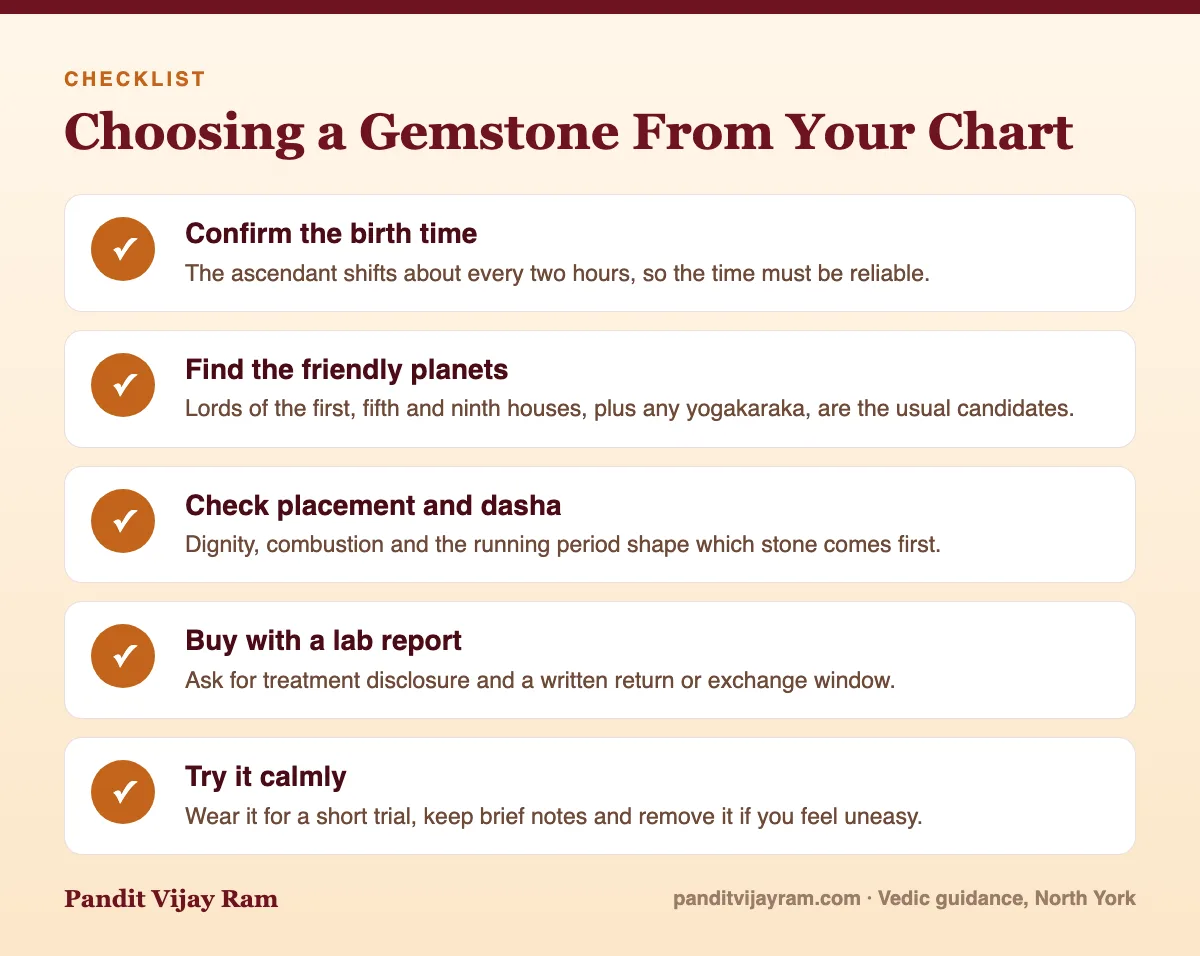
The right gemstone is linked to a planet that works in your favour according to your ascendant. An astrologer identifies those friendly planets, checks how strong and well placed they are, looks at the running dasha, and only then suggests the matching stone. Without an accurate birth time, any recommendation is a guess.
Vedic astrology links nine gems to the nine grahas. The classic pairings are ruby for the Sun, pearl for the Moon, red coral for Mars, emerald for Mercury, yellow sapphire for Jupiter, diamond for Venus, blue sapphire for Saturn, hessonite for Rahu and cat's eye for Ketu. Together they are called the navaratna.
Knowing the pairings is the easy part. The real work is deciding which planet deserves strengthening. A gem is believed to amplify whatever its planet stands for in your chart, so the planet must be one whose themes you actually want more of.
I work through four questions in order:
- Which sign is rising? The lagna or ascendant sets the house each planet rules.
- Which planets rule good houses? Lords of the first, fifth and ninth houses are the usual candidates.
- How are they placed? Sign dignity, house, combustion and aspects all matter.
- What period is running? A stone for the current dasha lord is often considered first, if that planet is friendly.
If a planet fails the second question, I do not suggest its stone however weak it looks. That single rule prevents most poor choices. A full kundli reading covers all four steps.

Can I choose a gemstone by my rashi or birth month?
Lists by rashi or birth month are easy to follow but too broad. A Moon-sign list ignores the ascendant, so millions of people share one answer. Western birthstone charts by month are a modern jewellery convention with no planetary logic. Both can point you to a stone that suits someone else's chart better than yours.
A rashi list usually takes the lord of your Moon sign and assigns its stone. Someone with the Moon in Leo is told to wear ruby, for example. The Moon sign matters a great deal in Vedic reading, and you can learn more in our guide to the Moon sign versus the Sun sign. Yet the Moon sign alone does not tell us which houses the Sun rules for you.
Take two people with the Moon in Leo. One has Aries rising, so the Sun rules the fifth house of children, study and merit. The other has Capricorn rising, so the Sun rules the eighth house of sudden change. The same ruby carries a very different meaning in those two charts.
Monthly birthstones are another matter. They were set by jewellers as a gift-giving list. Garnet for January or opal for October is a pleasant tradition, but it has no link to grahas, houses or dashas.
If you already wear a sign-list stone and feel fine, there is no reason to panic. Simply have the chart checked before buying anything costly. Free online calculators can show your ascendant as a first step, provided your birth time is accurate.
Which planets are good for my ascendant?
In the Parashari approach, lords of the trine houses support each ascendant, and a yogakaraka planet ruling both a kendra and a trikona is especially valued. The list below gives the commonly cited friendly planets per lagna. Placement and dasha can change the advice, and schools differ on several signs.
Treat this as a map, not a prescription. A friendly planet badly afflicted may still be better served by mantra than by a gem.
- Aries: Mars, the Sun and Jupiter, so red coral, ruby or yellow sapphire.
- Taurus: Saturn as yogakaraka, plus Mercury and Venus.
- Gemini: Venus and Mercury; Saturn is debated.
- Cancer: Mars as yogakaraka, the Moon and Jupiter.
- Leo: Mars as yogakaraka, the Sun and Jupiter.
- Virgo: Venus and Mercury.
- Libra: Saturn as yogakaraka, Mercury and Venus.
- Scorpio: the Moon, Jupiter, the Sun and Mars.
- Sagittarius: Jupiter, the Sun and Mars.
- Capricorn: Venus as yogakaraka, Saturn and Mercury.
- Aquarius: Venus as yogakaraka and Saturn.
- Pisces: Jupiter, the Moon and Mars.
Rahu and Ketu own no signs in the classical scheme, so hessonite and cat's eye are judged by their placement and dispositor. Those two stones are usually recommended with extra care. For individual stones, see our pages on blue sapphire and yellow sapphire. Sign dignity also matters, since an exalted or debilitated planet behaves differently.
Why is wearing a random gemstone a bad idea?
A random gemstone may strengthen a planet that rules a difficult house in your chart, so it supports nothing you want. It also costs money, may be treated or fake, and can give false hope. Removing an unsuitable stone simply ends its role; there is no need for fear.
I want to be careful here, because gem sellers sometimes frighten people. A stone is not a curse. If one does not suit you, you take it off and the matter rests.
The real problems are quieter:
- Wrong planet. Lords of the sixth, eighth and twelfth houses govern conflict, upheaval and loss. Strengthening them is not the goal of a remedy.
- Wasted money. Fine sapphires and rubies are expensive, and a poor choice is hard to resell.
- Hidden treatments. Many stones are heated, filled or dyed. Our guide to buying gemstones safely explains reports and returns.
- Misplaced hope. A ring cannot do a job interview, repair a marriage or settle a debt. It is meant to support effort, not replace it.
Some readers also wear several big stones at once because each one was suggested by a different source. Certain combinations, such as ruby with blue sapphire, are traditionally avoided because the Sun and Saturn are natural enemies. Traditions vary on these pairings, so ask before stacking rings.
How does a gemstone trial period work?
A gemstone trial means wearing the stone for a short, agreed period while you note how you feel and what happens day to day. Customs vary from a few nights under the pillow to several days on the finger. The aim is calm observation, not hunting for omens, and you stop if unsure.
Trial wearing is most often discussed for blue sapphire, but I suggest a version of it for any major stone. Here is a simple method:
- Get the chart checked first. A trial is not a shortcut around analysis.
- Borrow or buy with a return window. Ask the seller in writing whether a trial or exchange is allowed.
- Start on the planet's customary day. For example, Thursday for Jupiter or Saturday for Saturn, though traditions differ.
- Keep a short journal. Note sleep, mood, work and relationships in a line or two each evening.
- Review honestly. Ordinary events, such as a busy week or a cold, are not signs from the stone.
My decision rule is simple. If nothing notable happens and the chart supports the stone, you may continue. If you feel uneasy, remove it without guilt. Feelings during a trial are subjective, so I never read them as proof either way.
Health worries, low mood or sleep trouble during a trial deserve a visit to your family doctor, whatever you believe about the stone.
When is no gemstone the better choice?
No gemstone is the better choice when the birth time is uncertain, when the helpful planet is too afflicted, when the cost would strain your budget, or when the real need is medical, legal or financial help. Mantra, charity and steady routine can then carry the remedy instead.
I decline to suggest a stone more often than people expect. Common reasons include:
- Unknown birth time. If the ascendant could be either of two signs, the friendly planets change. A careful reading starts with the most reliable time you can find.
- Debt or tight money. A remedy should never push a family into hardship.
- A planet that is both friendly and badly placed. Mantra japa or a weekday fast may suit better than amplifying it.
- A problem that needs professionals. Illness, legal disputes and abuse need a doctor, lawyer or the police first.
Non-gem remedies are not second best. Reciting a planet's mantra, giving food or clothing on its day, and serving elders are traditional practices in their own right. A smaller substitute stone is another option, which our guide to uparatna substitutes covers.
If you would like a chart-based recommendation, our gemstone and numerology consultation explains what is checked and why.
The bottom line
Which gemstone should I wear is best answered by your ascendant and the planets that support it, not by a sign or month list. A friendly, reasonably placed planet and its running dasha guide the choice, and a short observed trial helps confirm it. When the birth time is shaky, the budget is tight or the need is practical, mantra and service can take the place of a stone.
Key takeaways
- Your ascendant decides which planets are friendly to you.
- Rashi and birth-month lists are too broad to choose a costly stone.
- Lords of the sixth, eighth and twelfth houses are usually not strengthened.
- A calm trial with a written return window is sensible for any major gem.
- Mantra, charity and routine are full remedies, not lesser ones.