
Prashna Kundli: Answering a Question Without a Birth Chart
Plenty of people want guidance from Jyotish but have no idea when they were born. A grandmother remembers that it was "around dawn", a hospital record went missing, or the family never wrote anything down. Others have a birth chart yet carry one urgent question that a general reading would not settle. For both groups, prashna kundli is the traditional answer, and people in North York ask me about it more often than they expect to. This article explains what a question chart is, how it is drawn, which parts of it an astrologer reads, and which kinds of questions it handles well or badly. You will also learn why the tradition insists on sincerity and why the same question should not be asked again and again. In more than forty years of practice, I have found horary work one of the most demanding branches of the art, because everything rests on one moment and one honest question. Handled with care, it can bring a clear head to a cloudy situation. Handled carelessly, it turns into fortune-telling, which is not what the texts intended.
What is prashna kundli in Vedic astrology?
Prashna kundli, also called a question chart, is a horoscope calculated for the moment a question is asked rather than the moment of birth. It belongs to prashna shastra, the horary branch of Jyotish. The astrologer reads the chart as a picture of the question itself, its background and its likely direction.
The Sanskrit word prashna simply means a question. Classical Jyotish has three broad divisions: mathematical astronomy, natal and mundane interpretation, and a practical branch that includes omens, muhurta and horary work. Prashna sits in that practical branch.
The idea behind it is that a sincere question arises at a meaningful time. The chart drawn for that moment is read as a portrait of the worry, not of the whole person.
Several well-known texts carry the method. Prashna Marga, a Kerala work, is the most detailed and also describes temple-based enquiries such as Ashtamangala prashna. Shatpanchashika, attributed to Prithuyashas, the son of Varahamihira, is a short and dense manual. Many modern teachers also borrow from the Tajika tradition, which shares roots with Persian and Arabic horary practice.
Western astrology has its own horary school, with different house rules and aspect doctrine. The family resemblance is real, yet the two are not interchangeable, a theme explored further in our comparison of Vedic and Western astrology.
Prashna is not a shortcut around the birth chart. It answers one matter at one time. For broader questions about temperament or the long arc of life, a natal reading through the kundli and horoscope service remains the main tool.
How is a prashna chart cast and read?
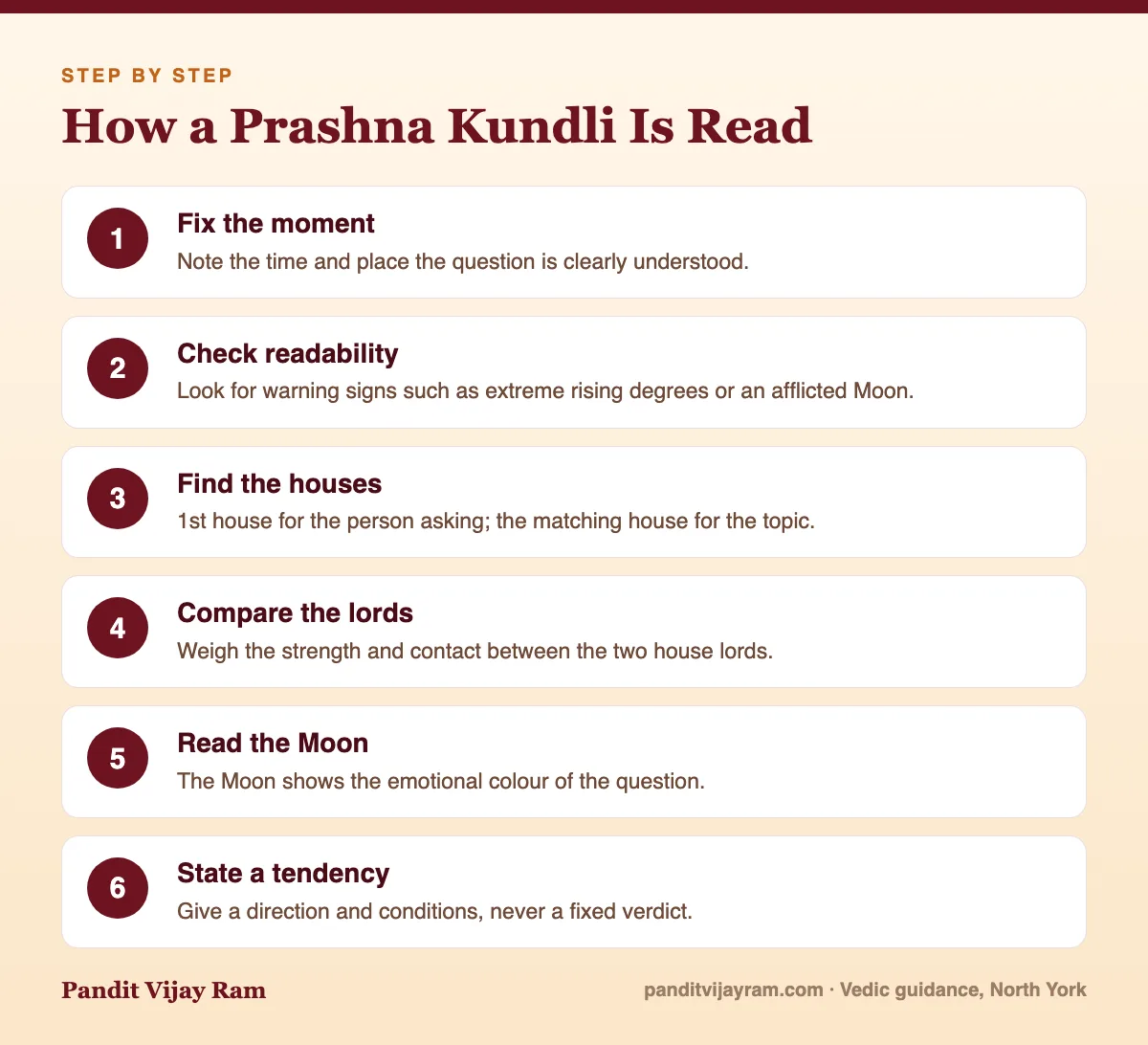
The astrologer records the time and location at which the question is clearly stated, then calculates the rising sign, planets and Moon for that moment. The ascendant represents the querent, the relevant house represents the topic, and the connection between their lords and the Moon shapes the reading.
A careful horary reading follows a sequence. The order below is how I work, and most trained practitioners use something close to it.
- Fix the moment. The time is taken when the question is fully understood by the astrologer, not when a message was first typed. Location is where the astrologer is, by most schools, though some use the querent's place.
- Check that the chart is readable. Texts give warning signs, such as a very early or very late degree rising, or an afflicted Moon, that suggest the matter is not ready to be judged.
- Identify the houses. The 1st is the person asking. A job question looks to the 10th, a lost item to the 2nd or 4th, a marriage question to the 7th, a property question to the 4th.
- Compare the two lords. The lord of the 1st and the lord of the relevant house are examined for strength, mutual aspect, exchange or approaching contact.
- Read the Moon. The Moon carries the emotional colour of the question and is often weighted as a co-significator of the querent.
- Look at supporting factors. Benefics in kendras, the nature of the rising sign, and in Kerala practice the arudha, all refine the answer.
- State a tendency, not a verdict. The output is a direction, a set of conditions and sometimes a rough window.
Readers who want to understand the houses themselves can use our guide to the 12 houses of a kundli.
When is a question chart used instead of a birth chart?
A prashna chart is most often used when the birth time is unknown or unreliable, when a single specific decision needs focus, or when a natal reading has already been done and a narrower question remains. It is also traditional for lost items, travel, and choosing whether to begin something now.
Some situations naturally suit horary work. Others are better served by a different method. This simple decision rule may help.
- No reliable birth time: prashna is a sensible first step. Birth time rectification can come later if you want a full natal chart.
- One clear decision with a known deadline: prashna is well suited, provided the question is specific.
- Long-term patterns, temperament, life themes: use the birth chart and its dasha periods instead. See our guide to Vimshottari dasha.
- Choosing an auspicious date: that is muhurta, a related but separate craft.
- Relationship compatibility: chart matching uses both partners' birth data; prashna can only address a specific worry.
Families who arrive with no birth data at all are often relieved that something can still be done.
There is also a practical benefit. Because prashna forces a person to put the worry into one sentence, the conversation itself becomes clearer. Many people realise, as they phrase it, that the real question was different from the one they walked in with.
How should you phrase a question for prashna?
Ask one specific, sincere question about your own life, in plain words, with a sense of the time frame you care about. Avoid stacking several issues together, asking about another person's private choices, or testing the astrologer. The texts link a clear mind at the moment of asking to a readable chart.
Wording matters more in horary work than in any other kind of reading. Compare these pairs.
- Vague: "Will my life get better?" Clearer: "Is it wise to accept the transfer I have been offered?"
- Stacked: "Should I move, change jobs and marry this year?" Clearer: pick the one that is most pressing today.
- About someone else's will: "Will he come back to me?" Clearer: "What should I focus on while this relationship is uncertain?"
The last example matters. Prashna is about the querent's situation. It is not a way to read another adult's private intentions or to decide for them. I gently decline questions that seem aimed at controlling a partner, an ex or a colleague.
The tradition also advises against repeating the same question within a short span because the first answer was disliked. A new chart cast a day later for the same worry tends to muddy things rather than clarify them.
Writing the question down before the consultation is helpful. Our page on preparing for a kundli reading has more on framing questions for any type of session.
How accurate is prashna astrology?
There is no scientific evidence that horary charts predict events, and a responsible astrologer says so. What people often find useful is the structure: one question, a calm look at the factors involved, and a clearer sense of options. Treat the answer as guidance for reflection, never as a guarantee or a reason to stop practical planning.
Honesty about limits protects the person asking. Horary methods depend heavily on the astrologer's judgment, and two trained readers can disagree about the same chart. That is a reason for humility, not for fear.
Some limits are built into the method itself:
- A question chart reflects one moment. It cannot account for changes in circumstance after the reading.
- Questions about health, legal cases, immigration files or money need qualified professionals first. A chart cannot replace a doctor, a lawyer, IRCC or a financial adviser.
- Prashna cannot decide another person's free choice, however the chart looks.
- Timing indications in horary work are rough. They are offered as windows to watch, not dates to rely on.
Where prashna earns its place is as a disciplined conversation. Many people come back to say the reading helped them stop circling and take the next practical step. That is a modest benefit, and it is the honest one. A fuller discussion of evidence and belief is in our article is astrology accurate.
If anyone presents a horary answer as certain, or uses it to sell an expensive remedy on the spot, treat that as a red flag.
Can you get a prashna reading by phone or video?
Yes. Because a question chart is cast for the moment the astrologer receives and understands the question, it works by phone, video or message as well as in person. Most schools use the astrologer's location for the calculation, so distance from the querent does not prevent a reading.
Remote horary work has a long tradition. Messengers once carried questions to astrologers, and texts discuss how to treat a question asked on someone else's behalf. Modern calls and video sessions follow the same logic.
A few practical points keep a remote prashna clean:
- Be in a quiet place when you ask, with your question already written out.
- Ask the question yourself where possible. Questions relayed through a relative are read, but with more caution.
- Agree in advance whether the reading will also look at your birth chart, if you have one, or stay with the question alone.
- Take notes, or ask whether you can record the call for your own use.
People in North York and nearby neighbourhoods can sit with Vijay Ram ji for in-person consultations, while clients elsewhere in Canada and the US use phone, video or WhatsApp. Details of how to arrange a time are on the contact page, and the North York astrologer page explains the local practice.
The bottom line
Prashna kundli reads a chart cast for the moment a sincere question is asked, which makes it useful when the birth time is missing or when one decision needs focus. Its strength lies in clear wording, one question at a time and a careful reading of the ascendant, the relevant house and the Moon. Its limits are real: it offers tendencies rather than certainties and never replaces doctors, lawyers or financial advisers. Used that way, a prashna kundli can help you think more clearly about the choice in front of you.
Key takeaways
- A prashna kundli is cast for the moment a question is asked, not the moment of birth.
- It is especially helpful when the birth time is unknown or uncertain.
- One specific, sincere question gives a far more readable chart than several stacked together.
- Horary answers describe tendencies; there is no scientific evidence that they predict events.
- Health, legal, immigration and money questions need qualified professionals first.