
Darakaraka: Your Spouse Indicator in Jaimini Astrology

Darakaraka has become a popular word online, often paired with confident claims like "Venus darakaraka means a beautiful spouse" or "Saturn darakaraka means you will marry late". Clients in North York sometimes arrive with screenshots of these lists and real worry. The idea behind them is genuine and old, but the shortcuts usually skip the method and its limits. In this guide you will learn what the chara karakas are, how to rank the planets yourself with a worked example, why the seven-karaka and eight-karaka schemes can give different answers, and what each planet as darakaraka is traditionally said to describe. I will also show where a reading needs care, because a small error in birth time can quietly change the result. Over more than forty years I have come to value the darakaraka as a lens on how two people grow through each other, rather than as a photo-fit of a future husband or wife. Used that way, it is a thoughtful tool. Used as a verdict, it misleads.
What is the darakaraka in Jaimini astrology?
The darakaraka is the chara karaka, or movable significator, for the spouse. Unlike Venus, which is the fixed significator of love in every chart, the darakaraka changes from chart to chart. It is the planet whose degree within its sign is the lowest among the planets used for the karaka scheme.
Vedic astrology uses two kinds of significators. Sthira or fixed karakas are the same for everyone: Venus for a wife and for love, Jupiter traditionally for a husband and children, the Sun for the father, the Moon for the mother. Chara or movable karakas are assigned freshly in each chart according to the planets' degrees.
The idea is laid out in the Jaimini Sutras and in the Brihat Parashara Hora Shastra. Planets are ranked by how far they have travelled through the sign they occupy, ignoring which sign it is. The planet furthest along becomes the atmakaraka, the significator of the soul. The planet least advanced becomes the darakaraka, from dara, meaning spouse.
The full sequence, from highest degree to lowest, in the eight-karaka scheme is:
- Atmakaraka (AK), the self
- Amatyakaraka (AmK), career and counsel
- Bhratrikaraka (BK), siblings and courage
- Matrikaraka (MK), mother and home
- Pitrikaraka (PiK), father
- Putrakaraka (PK), children and creativity
- Gnatikaraka (GK), rivals, illness and obstacles
- Darakaraka (DK), the spouse
In the seven-karaka scheme one role is dropped, most commonly the pitrikaraka. Either way, the darakaraka is always last. It works alongside the upapada lagna, which shows the marriage itself rather than the spouse.

How do you find your darakaraka planet?
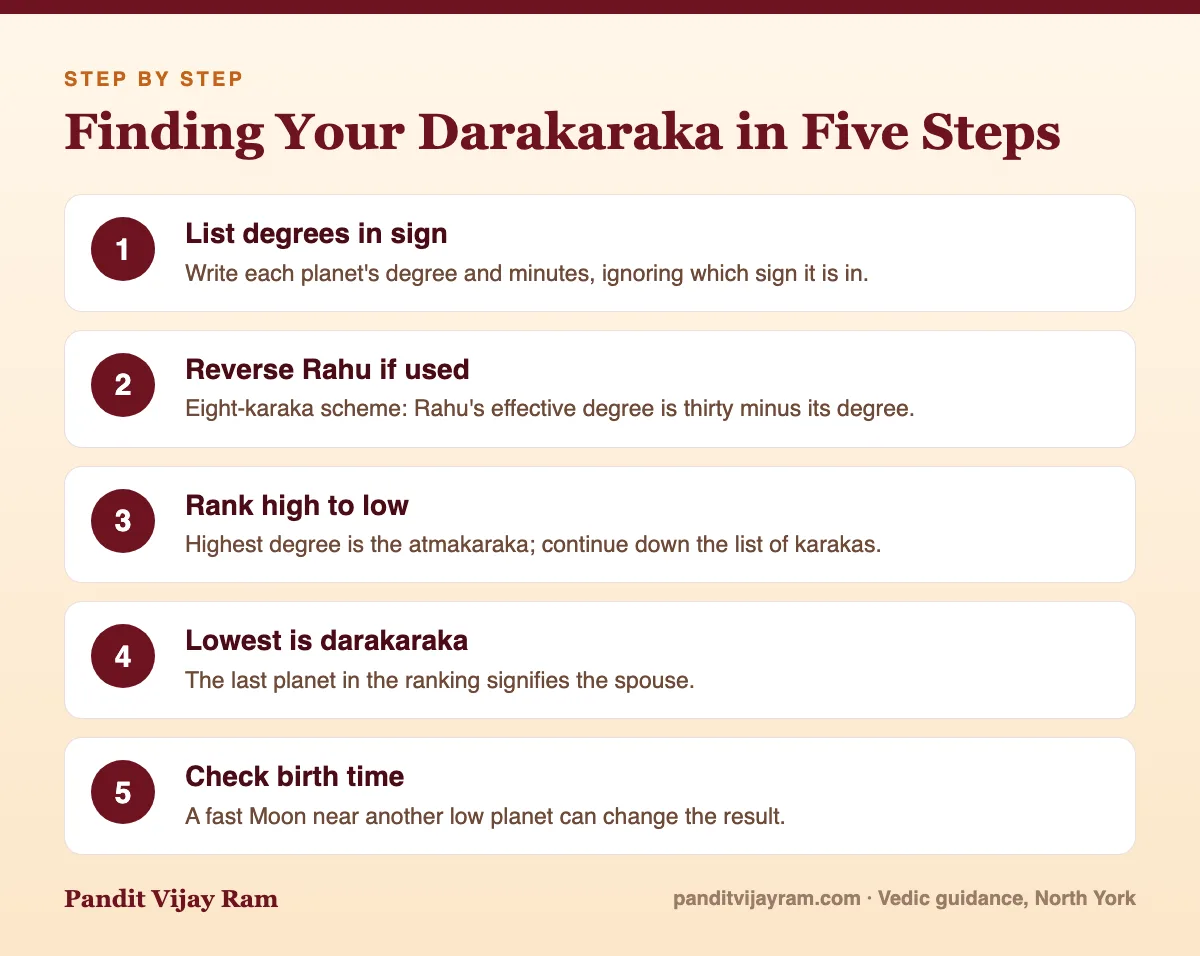
To find your darakaraka, list each planet's degree within its sign, ignoring the sign itself. Rank them from highest to lowest; the lowest is the darakaraka. In the eight-karaka scheme include Rahu, but subtract its degree from thirty first. Ketu is not used. Use an accurate sidereal chart.
Here is the method with an example you can follow on paper:
- Note each planet's degree and minutes within its sign. Example: Sun 18°20', Moon 4°10', Mars 27°05', Mercury 11°40', Jupiter 22°15', Venus 2°50', Saturn 14°30'.
- Rank them from highest to lowest. Mars, Jupiter, Sun, Saturn, Mercury, Moon, Venus.
- Assign the roles in order. In the seven-karaka scheme, Mars is the atmakaraka and Venus, at 2°50', is the darakaraka.
- For the eight-karaka scheme, add Rahu. Rahu moves backward, so its effective degree is thirty minus its actual degree. If Rahu is at 28°30', its effective degree is 1°30'.
- Re-rank. Rahu at 1°30' is now the lowest, so Rahu becomes the darakaraka in the eight-karaka scheme, while Venus moves up to gnatikaraka.
That last step shows why two respected astrologers can give you different answers. Both are following real texts; they simply use different schemes. When I read a chart, I tell the client which scheme I use and, where the two disagree, I describe both.
Two practical notes. If two planets share exactly the same degree and minute, texts offer tie-breaking rules, and lineages differ. And always use sidereal positions, the zodiac used in Vedic astrology, rather than a Western tropical chart. A kundli and horoscope reading can confirm the calculation for you.
What does each planet as darakaraka mean?
Each planet as darakaraka colours the spouse's temperament and the lessons of the relationship. The Moon suggests a caring, emotional partner, Saturn a mature and dutiful one, Mercury a youthful and talkative one. These are broad tendencies, modified by the planet's sign, dignity, house and navamsa position.
Below are the traditional associations. Read them as temperament sketches, not physical descriptions or predictions:
- Sun darakaraka. A partner with dignity, pride or a sense of leadership. Lessons around ego and respect.
- Moon darakaraka. A nurturing, sensitive or home-loving partner. Lessons around moods and emotional security.
- Mars darakaraka. An energetic, brave or competitive partner. Lessons around anger, protection and independence.
- Mercury darakaraka. A witty, curious or youthful partner, often a good communicator. Lessons around trust in words and flexibility.
- Jupiter darakaraka. A principled, learned or guiding partner. Lessons around faith, ethics and shared values.
- Venus darakaraka. An affectionate, artistic or comfort-loving partner. Lessons around pleasure, balance and mutual care.
- Saturn darakaraka. A serious, hardworking, perhaps older or more mature partner. Lessons around patience and duty.
- Rahu darakaraka (eight-karaka scheme only). An unconventional match, sometimes across cultures or backgrounds. Lessons around desire and expectation.
Dignity changes everything. A debilitated planet as darakaraka does not mean a weak spouse; it may mean that area of life needs more patience. Many readers also see the darakaraka as a teacher, linked to themes in karmic relationships. How those lessons unfold over time is read through the dashas.
How is the darakaraka read in the navamsa chart?
Astrologers often read the darakaraka's sign and companions in the navamsa (D9), the divisional chart of marriage. Its D9 sign, the planets with it, and its relationship to the atmakaraka add detail. Some lineages also study the sign the darakaraka occupies in the navamsa as the spouse's character.
The navamsa chart divides each sign into nine parts and is traditionally the most important divisional chart for marriage. A careful reading of the darakaraka usually follows these layers:
- Its sign and house in the main chart. These show where the spouse's influence is felt in daily life, such as career, home or travel.
- Its sign in the navamsa. Many readers give this great weight. A darakaraka in its own or exalted navamsa sign is often read as a supportive spouse.
- Planets with it. Benefics joining the darakaraka are said to add warmth; malefics may add friction or responsibility.
- Its relationship to the atmakaraka. When the soul planet and the spouse planet are friends, or placed in supportive positions from each other, the partnership is said to help the person's inner growth.
- Dasha timing. Periods of the darakaraka or planets linked to it are often studied when people ask about the timing of marriage.
None of this replaces the seventh house, Venus or the upapada. The darakaraka adds a layer. When all point in a similar direction, the reading gains confidence. For couples, a relationship compatibility consultation can compare each person's darakaraka with the other's chart, which is often more revealing than looking at one chart alone.
How accurate is the darakaraka, and what are its limits?
The darakaraka is sensitive to small errors. The Moon moves roughly half a degree an hour, so an uncertain birth time can change which planet is lowest. The seven- and eight-karaka schemes can disagree, and ayanamsa choice can shift planets near a sign boundary. Treat it as a tendency, not a verdict.
Three technical limits deserve attention:
- Birth time and the Moon. Most planets move slowly, but the Moon covers about thirteen degrees a day. If the Moon is close in degree to another low planet, an error of an hour or two can swap them.
- Scheme choice. As the worked example showed, including Rahu can change the darakaraka entirely. Neither scheme is a mistake; they are different traditions.
- Ayanamsa. Different ayanamsas, the corrections that convert tropical positions to sidereal ones, shift all planets by the same small amount. Usually the ranking is unchanged, but a planet sitting at the very start of a sign can wrap back to near thirty degrees of the previous sign and jump to the top of the list.
There are interpretive limits too. A darakaraka describes tendencies in how you relate and what you learn, not a specific person you are destined to meet. I am wary of any reading that names a spouse's job, appearance or arrival date from this planet alone.
If you are worried that you have not yet met someone, the darakaraka is not a countdown. Meeting people through community, friends and shared interests still matters most, as discussed in when will I find true love. The chart is a mirror for understanding yourself as a partner. It cannot choose for you, and it never overrides another person's free choice.
The bottom line
The darakaraka is the Jaimini spouse significator, the planet with the lowest degree in its sign among the chara karakas. You find it by ranking planets by degree, with Rahu reversed in the eight-karaka scheme, and the two schemes can disagree. Each planet sketches a temperament and a set of relationship lessons, refined by sign, dignity and the navamsa. Because birth time, scheme and ayanamsa can all change the darakaraka, it is a helpful tendency to reflect on, not a verdict about your future spouse.
Key takeaways
- The darakaraka is the planet with the lowest degree within its sign among the karakas.
- In the eight-karaka scheme Rahu is included and counted as thirty minus its degree.
- The seven- and eight-karaka schemes can give different darakarakas.
- The navamsa sign and the link to the atmakaraka add depth to the reading.
- Birth-time errors can change the darakaraka, so it should never be read as a verdict.