
Husband Not Giving Time: What Wives Can Do

You cook, you work, you manage the children's school and his parents' appointments, and by the time he comes home he is on his phone or asleep on the sofa. Weekends go to overtime, a cousin's errands or cricket. You are not asking for holidays abroad; you are asking for an hour that belongs to the two of you. If your husband not giving time has become the main sadness in your marriage, this guide is for you. Wives in North York, Scarborough and across the GTA describe this to me in almost the same words. Here you will find the most common reasons a husband pulls back, a way to raise the subject without starting a fight, how to share the workload more fairly, and simple routines that rebuild connection. In more than forty years of practice, I have noticed that most husbands who are "never there" are not indifferent. Many are tired, worried about money or unsure how to reconnect. The way forward respects both of you.
Why is my husband not giving time to me and the family?
The most common reasons are long or irregular work hours, a second job or business, financial pressure from home or abroad, stress and low mood, and habits like phone use that fill every spare minute. Sometimes a husband avoids home because arguments feel unavoidable there. Each cause needs a different response.
It helps to look at the reason before deciding what the behaviour means. Here are the patterns I hear about most:
- Work and shifts. Warehouse, trucking, driving and healthcare jobs in the GTA often mean nights, weekends and overtime. Some men take every extra shift because they fear falling behind on the mortgage.
- Money sent home. A husband supporting parents or siblings abroad may feel he cannot say no to extra work. The guide to money fights between couples discusses remittances fairly.
- Stress and mood. Withdrawal, irritability and constant tiredness can be signs of depression or burnout. Men in many of our communities are taught not to talk about this.
- Screens. Phones, gaming and endless news feeds are designed to hold attention. They quietly replace conversation.
- Avoidance. If home has become a place of criticism or conflict, some people stay away to escape it. This needs honesty from both sides.
- Different expectations. He may believe providing money is how he shows love, while you need presence and attention.
None of these excuses neglect, but naming the real cause changes the conversation from "you don't care" to "what is getting in the way?" If the distance also feels emotional and cold, the guide to a spouse becoming distant covers that pattern.

How do I talk to my husband about not spending time together?
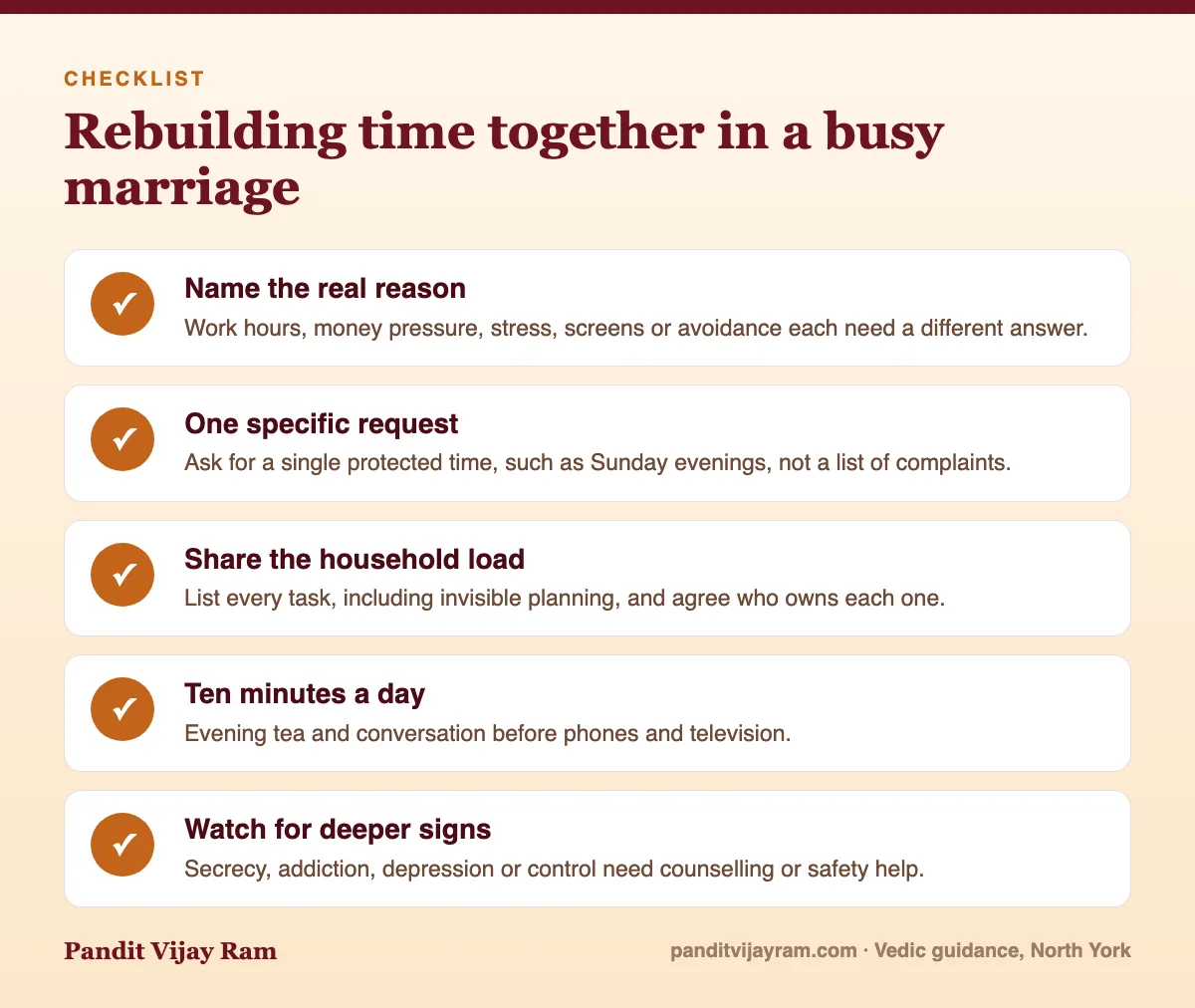
Pick a calm moment, describe a specific situation and how it made you feel, then ask what is happening for him. Make one clear, small request rather than a list of complaints. Husbands respond far better to "I miss our Sunday walks" than to "You never have time for us."
Many wives try to raise this when they are already hurt, late at night or in front of the children. That almost always turns into defence. A better approach:
- Choose the time. A quiet morning, a drive, or a short walk. Avoid the minutes after he walks in from work.
- Be specific. "Last weekend you worked both days and then went to your cousin's place, and I spent the evening alone."
- Share the feeling, not the verdict. "I felt lonely and unimportant" invites care. "You are selfish" invites argument.
- Ask and listen. "Is something worrying you? Is work harder than you have told me?" You may hear about debts, pressure from his parents or a job he fears losing.
- Make one request. "Could we keep Sunday evenings for the family?" Small and clear is easier to agree to.
- Follow up kindly. When he keeps his word, notice it. Appreciation makes change feel worthwhile.
If conversations repeatedly collapse into shouting or silence, the techniques in communication problems in marriage may help both of you speak more safely.
How can a husband and wife share household work more fairly?
Write down every recurring task, including invisible ones like planning meals, booking appointments and remembering birthdays, and decide together who owns each. Ownership means doing it and remembering it. Review the list monthly. When both partners work outside the home, a fair split is essential for having any time left together.
Many wives are not only asking for time; they are asking for relief. When one partner carries the job, the home, the children and both families, there is no energy left for closeness. Researchers sometimes call the invisible part of this "mental load" or emotional labour.
A practical method:
- Make a full list for one week. Include cooking, cleaning, laundry, school forms, groceries, bills, calls to elders, festival preparation and children's activities.
- Mark each task: who does it now, and who remembers it.
- Agree who will own each task from now on. Ownership includes noticing when it needs doing.
- Swap tasks that one person hates and the other does not mind.
- Put the plan on the fridge and look at it together each month.
A useful decision rule: if one person is working more paid hours, the other may do more at home, but the total of paid and unpaid work should feel roughly equal to both partners. If it does not, it gets renegotiated.
This is not about blaming husbands. Many men were never taught household skills, and some feel unsure of themselves in the kitchen or with paperwork. Patience while he learns, without criticism of his first attempts, builds lasting change.
What routines help a busy couple spend more time together?
Short, protected routines work better than occasional big plans. Ten minutes of tea and conversation each evening, a weekly walk or meal out, a phone-free dinner, and a shared prayer or aarti all create regular connection. The key is to treat these appointments as seriously as a work shift.
Couples with demanding jobs often wait for a free weekend that never comes. Instead, build small habits into the week:
- The evening ten minutes. Before phones and television, sit together with chai and ask each other about the day.
- Phone-free meals. A basket for devices at dinner, for parents as well as children.
- One weekly outing. A walk at Edwards Gardens, a drive, groceries together, a temple visit. Cheap and simple counts.
- Shared prayer. Lighting the evening lamp together, a short Hanuman Chalisa or a quiet moment before bed. Many couples find these minutes calm the whole home. The page on daily prayers for family peace has short options.
- Shift-worker plans. If he works nights, breakfast or a late-afternoon walk may be your time. Adapt rather than give up.
From a Vedic view, a reading may show that a demanding Saturn period is making work feel heavier for one partner. That understanding can soften resentment, but it does not excuse neglect. The marriage problem guidance page explains how a reading and prayer support this practical work.
When is a husband's lack of time a sign of a deeper problem?
It may be deeper when he hides where he goes, guards his phone, spends money secretly, drinks or gambles heavily, refuses any conversation, or responds to requests with anger or threats. Persistent withdrawal can also signal depression. These situations need counselling, medical care or, where there is fear, safety support.
Most busy husbands are simply overstretched. A few patterns, though, suggest something more serious:
- Secrecy. Unexplained absences, a locked phone and defensiveness may point to an affair or hidden debts. If you discover infidelity, the guide to the first weeks after discovering an affair offers calm next steps.
- Addiction. Gambling, alcohol or drug use that eats time and money needs professional help. ConnexOntario provides free information about services across the province.
- Depression. Constant exhaustion, hopelessness or loss of interest in everything deserve a visit to the family doctor. In a crisis, call or text 988.
- A change in personality. If he seems like a different man since the wedding, see the guide on a husband who changed after marriage.
- Control or threats. If he restricts your money, friends or movement, shouts you down or frightens you, that is not about time. It is abuse. Call 911 if you are in danger, and contact a domestic-violence service.
Couples counselling is worth trying when both partners are willing and safe. If he will not attend, individual counselling can still help you decide your next steps with clarity.
The bottom line
A husband not giving time is usually a sign of overload, stress or habit rather than a lack of love, though secrecy, addiction or control signal something deeper. A calm, specific conversation, a fairer split of household work and small routines you both protect will repair most of the distance. Where the pattern continues, counselling and, if needed, medical or safety support come first, with prayer offered as steady support.
Key takeaways
- Find the cause first: work, money pressure, stress, screens or avoidance.
- Make one small, specific request instead of a list of complaints.
- Write down every household task and agree who owns each one.
- Short routines like ten minutes of evening tea matter more than rare outings.
- Secrecy, addiction or control need professional or safety help.