
My Husband Has Changed After Marriage

Many wives describe the same shock. Before the wedding he was attentive, patient and fun. Months later he is short-tempered, distant or suddenly strict about money, clothes or friends. Women in North York and across the GTA bring this to me quietly, often unsure whether they are overreacting. If you feel your husband changed after marriage, this guide helps you sort the change into what it most likely is. Some shifts come from pressure: a new household, a demanding job, debt, family expectations or depression that men rarely name. Others are warning signs of drinking, gambling or a partner who is beginning to control. The response to each is very different, which is why the difference matters, and why guessing can leave a wife either blaming herself or staying somewhere unsafe. In over forty years of sitting with couples, I have learned to ask first whether a wife feels safe at home. Everything else, including any astrology, comes after that answer.
Why do husbands change after marriage?
Most husbands who change after marriage are reacting to pressure: financial responsibility, a new role in two families, work stress, lost freedom or untreated depression. Courtship also hides habits that daily life reveals. A smaller group change because they feel entitled to control a wife once married, which is a serious warning sign rather than ordinary adjustment.
It helps to separate three broad kinds of change before deciding what to do.
- Pressure. Rent or a mortgage, sending money home, a new job or a demanding manager can make a man tense and withdrawn. In joint or extended families he may feel pulled between his parents and his wife and handle it by going quiet.
- Revealed habits. During courtship, both people show their best side. After the wedding, ordinary habits appear: untidiness, long hours online, a short fuse when tired. These are real but workable.
- Entitlement. Some men treat marriage as the moment a wife becomes answerable to them. Rules about clothing, friends, phones, money or visiting her own family start to appear. This is not stress. It is control.
Low mood deserves its own mention. Depression in men often looks like anger, irritability, overworking, drinking more or withdrawing, rather than sadness. A man who seems angry at everything may be struggling and unable to say so.
If much of the strain is about living with in-laws, our guide to adjusting to a new family after marriage covers the first months in a joint household. For deeper conflict with his relatives, see in-law problems and solutions.

Is my husband stressed or is this abuse?
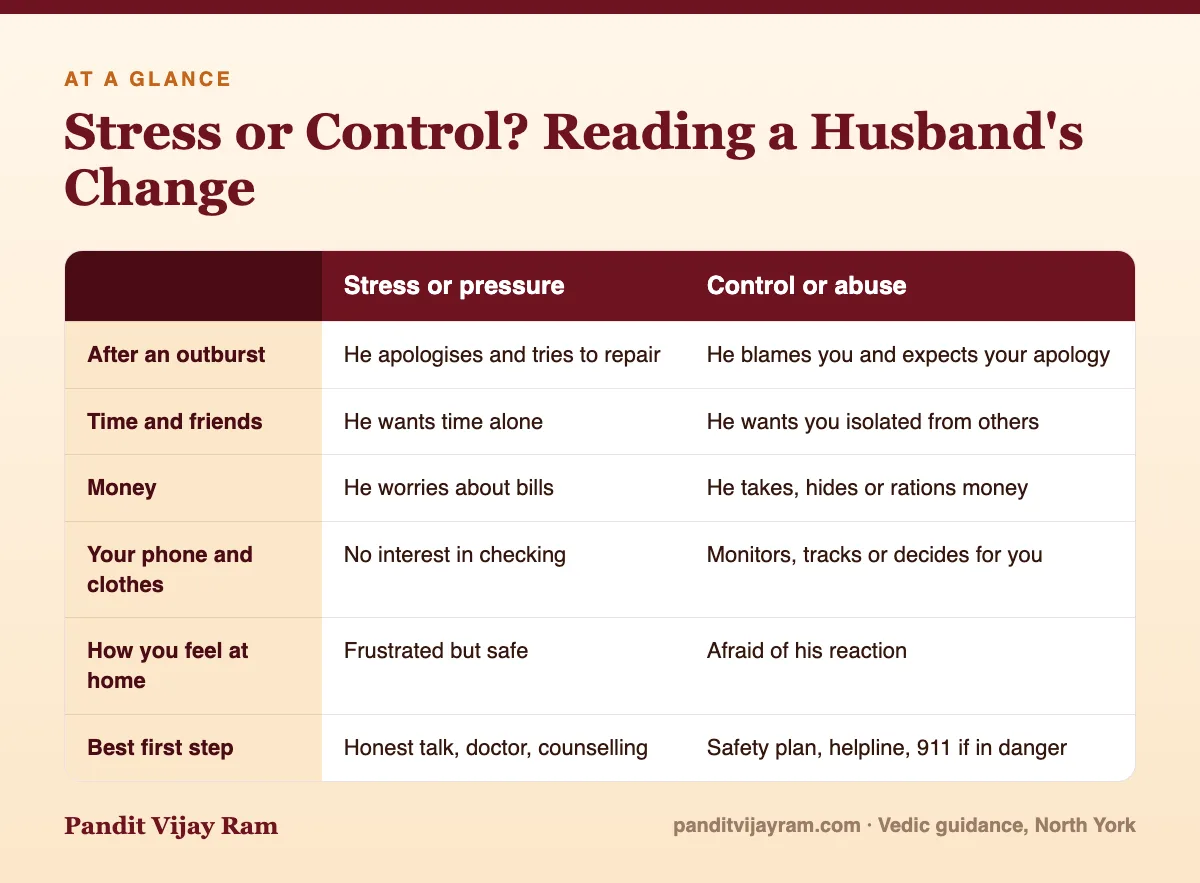
Stress tends to make a husband tired, irritable or withdrawn, but you are not afraid of him and he can still listen. Abuse is a pattern of control: monitoring, isolating you, controlling money, insults, threats or physical harm. If you change your behaviour to avoid his reaction, or feel fear at home, treat it as a safety issue.
Use this side-by-side check. It is not a diagnosis, but it helps you see a pattern clearly.
- Stress: he snaps, then apologises and tries to repair. Control: he blames you for his anger and expects you to apologise.
- Stress: he wants time alone. Control: he wants you alone, away from friends and family.
- Stress: he worries about money. Control: he takes your pay, hides accounts or makes you ask for basics.
- Stress: he is short on patience. Control: he checks your phone, tracks your location or decides what you wear.
- Stress: arguments are loud but mutual. Control: you are frightened, or he has pushed, grabbed, hit or threatened you.
Abuse often begins or worsens after a wedding, a move to a new country, or during pregnancy, when a woman may feel more dependent. Newcomer wives sometimes fear that leaving will affect their immigration status. Speak with a lawyer or settlement worker before assuming you have no options.
If you are in danger, call 911. Our guide to domestic violence help in the GTA lists confidential helplines and shelters, and signs of a controlling partner explains coercive control in more depth.
Could drinking, gambling or drugs be behind the change?
Yes. Addiction often hides behind mood swings, secrecy, missing money, late nights and broken promises. Watch for patterns rather than single incidents. You cannot make him stop, but you can protect your finances, encourage professional help, and seek support for yourself. ConnexOntario offers free information about addiction, mental health and gambling services in Ontario.
Wives often notice addiction through its side effects before they see the habit itself. Signs worth noting include:
- Money missing from joint accounts, new debt, or bills unexpectedly unpaid.
- Constant phone use with sudden anger if you look at the screen, which can also point to online betting.
- Coming home late with vague explanations, or smelling of alcohol often.
- Sharp mood changes between evenings, or irritability that eases only after a drink.
- Lost interest in work, prayer, family or things he once enjoyed.
What helps more than confrontation:
- Speak when he is sober and calm, describing specific events rather than labels.
- Protect essentials. Keep your own bank account and important documents safe.
- Suggest his family doctor or an assessment through ConnexOntario.
- Get support for yourself. Family groups for partners of people with addiction exist across the GTA.
Addiction and abuse can occur together. If drinking makes him frightening, the safety steps above apply.
Money arguments that come with gambling or hidden debt are covered in our guide to money fights between couples.
How do I talk to my husband about how he has changed?
If you feel safe, choose a calm, private moment, describe two or three specific changes, explain how they affect you and ask what has been happening for him. Avoid labels such as 'you are selfish'. Agree on one practical step together. If he responds with threats or punishment, stop and focus on your safety instead.
This advice is for marriages where there is strain but no fear. If you are afraid of his reaction, do not test it alone; speak with a helpline first.
A conversation plan many couples find useful:
- Name the change, not the man. 'Since the move, you rarely talk at dinner and you seem angry most evenings.'
- Share the effect. 'I feel lonely, and I'm not sure what I've done.'
- Ask about his side. 'Is something worrying you that you haven't told me?'
- Listen without solving. Many men have never been asked how they are coping.
- Agree one step. A weekly walk together, a doctor's visit, a budget meeting or a counsellor.
Choose a counsellor you can verify. In Ontario, registered psychotherapists appear on the CRPO public register, and many employers offer counselling through an assistance programme. Couples counselling is not recommended where there is ongoing abuse, because it can make an unsafe partner angrier. In that case, individual support is safer.
Family elders can help when both of you trust them and he is open to it. Bringing in relatives to pressure him usually backfires.
Can astrology explain why my husband changed?
A kundli can describe pressures and temperaments, such as a demanding dasha or a strong Mars, but it cannot excuse controlling or harmful behaviour. Astrology is best used for understanding and timing, alongside counselling and practical help. No planet makes abuse acceptable, and no remedy should keep a woman in danger at home.
When both partners consent, I look at the 7th house, its lord, Venus and Mars in each chart, the Moon for emotional state, and the current Vimshottari dasha periods. Saturn periods are often read as heavy responsibility, Rahu periods as restlessness or distraction, and Mars as heat and impatience. These are tendencies that help a couple talk about pressure without blame.
Three honest limits apply:
- A chart is not a character reference. Two men with similar placements can treat their wives very differently.
- A difficult period ends, but behaviour is a choice. Waiting for a dasha to change is not a plan if you are unsafe now.
- Remedies are for the person doing them. Prayer, a Tuesday Hanuman practice or a simple vrat can steady your own mind. They are not a way to control him.
I sometimes hear 'the pandit said it is my karma to bear this'. I disagree. Dharma does not require anyone to accept cruelty.
For couples dealing with stress rather than danger, a reading through the marriage problem guidance service can sit alongside counselling, and our article on husband–wife arguments and astrology explains the chart factors in more detail.
The bottom line
A husband changed after marriage may be under pressure from money, work, family roles or untreated low mood, and those strains respond to honest talk and support. Drinking, gambling and secrecy need professional help and protected finances. Control, threats or fear are not stress at all, and safety comes before counselling, family mediation or astrology. Know which situation you are in before you choose the next step.
Key takeaways
- Most change after marriage comes from pressure, not lost love.
- Fear at home, monitoring or money control point to abuse.
- Addiction often shows through secrecy and missing money first.
- Couples counselling is not advised while abuse continues.
- No chart placement excuses harmful behaviour.