
Gemstone Substitutes (Uparatna): Affordable Alternatives

A good sapphire, ruby or emerald can cost more than many families can comfortably spend. That is a real concern, and it should never be brushed aside with talk of investment or luck. When people in North York ask me about gemstone substitutes, I am glad they asked before stretching their budget. In more than forty years of practice I have seen families take on debt for a stone, and I would much rather they did not. An uparatna, or secondary stone, gives a gentler and more affordable option when the planet is genuinely friendly in the chart. This guide explains what uparatnas are, gives a planet-by-planet table of the substitutes most often named, sets out a simple decision rule for when a substitute makes sense, and is honest about what nobody can measure. It closes with remedies that need no stone at all, because mantra, charity and steady practice are full remedies in their own right. Gemstones are a matter of personal faith. They never replace medical, legal or financial advice, and no remedy should put a family under strain.
What is an uparatna in Vedic astrology?
An uparatna is a secondary or substitute gemstone linked to the same planet as a primary ratna. The word combines upa, meaning near or subordinate, with ratna, a jewel. Uparatnas are usually semi-precious stones of similar colour, considered milder in effect and much easier to afford than the nine classical gems.
The nine primary gems, or maharatnas, are ruby, pearl, red coral, emerald, yellow sapphire, diamond, blue sapphire, hessonite and cat's eye. Together they form the navaratna set linked to the nine grahas.
Uparatna lists grew up later through gem lore, regional custom and the trade. That is why one teacher may name red spinel for the Sun while another names red garnet or sunstone. Neither is simply wrong. They reflect different lineages and different markets.
The usual logic for a substitute is colour and character. A planet's stone carries its colour: red for the Sun and Mars, white for the Moon and Venus, green for Mercury, yellow for Jupiter, blue or dark for Saturn. A secondary stone of matching colour is thought to carry a softer version of the same influence.
Two points matter more than any list:
- Same suitability rule. A substitute is chosen only for a planet that is friendly from your ascendant, as explained in how a chart chooses a gemstone.
- Quality still counts. A clean, honestly described semi-precious stone is better than a cloudy or dyed one.

Which substitute stone goes with each planet?
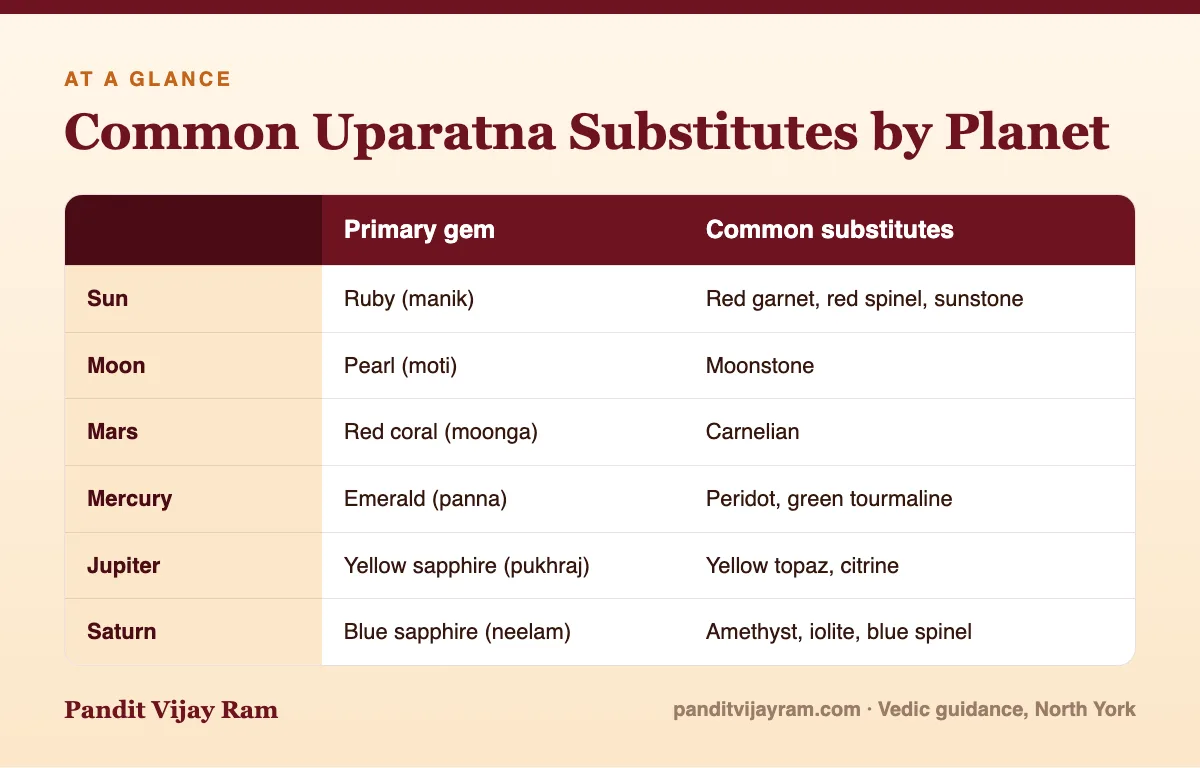
Common pairings are red garnet or spinel for ruby, moonstone for pearl, carnelian for red coral, peridot or green tourmaline for emerald, yellow topaz or citrine for yellow sapphire, white zircon or white sapphire for diamond, and amethyst or iolite for blue sapphire. Rahu and Ketu substitutes vary most between teachers.
Here is the planet-by-planet list as I most often hear it used. Regional lists differ, so treat this as a map rather than a rule.
- Sun, ruby (manik): red garnet, red spinel or sunstone. More in our page on ruby for the Sun.
- Moon, pearl (moti): moonstone. See pearl and moonstone.
- Mars, red coral (moonga): carnelian, a red-orange chalcedony. Our red coral guide explains why some families prefer it.
- Mercury, emerald (panna): peridot or green tourmaline. Green onyx is sold too, usually as dyed chalcedony.
- Jupiter, yellow sapphire (pukhraj): yellow or golden topaz, or citrine.
- Venus, diamond (heera): white sapphire, colourless zircon or white topaz. Some teachers name opal.
- Saturn, blue sapphire (neelam): amethyst, iolite (sometimes sold as neeli) or blue spinel. Read why neelam is tested in blue sapphire neelam.
- Rahu, hessonite (gomed): teachers differ; some suggest a modest hessonite garnet itself, which is already affordable.
- Ketu, cat's eye (lehsunia): quartz cat's eye or tiger's eye, both showing a band of light.
Note that colourless zircon is a natural mineral, while cubic zirconia is a synthetic. The names sound alike, and sellers sometimes blur them.
When does a substitute gemstone make sense?
A substitute makes sense when the planet is clearly friendly in your chart but the primary gem would strain your budget, when you want a gentler start, when the main gem raises ethical concerns, or when the stone must survive hard daily wear. It does not make sense for a planet that rules difficult houses.
I use a short decision rule with clients:
- Is the planet a functional benefic for your ascendant? If no, stop. Neither the main gem nor a substitute is the right remedy.
- Can you afford a clean, honestly described primary gem without debt? If no, a substitute is sensible.
- Do you have an ethical concern? Pearl and coral are animal products. Moonstone and carnelian are mineral options.
- Is your work hard on jewellery? Pearl and coral are soft. A durable substitute may simply last longer.
- Do you want to start gently? Some people prefer a substitute first and decide on the primary stone later.
A substitute is also a sensible choice for teenagers, who outgrow and lose rings, and for anyone whose birth time is uncertain enough that a costly decision feels premature.
What I discourage is buying a substitute because a seller said the main stone is "dangerous" for you. Fear is a poor reason to buy anything. If a planet is unfriendly, no version of its stone fixes that, and non-gem remedies are the honest route.
Families thinking about a larger purchase should read our guide to fake gemstones and lab reports first, since substitutes are sometimes passed off as the real thing.
Are uparatnas less effective than real gemstones?
Tradition says uparatnas act more gently than primary gems, and many teachers suggest a slightly larger substitute to compensate. Nobody can measure a gemstone's astrological effect, so these comparisons rest on lineage and experience rather than evidence. A substitute is best seen as a sincere support, alongside effort and prayer.
I want to be straightforward here. There is no laboratory test for astrological strength. When teachers say a garnet is weaker than a ruby, they are passing on a lineage view, not a measured result. I hold that view too, but I hold it humbly.
What I have observed in practice is that people who choose an affordable, well-suited stone and pair it with a regular mantra tend to stay with the remedy calmly. People who strain to buy an expensive gem sometimes carry anxiety about whether it is working, and that worry itself becomes a burden.
A few practical points:
- Size: some teachers suggest a substitute a little larger than the primary stone would be. Others say size matters less than clarity.
- Treatment: substitutes are treated too. Much citrine is heated amethyst, and most blue topaz is irradiated.
- Setting: the same metal, finger and weekday customs used for the main gem are usually followed.
If you have hopes tied to health, work, a relationship or money, please keep those practical paths open. A stone of any grade supports your effort; it does not replace a doctor, a counsellor or a budget.
What remedies work without buying any gemstone?
Every planet has traditional remedies that cost little or nothing: its mantra recited on its weekday, charity of foods or items linked to it, fasting where health allows, worship of its presiding deity, and conduct that reflects its qualities. These are complete remedies in Vedic practice, not lesser options.
Here are examples of non-gem remedies by planet:
- Sun: water offered at sunrise and respect for one's father.
- Moon: Monday prayer to Shiva and caring for one's mother.
- Mars: Tuesday Hanuman Chalisa and calm handling of conflict.
- Mercury: Wednesday charity of green moong and honest speech.
- Jupiter: Thursday respect for teachers and gifts of books.
- Venus: Friday Lakshmi prayer and kindness in partnership.
- Saturn: Saturday service to people who labour hard.
- Rahu and Ketu: Durga or Ganesha worship and steady routines.
For larger concerns, a family may choose a graha shanti or a longer mantra anushthan. Our puja and anushthan page explains how those are arranged, both in person and by sankalp for families who live further away.
Fasting is not for everyone. If you are pregnant, diabetic, elderly or taking medication, speak with your doctor first and choose prayer or charity instead.
For a personal recommendation that weighs a primary gem, a substitute and non-gem options side by side, our gemstone and numerology consultation covers all three.
The bottom line
Gemstone substitutes, or uparatnas, give an affordable and gentler way to support a planet that is already friendly in your chart. The planet-by-planet pairings vary between teachers, and the suitability rule is the same as for primary gems. Nobody can measure the difference in strength, so choose within your means, and remember that mantra, charity and conduct are complete remedies without any stone.
Key takeaways
- An uparatna is a milder, affordable stone linked to the same planet.
- Substitute lists vary by lineage and region; none is the only correct one.
- A substitute never makes an unfriendly planet suitable.
- Substitutes can be treated or misnamed too, so ask for disclosure.
- Mantra, charity and conduct are full remedies that cost little.