
Pearl (Moti) and Moonstone for the Moon
The Moon governs the part of us that feels: home, mother, nourishment and the changing tides of mood. Because of that, many people come to a pearl moti hoping it will settle restless nights or a heavy heart. I understand that hope, and I want to handle it honestly. In Jyotish the Moon is the karaka of the mind, but a pearl is a symbol and a devotional support, not a treatment for anxiety, low mood or sleep problems. Those deserve a conversation with your family doctor. When a family in North York asks me about a pearl, I check the chart, ask gently how the person is really doing, and only then talk about stones. In more than forty years of practice, that order has served people well. This guide covers what the Moon signifies, which ascendants welcome a pearl, the customary metal, finger and day, the difference between natural, cultured and imitation pearls, and when moonstone or a simple Monday practice may suit you better. It also notes why some vegetarian families prefer moonstone.
What does the Moon signify, and why is pearl its gem?
The Moon, or Chandra, signifies the mind, emotions, mother, home, nourishment and public life in Vedic astrology. He rules Cancer, is exalted in Taurus and debilitated in Scorpio. Pearl is his ratna because of its soft white lustre, which matches the Moon's cool, reflective nature in tradition.
Vedic astrology gives the Moon special weight. Your Moon sign is your rashi, your birth nakshatra is the Moon's star at birth, and the Vimshottari dasha begins from the Moon's position. Our guide to the Moon sign versus the Sun sign explains why Vedic horoscopes lean on it.
Chandra's significations include:
- Manas, the feeling mind and its receptivity.
- The mother and maternal care.
- Home, comfort, food and water.
- The public and how people respond to you.
- Travel by water and fluid, changing circumstances.
A strong Moon is traditionally said to give steadiness and warmth. A weak one, such as a dark Moon near new moon, or one afflicted by Saturn, Rahu or Ketu, is often read as a tendency towards changeability.
These are symbolic tendencies, not diagnoses. A chart cannot tell you that you have depression or an anxiety disorder, and a pearl cannot treat either. If your mood has been low through the dark months, our article on winter low mood in Toronto puts medical care first and shows where spiritual practice can sit alongside it.

Who should wear a pearl according to the chart?
A pearl usually suits ascendants where the Moon rules a favourable house: Cancer, where he is lagna lord, Scorpio for the ninth, Pisces for the fifth, and often Aries for the fourth. Taurus, Leo, Sagittarius, Capricorn and Aquarius usually avoid it. Gemini, Virgo and Libra are judged individually.
A sign-by-sign view, as most Parashari astrologers read it:
- Cancer: lagna lord. Usually suitable.
- Scorpio: ninth-house lord. Usually suitable, even though the Moon is debilitated in this sign.
- Pisces: fifth-house lord. Usually suitable.
- Aries: fourth-house lord and a friend of Mars. Often suitable.
- Gemini: second house. Mixed.
- Libra: tenth house. Mixed; placement decides.
- Virgo: eleventh house. Often cautious.
- Taurus, Leo, Sagittarius, Capricorn, Aquarius: the Moon rules the third, twelfth, eighth, seventh or sixth. Usually avoided.
Next I look at the Moon's phase at birth. A Moon close to the full is bright and strong; one close to the new moon is dim. Aspects from Saturn and conjunction with Rahu or Ketu also shape the advice.
Pairing customs say pearl sits well with ruby, red coral and yellow sapphire, because the Sun, Mars and Jupiter are friendly to the Moon. Many teachers keep pearl away from hessonite and cat's eye. Traditions vary, so the full method in choosing a gemstone from your chart is worth reading before you add rings.
How is a pearl worn: finger, metal and day?
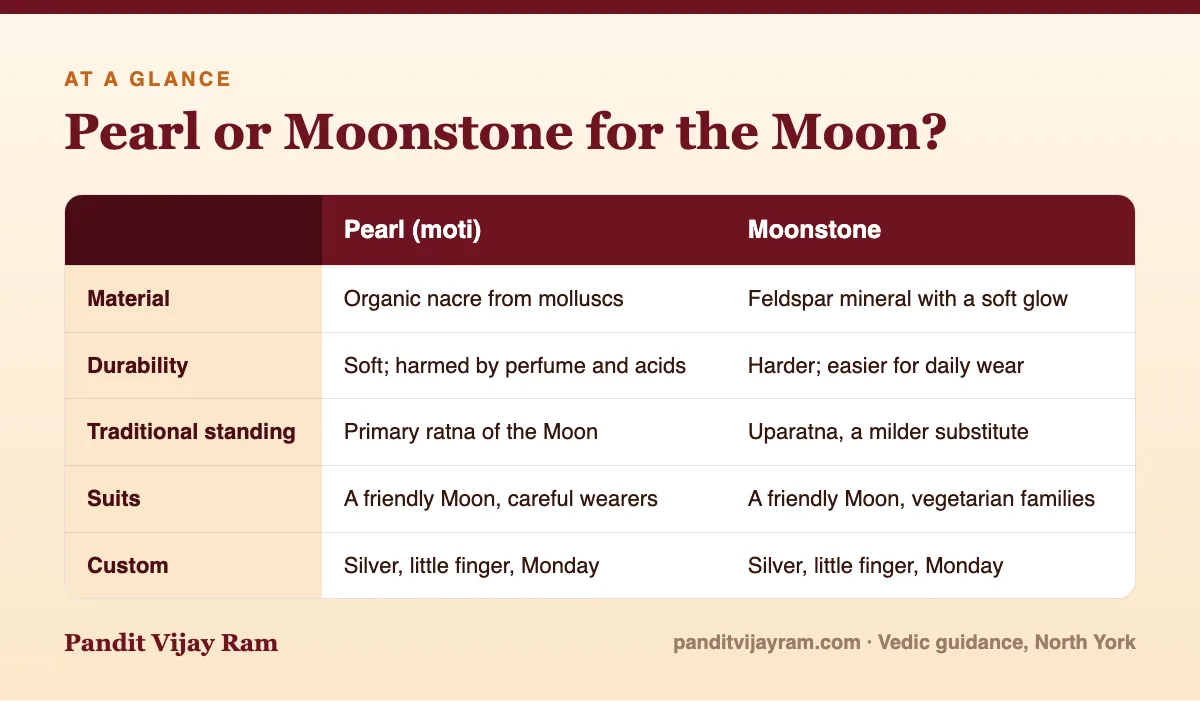
A pearl is customarily set in silver and worn on the little finger, though many traditions use the ring finger instead. It is usually first worn on a Monday, often in the bright half of the lunar month, after rinsing it in raw milk or Ganga jal and reciting a Chandra mantra.
A gentle home method:
- Pick a Monday. Check a Toronto panchang if you want the waxing fortnight, which many families prefer for the Moon.
- Choose silver. It is the Moon's metal in tradition. An open setting that lets the pearl touch the skin is common.
- Rinse briefly. A quick dip in raw milk or Ganga jal, then clean water. Pearls are soft, so never soak or scrub them.
- Recite the mantra. Om Som Somaya Namah or Om Shram Shreem Shraum Sah Chandraya Namah, often 108 times.
- Wear it with a prayer to Lord Shiva, who carries the crescent Moon, and to your mother or family deity.
Pearl needs more care than any mineral gem. Put the ring on after perfume, lotion and hairspray, and remove it for swimming, cleaning and cooking with acidic foods. Wipe it with a soft cloth after wearing, and store it away from harder stones that can scratch it.
Some families prefer a pendant over a ring. That is a valid choice, especially for people who work with their hands.
How can I tell a natural pearl from a cultured or fake one?
Natural pearls form without human help and are rare. Cultured pearls start with a bead or tissue placed in the mollusc, and they make up most pearls sold today. Imitations are glass, shell or plastic beads with a pearly coating. Only a gem laboratory, often using X-ray imaging, can confirm natural origin.
Pearl is an organic gem. It grows as a mollusc lays down layers of nacre, a mix of calcium carbonate and a protein called conchiolin. That is why pearls are soft and sensitive to acids, sweat and cosmetics.
The main categories:
- Natural pearls. Historically fished from the Persian Gulf, the Gulf of Mannar and elsewhere. Rare and costly.
- Cultured saltwater pearls. Akoya, South Sea and Tahitian types, grown in farmed oysters.
- Cultured freshwater pearls. Grown in mussels, widely available and affordable.
- Imitations. Coated glass or shell beads, often smooth and uniform.
Many astrologers accept cultured pearls, since a living mollusc still forms the nacre. Some insist on natural ones. I accept either when honestly described.
Treatments include bleaching, dyeing and coating. Dark pearls in particular may be dyed. Ask for disclosure in writing, and for a valuable piece, an independent lab report. Our guide to fake gemstones and certificates covers return windows and consumer protection.
Is moonstone a good substitute for pearl?
Moonstone is the most common uparatna for the Moon. It is a feldspar mineral with a soft, floating glow called adularescence. It suits people when the Moon is friendly but a fine pearl is out of reach, or when they prefer not to wear an animal product. The same chart rules apply.
Moonstone has a long folk link to the Moon in many cultures, which makes it a natural stand-in. In India it is sometimes called chandrakant mani. It is harder than pearl and less affected by perfume or sweat, which some people find practical.
When I suggest moonstone:
- The Moon is a functional benefic, and budget rules out a good pearl.
- The family follows vegetarian or Jain values and prefers not to wear a mollusc product.
- The person works with water, chemicals or food all day, where pearl would suffer.
Moonstone is not a way around an unfriendly Moon. For Capricorn or Sagittarius rising, a Monday practice usually serves better than any stone.
Practices that honour Chandra without a gem:
- Offering water or milk to a Shiva lingam on Mondays.
- A light Monday fast where health allows; skip it if you are pregnant, diabetic or on medication.
- Calling or visiting your mother, or caring for an elder woman in the community.
- Giving rice, milk or white clothing on Mondays.
More options appear in our guide to uparatna substitutes. For a personal reading of your Moon, our gemstone consultation is available.
The bottom line
Pearl moti is the Moon's gem, an organic creation of molluscs, and it suits charts where the Moon rules favourable houses, such as Cancer, Scorpio and Pisces rising. Silver on the little or ring finger from a Monday is the common custom, and pearls need gentle care. Moonstone offers a practical, animal-free substitute under the same chart rule, while low mood or poor sleep always calls for a family doctor first.
Key takeaways
- Pearl is an organic gem and the classical ratna of the Moon.
- Cancer, Scorpio and Pisces ascendants are the usual candidates.
- Most pearls today are cultured; imitations are coated glass or shell.
- Moonstone suits vegetarian families and busy hands, with the same chart rule.
- No gem treats anxiety, low mood or sleep problems; see your family doctor.