
Red Coral (Moonga) for Mars: Uses and Cautions

Red coral is often the first stone suggested when a family in North York hears the word manglik. A worried parent is told that a moonga ring will settle the matter before a wedding, and the family buys one in a hurry. I want to slow that moment down. A red coral moonga is a legitimate Mars remedy in the right chart, but it is not an answer to every Mangal dosha worry, and the dosha itself is far less alarming than its reputation. Coral also carries a responsibility other gems do not, because it comes from living marine colonies that grow very slowly. When families ask me about it, I look at Mars from the ascendant, check whether a dosha is present or cancelled, and talk about where the coral came from. In more than forty years of practice, I have learned that calm facts help more than quick purchases. This article explains Mars and his stone, who should wear it, how coral is harvested and regulated, how dyed and imitation coral is sold, and the honest truth about coral and manglik matching.
What is moonga, and why is it linked to Mars?
Moonga is the Hindi name for precious red coral, the hard skeleton built by colonies of small marine animals in the genus Corallium. In Vedic astrology it is the ratna of Mangal, or Mars, because of its red to orange colour. Mars signifies courage, energy, siblings, property, discipline and the drive to act.
Unlike ruby or sapphire, coral is not a crystal. It is an organic gem made of calcium carbonate, laid down by coral polyps over many years. That makes it relatively soft and sensitive to acids, heat and household chemicals.
Mangal in Jyotish is the commander of the planetary court. He rules Aries and Scorpio, is exalted in Capricorn and debilitated in Cancer. His themes include:
- Courage, initiative and physical stamina.
- Brothers and younger siblings.
- Land, property and engineering.
- Police, armed forces, sport and surgery as fields of work.
- Anger and conflict when he is badly placed.
Coral is chosen when Mars is friendly for the ascendant but weak, so that his positive qualities can show more. It is not meant to make anyone more aggressive. Many online claims link coral to blood, energy levels or recovery from illness. I make none of those claims; health concerns belong with your family doctor.
Devotion to Lord Hanuman is closely tied to Mars in many households, with Tuesday prayers and Hanuman Chalisa. Our Hanuman puja service describes that practice.

Who should wear red coral?
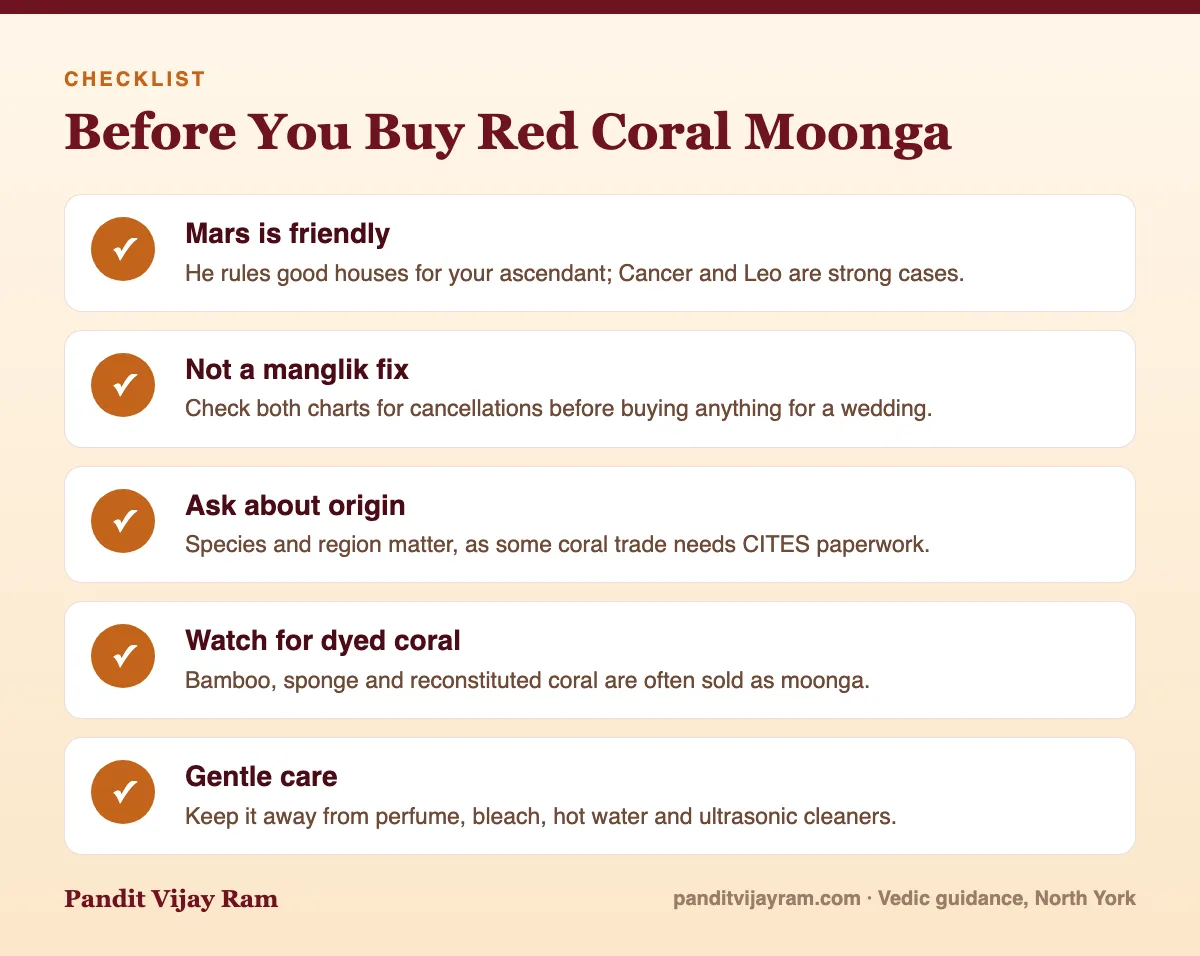
Red coral usually suits ascendants where Mars is a functional benefic: Aries and Scorpio, which he rules, Cancer and Leo, where he is yogakaraka, and Sagittarius and Pisces, where he rules a trikona. Taurus, Gemini and Virgo usually avoid it. Libra, Capricorn and Aquarius need careful case-by-case review.
Here is the usual sorting:
- Yogakaraka: Cancer (fifth and tenth) and Leo (fourth and ninth). Strong candidates.
- Lagna lord: Aries and Scorpio. Usually suitable, though Mars also owns the eighth for Aries and the sixth for Scorpio.
- Trikona lord: Sagittarius (fifth) and Pisces (ninth). Usually suitable.
- Mixed: Capricorn (fourth and eleventh), Aquarius (third and tenth) and Libra (second and seventh, both maraka houses).
- Usually avoided: Taurus (seventh and twelfth), Gemini (sixth and eleventh) and Virgo (third and eighth).
After the ascendant, I look at Mars's sign and house, aspects from Saturn or Rahu, and the running dasha. A friendly Mars that is already strong may need no coral at all.
Customs for wearing: gold or copper, ring finger of the working hand, Tuesday morning after reciting Om Kram Kreem Kraum Sah Bhaumaya Namah or Om Angarakaya Namah. Some families prefer silver, and some wear coral as a pendant. Traditions vary.
Coral pairs traditionally with ruby, pearl and yellow sapphire, since the Sun, Moon and Jupiter are Mars's friends. It is usually kept apart from emerald. The wider method is in our guide to which gemstone you should wear.
Does red coral remove manglik dosha?
No gemstone removes Mangal dosha. Red coral may be suggested to support a friendly Mars, but in charts where Mars rules difficult houses it can be the wrong remedy. Mangal dosha is common, is defined differently by different schools, and is often cancelled by other factors in the chart or in a partner's chart.
Let me address the fear directly. Mangal dosha, or being manglik, usually means Mars sits in the first, second, fourth, seventh, eighth or twelfth house, counted from the lagna and sometimes also from the Moon and Venus. Under such broad rules a large share of people qualify. It is a factor for compatibility, not a curse.
Common myths I hear:
- “A coral ring cancels the dosha.” It does not. If anything, strengthening Mars in an unsuitable chart works against the aim.
- “Manglik people must marry manglik people.” Matching two manglik charts is one traditional approach, but many cancellations exist.
- “A manglik marriage is doomed.” Marriages succeed or struggle for human reasons: respect, communication, money habits and family support.
Traditional supports include Hanuman worship on Tuesdays, the Rin Mochan Mangal Stotra, and in some families a symbolic kumbh vivah ritual. For couples, our article on manglik and non-manglik marriage explains cancellation rules and how matching really works.
If anyone is pressuring you to buy coral urgently before a wedding, pause. A good astrologer will look at both charts first.
Is buying red coral sustainable and legal?
Precious coral grows very slowly in deep water and has been heavily harvested, so its trade is regulated in many places. Some Corallium species are listed under CITES, the international wildlife trade agreement, which can mean paperwork for cross-border shipments. Buy from sellers who can explain origin, and check Canadian import rules before ordering abroad.
Precious red coral is not the same as the reef-building corals of tropical shallows, but it faces similar pressures. Colonies grow slowly, can take many years to reach gem size, and have been over-collected in parts of the Mediterranean and western Pacific. Fisheries in several countries now limit where and how much can be taken.
Some precious coral species have been listed under CITES Appendix III at the request of a range country. In practice, that means international shipments may need export or origin documents. Canada implements CITES through federal law, and Environment and Climate Change Canada handles permits. Rules change, so check the current position before importing a stone or a strand from overseas.
Practical steps for a careful buyer:
- Ask the seller which species and region the coral came from.
- Prefer a small, well-cut stone over large carvings, which consume more material.
- Consider an older family piece that can be reset, which needs no new harvest.
- If sustainability weighs on you, carnelian is a mineral substitute used by some teachers.
I respect clients who choose not to wear coral at all for ethical reasons. Mars can be honoured fully through prayer, discipline and service, as explained in our guide to gemstone substitutes.
How can I tell real coral from dyed or fake coral?
Dyed bamboo coral, resin-filled sponge coral, reconstituted coral powder, dyed shell, glass and plastic are all sold as moonga. Real precious coral shows a fine, wavy growth pattern and an even, natural colour. Because experienced eyes can still be fooled, ask for a written description and, for a costly piece, an independent lab report.
Common substitutes and how they are sold:
- Bamboo coral: a different, more common coral, often dyed red. Colour may gather in cracks.
- Sponge coral: porous coral filled with resin and dyed.
- Reconstituted coral: ground coral or shell bound with resin into blocks.
- Glass and plastic: often too uniform, too light or too warm to the touch.
Please do not try the old acid or flame tests at home. They damage real coral and can be unsafe. A gem laboratory uses magnification and other methods instead. Wiping with solvents to look for dye can also spoil a genuine stone's polish, so leave testing to professionals.
Care is simple once you have it: avoid perfume, bleach, hot water and ultrasonic cleaners, and wipe with a soft damp cloth.
Our guide to fake gemstones and safe buying in Canada explains return windows, written descriptions and what to do if a stone is misrepresented. For a chart-based view of Mars, our gemstone consultation covers his houses, dignity and dasha.
The bottom line
Red coral moonga supports Mars where he is a functional benefic, mainly for Aries, Scorpio, Cancer, Leo, Sagittarius and Pisces ascendants. Coral is an organic, slow-growing and regulated material, so origin, sustainability and dyed imitations all deserve attention. Above all, no stone removes Mangal dosha; careful matching, Hanuman prayer and honest family conversation do far more.
Key takeaways
- Moonga is organic precious coral and the classical gem of Mars.
- Cancer and Leo ascendants, where Mars is yogakaraka, are strong candidates.
- Coral does not cancel Mangal dosha, which is common and often cancelled.
- Some coral species are regulated under CITES; check import rules.
- Dyed bamboo coral and reconstituted coral are widely sold as moonga.