
Ruby (Manik) for the Sun: Who Should and Shouldn't Wear It
A ruby has a warmth that few other stones match, and people who hold leadership roles, run businesses or face public work often feel drawn to it. The Sun is the king of the planets in Jyotish, so a ruby manik is sometimes treated as a symbol of status as much as a remedy. That is where care is needed. The Sun is a natural malefic in classical reading, and in half the ascendants he rules houses that most families would not wish to strengthen. When someone in North York shows me a ruby bought for a promotion or a government application, I first look at which house the Sun owns in their chart and how he is placed. In more than forty years of practice, I have often advised against a ruby that looked perfect in the shop. This guide explains what the Sun signifies, a clear decision rule for who should and should not wear ruby, the customary way it is worn, how glass-filled rubies and look-alikes are sold, and what to do instead when the stone does not fit. No gem promises results, and none replaces professional advice.
What does the Sun represent in Vedic astrology?
In Vedic astrology the Sun, or Surya, represents the soul, authority, self-respect, the father, government and leadership. He rules Leo, is exalted in Aries and debilitated in Libra. Ruby is his ratna because of its red colour, and it is chosen to strengthen a friendly Sun that is weak or afflicted.
Surya is the atmakaraka by nature, the indicator of the self. He shows how we stand in the world, how we relate to authority figures, and how others perceive our dignity. Classical texts also link him to the father and to rulers and government service.
The Sun is also a natural malefic, meaning he is hot and separating by temperament. That is not a moral judgement. It means his stone should be chosen with clear reasons.
Key points a reader looks at:
- Dignity. Exalted in Aries, debilitated in Libra, at home in Leo. Our guide to exalted and debilitated planets covers cancellation.
- House. The Sun gains directional strength in the tenth house, which is why he matters in career readings.
- Company. Planets very close to the Sun become combust and lose visible strength.
People often ask about ruby when hoping for public service roles. Our article on government job yogas explains why chart factors are tendencies and why exam preparation still decides most outcomes.

Who should wear ruby, and who shouldn't?
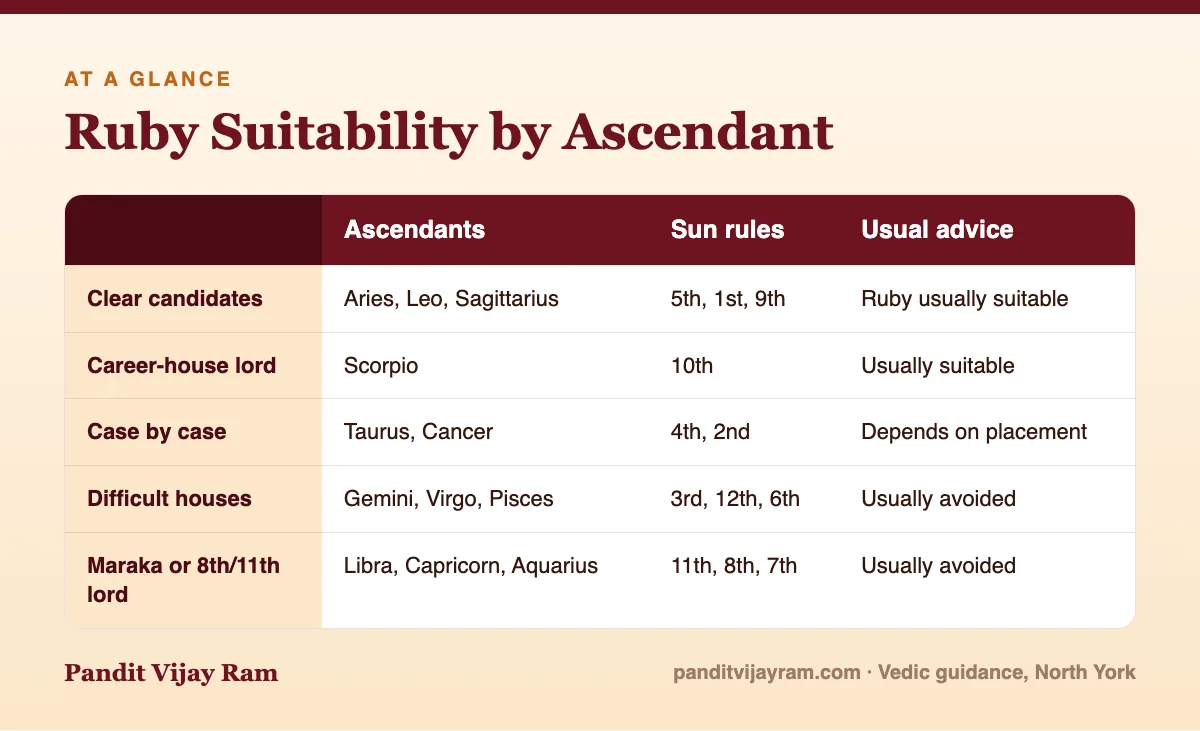
Ruby usually suits ascendants where the Sun rules a trikona or the tenth house: Aries, Leo, Scorpio and Sagittarius. Taurus and Cancer are judged case by case. Gemini, Virgo, Libra, Capricorn, Aquarius and Pisces generally avoid it, because the Sun rules the third, sixth, seventh, eighth, eleventh or twelfth house there.
Here is the decision rule I start with, sign by sign:
- Aries: the Sun rules the fifth, a trikona, and is exalted in the lagna. Usually suitable.
- Leo: the Sun is the lagna lord. Suitable unless badly afflicted.
- Sagittarius: the Sun rules the ninth. Usually suitable.
- Scorpio: the Sun rules the tenth. Usually suitable.
- Taurus: the Sun rules the fourth, a kendra. Often acceptable, depending on placement.
- Cancer: the Sun rules the second, a wealth house but also a maraka. Judge carefully.
- Gemini: third house. Usually avoided.
- Virgo: twelfth house. Usually avoided.
- Libra: eleventh house, and debilitated in the lagna. Usually avoided.
- Capricorn: eighth house. Usually avoided.
- Aquarius: seventh house, a maraka. Usually avoided.
- Pisces: sixth house. Usually avoided.
“Avoided” here means a ruby is not the right remedy. It does not mean anything terrible will happen if you wore one briefly. You simply take it off. Some astrologers allow exceptions when the Sun is very well placed, and schools differ on Cancer and Taurus.
Pairings matter as well. Ruby is traditionally kept apart from blue sapphire and diamond, since Saturn and Venus are the Sun's enemies, though practice varies. See how a chart chooses a gemstone for the full method.
Which finger and metal are used for a ruby ring?
A ruby is customarily set in gold or copper and worn on the ring finger of the working hand, which palmistry links to the Sun. It is usually put on during Sunday morning near sunrise, after offering water to the Sun and reciting a Surya mantra. Traditions vary on metal, hour and hand.
A simple, traditional sequence many families follow:
- Day: Sunday, often in the bright half of the lunar month. A Toronto panchang can show this.
- Time: within roughly the first hour or two after sunrise, when many offer arghya, water poured towards the rising Sun from a copper vessel.
- Purification: a short rinse in raw milk or Ganga jal, then clean water.
- Mantra: Om Hram Hreem Hraum Sah Suryaya Namah, or the shorter Om Suryaya Namah, often 108 times.
- Setting: an open back so the stone touches the skin, in gold, copper or a gold-copper alloy.
Some teachers prefer the index finger for ruby, and some southern customs differ on the hour. I do not argue with honest family traditions. What matters more is that the stone suits the chart and is honestly described.
Ruby is hard, so it handles daily wear. Clean it with warm soapy water and a soft brush. If your ruby is glass-filled, explained below, avoid strong cleaners and tell any jeweller before repairs.
How do I know if a ruby is real or glass-filled?
You need an independent laboratory report. Ruby is red corundum, but many low-cost stones on the market are heavily fractured corundum filled with lead glass, sometimes called composite ruby. Others are heated, synthetic, or are garnet, spinel or glass sold as ruby. A trained gemmologist can tell; the eye usually cannot.
Ruby takes its red from chromium within corundum. Classic sources include Myanmar, Mozambique, Thailand and Sri Lanka. Origin shapes market price but not astrological value.
What you may be offered:
- Heated ruby. Very common and usually accepted when disclosed.
- Lead-glass-filled ruby. Low-grade material with glass filling much of its volume. It can be damaged by heat or even household acids. Many astrologers do not accept it as a true manik.
- Synthetic ruby. Grown in a laboratory, chemically corundum but not natural.
- Look-alikes. Red spinel, garnet, tourmaline and glass.
Red spinel deserves a historical note. Several famous crown jewels once called rubies, including the Black Prince's Ruby in the British crown jewels, were later identified as spinels. Spinel is a beautiful gem in its own right; it simply is not corundum.
Ask for a report from a laboratory unconnected to the seller, and check its number online. Our guide to buying gemstones safely in Canada explains returns and what to do if a description proves false.
What can I do for the Sun if ruby is not suitable?
If ruby does not suit your chart, the Sun can still be honoured through sunrise arghya, the Aditya Hridayam or Surya mantra, respect for one's father and elders, and honest dealings with authority. Red garnet or spinel are milder substitutes only when the Sun is already friendly.
Some of the oldest Vedic practices are Sun practices. They need no purchase at all:
- Arghya at sunrise. Offer water from a copper vessel while facing east. Many add a pinch of red sandalwood or a flower.
- Surya Namaskar. A yoga sequence of salutations. If you have back, joint or blood pressure concerns, ask your doctor before starting.
- Aditya Hridayam. The hymn Sage Agastya taught Lord Rama, recited on Sundays.
- Relationships. Respecting your father or father-figures, and repairing strained ties with them, is a traditional Sun remedy.
- Charity. Wheat, jaggery or copper items given on Sundays.
Online sellers sometimes claim ruby helps the heart, eyes or blood pressure. I make no such claims, and anyone with those concerns should see their family doctor.
Substitute stones are compared in our guide to uparatna alternatives. For a personal answer, our gemstone and numerology consultation looks at the Sun's house, dignity and dasha in your own chart.
The bottom line
Ruby manik strengthens the Sun, so it suits charts where the Sun rules favourable houses, mainly Aries, Leo, Scorpio and Sagittarius rising. Gold or copper on the ring finger from a Sunday sunrise is the common custom, with regional variation. Because glass-filled rubies and look-alikes are widespread, an independent lab report matters, and sunrise arghya, the Aditya Hridayam and respect for elders honour the Sun in every chart.
Key takeaways
- Ruby is red corundum and the classical gem of the Sun.
- Aries, Leo, Scorpio and Sagittarius ascendants are the usual candidates.
- Six ascendants generally avoid ruby because of the houses the Sun rules.
- Lead-glass-filled ruby and spinel look-alikes are common; ask for a lab report.
- Sunrise arghya and the Aditya Hridayam need no stone at all.