
Ganesh Mantras: Vakratunda, Om Gan Ganapataye and Their Uses
Most Hindu children learn at least one Ganesh mantra before they can read. Vakratunda Mahakaya is recited before exams, Om Gan Ganapataye Namah is heard at housewarmings, and the Ganesh Gayatri appears on countless phone wallpapers. Yet few of us were taught what the words actually mean. Devotees in North York often ask me which mantra to choose and whether they are saying it correctly. In more than forty years of Vedic practice, I have found that understanding a mantra changes how it is chanted; the voice slows, the attention deepens, and the practice begins to steady the mind. This guide explains each common ganesh mantra line by line, its source where that is known, and when families traditionally use it. You will also find a simple way to match a mantra to your purpose, sensible guidance on counts and pronunciation, and an honest note about the inflated promises made online. Meaning and steady practice matter far more than chasing a secret formula.
What is the meaning of the Vakratunda Mahakaya mantra?
Vakratunda Mahakaya Suryakoti Samaprabha, Nirvighnam Kuru Me Deva Sarva Karyeshu Sarvada means: O Lord with the curved trunk and mighty body, radiant as ten million suns, please make all my works free of obstacles, always. It is a prayer recited before beginning any task, from a journey to a puja.
Here is the verse word by word, so you can feel what each part asks.
- Vakratunda. Vakra means curved and tunda means trunk. The one with the curved trunk.
- Mahakaya. Maha, great, and kaya, body. The one of mighty form.
- Suryakoti samaprabha. Surya is the sun and koti means ten million. Equal in brilliance to ten million suns.
- Nirvighnam kuru me deva. Make, for me, O god, free of obstacles.
- Sarva karyeshu sarvada. In all works, at all times.
Notice the structure. Two lines of praise describe Ganesh's form and radiance, then two lines make one clear request. That pattern, praise followed by a humble request, runs through much of Hindu prayer.
Families use this verse in many small moments: before a child's first day at school, before signing a lease, before starting the car on a long drive, and at the very start of a home puja. It is a shloka rather than a japa mantra, so it is usually recited once, three times or eleven times rather than counted on a mala.
Many people also learn a companion verse, Gajananam bhuta ganadi sevitam, which salutes the elephant-faced lord served by the ganas, son of Uma, who removes sorrow. For a full home method that uses both verses, see our guide to Ganesh puja at home.
What does Om Gan Ganapataye Namah mean, and is it Gan or Gam?
Om Gan Ganapataye Namah means Om, salutations to Ganapati, with gam as Ganesh's seed syllable. Gam and gan are the same sound written two ways; the final nasal is pronounced softly, close to gung. It is the most widely chanted Ganesh japa mantra, used for daily practice and for new beginnings.
This short mantra has four parts.
- Om. The primordial sound, placed at the start of most Vedic mantras.
- Gam. The bija, or seed syllable, of Ganesh. The Ganapati Atharvashirsha describes how this syllable is formed from the sounds g and a with a nasal ending.
- Ganapataye. To Ganapati, lord of the ganas, Shiva's host of attendants.
- Namah. Salutation, a bowing of the self.
On spelling: Sanskrit's anusvara, the nasal dot, is written as m or n in English depending on the next sound. That is why you will see Om Gam, Om Gan and even Om Gang. Do not worry about which spelling is right. Let the nasal hum lightly through the nose rather than ending in a hard m or n.
Because it is short, this mantra suits japa on a mala of 108 beads. Many devotees chant one mala each morning or on Wednesdays, and twenty-one or more on Sankashti Chaturthi. Our guide to the Sankashti Chaturthi vrat explains how it fits into that monthly fast.
Some people chant the seed syllable alone, Om Gam, as a beej mantra meditation. Traditionally, intensive beej japa with large counts was learned from a teacher. Simple daily chanting of the full mantra needs no special initiation in most family traditions.
What is the Ganesh Gayatri mantra and what does it mean?
The Ganesh Gayatri is Om Ekadantaya Vidmahe, Vakratundaya Dhimahi, Tanno Danti Prachodayat. It means: we know the one-tusked lord, we meditate on the one with the curved trunk; may that tusked one inspire and guide our understanding. It follows the pattern of the Gayatri Mantra and is chanted for clarity and wisdom.
Many deities have a Gayatri, a prayer in the same three-part form as the famous Gayatri Mantra to Savitr. The Ganesh version reads:
- Om Ekadantaya vidmahe. We come to know the one with a single tusk. Ganesh is said to have broken his tusk, by many accounts to write the Mahabharata as Vyasa dictated, or in a battle with Parashurama in another telling.
- Vakratundaya dhimahi. We meditate on the one with the curved trunk.
- Tanno danti prachodayat. May that tusked one inspire and direct us.
The structure is worth noticing. Knowing, then meditating, then asking for inspiration. It is a request for understanding, not for possessions.
For that reason, parents often teach the Ganesh Gayatri to students before exams, alongside study habits that actually work. Our article on study-time remedies for students pairs it with Saraswati prayers and practical routines.
Some texts and families use a different first line, Om Tatpurushaya vidmahe, with the same second and third lines. Both are in use; follow the form your family or teacher gave you. Chant it three, eleven or 108 times, ideally at a steady pace with the breath.
Which Ganesh mantra should you chant for which purpose?
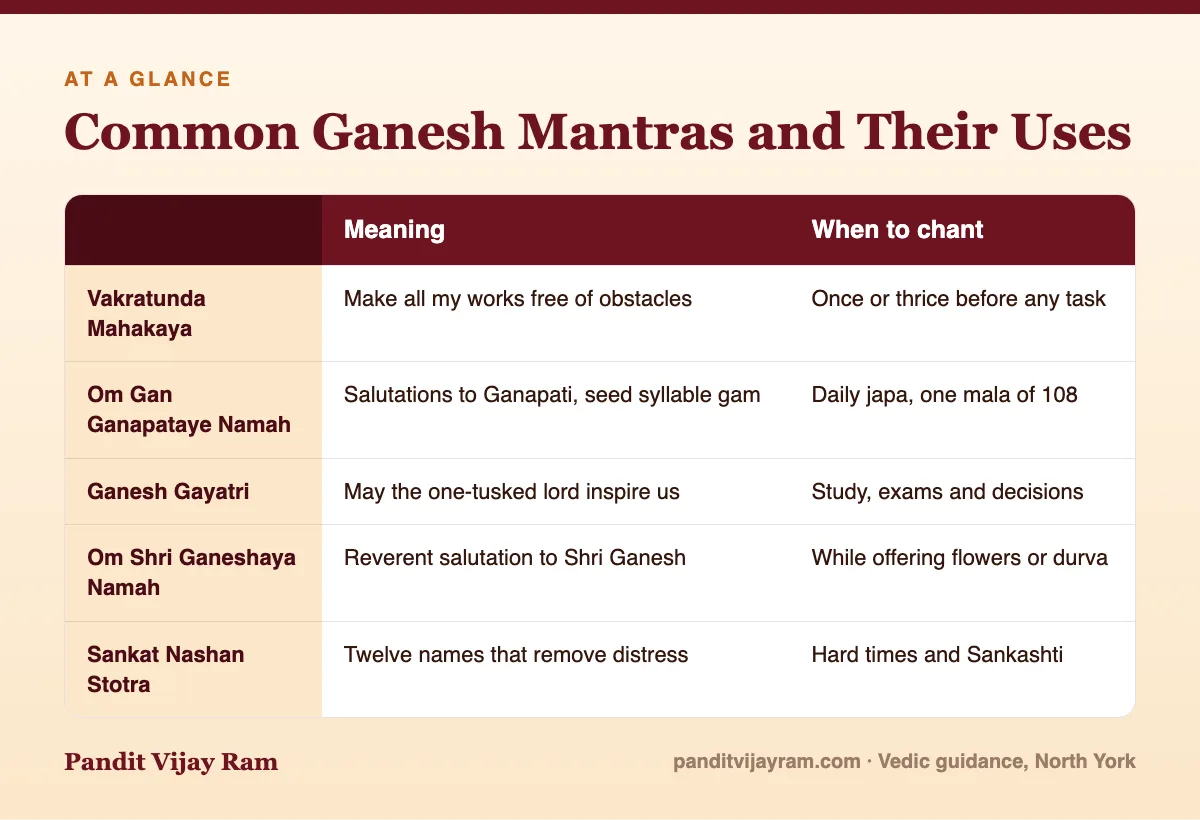
Match the mantra to the moment. Recite Vakratunda Mahakaya once before starting a task, chant Om Gan Ganapataye Namah on a mala for daily practice, use the Ganesh Gayatri for study and clarity, read the Sankat Nashan Ganesh Stotra in hard times, and say Om Shri Ganeshaya Namah while offering flowers.
Use this as a simple decision guide.
- Before beginning anything: Vakratunda Mahakaya, recited once or three times.
- Daily japa: Om Gan Ganapataye Namah, one mala of 108.
- Study, exams and decisions: the Ganesh Gayatri, eleven or 108 times.
- During a hard period: the Sankat Nashan Ganesh Stotra, which begins pranamya shirasa devam and is traditionally attributed to the Narada Purana. It recites twelve names of Ganesh, among them Vakratunda, Ekadanta, Lambodara, Vinayaka and Gajanana, and is often read on Sankashti.
- While offering flowers or durva: Om Shri Ganeshaya Namah, once per offering.
- A deeper recitation: the Ganapati Atharvashirsha, a Sanskrit text in the style of an Upanishad, often read on Chaturthi and at the start of major pujas.
Children do well with Om Shri Ganeshaya Namah and the Vakratunda verse. Adults who want a steady daily practice usually settle on Om Gan Ganapataye Namah.
Do not stack every mantra into one session out of worry that you will miss the right one. One mantra chanted with care is a complete practice. If you would like guidance on a mantra suited to your chart or situation, Vijay Ram ji's Ganesha puja service includes advice on personal practice.
How many times should you chant a Ganesh mantra, and does pronunciation matter?
Common counts are one, three, eleven, twenty-one or 108, with a mala of 108 beads used for longer japa. Pronunciation matters, but sincere effort matters more. Learn from a recording or a teacher, chant slowly, and improve over time. Be wary of online claims that a mantra will deliver wealth or results within days.
A few practical points help most beginners.
- Counts. Short verses are recited a few times; short name mantras suit malas. A mala of rudraksha, sandalwood or tulsi beads keeps count so your mind can rest on the sound. Our guide to rudraksha and tulsi malas explains how to care for one.
- Time. Early morning after bathing is traditional. Any calm, regular time is better than an ideal one you miss.
- Posture. Sit upright, on the floor or a chair, facing east or north if you can.
- Voice. Aloud, whispered or silent are all accepted. Many teachers regard silent repetition as the most inward form.
- Pronunciation. Listen to a trusted recording or ask a priest. Small errors made with devotion are forgiven in every tradition I know.
Be careful with social media posts promising that a particular Ganesh mantra will bring money in seven days or remove every problem. Mantras are practices that shape attention and devotion; they do not work like vending machines. Our article on why copied mantras online mislead explains the pattern, and our list of protective mantras covers other deities.
The bottom line
Every common Ganesh mantra carries a clear meaning worth knowing. Vakratunda Mahakaya asks that all your works be free of obstacles, Om Gan Ganapataye Namah salutes Ganapati through his seed syllable, and the Ganesh Gayatri asks for understanding. Choose the ganesh mantra that suits the moment, chant at a steady count, and improve pronunciation gradually. Ignore online promises of quick riches and let the practice steady your mind.
Key takeaways
- Vakratunda Mahakaya is a short prayer to remove obstacles before any task.
- Om Gan Ganapataye Namah uses Ganesh's seed syllable and suits daily mala japa.
- The Ganesh Gayatri asks the one-tusked lord to inspire our understanding.
- Match the mantra to the purpose rather than chanting everything at once.
- Sincere, steady practice matters more than perfect pronunciation or big counts.