
When Friends and Family Take Sides After a Breakup

A breakup rarely stays between two people. Within days, cousins are talking, aunties have theories, and the friend group you shared is quietly choosing who to invite. For many families, the reaction of family after breakup can hurt almost as much as the ending itself. In close diaspora communities across North York, Brampton and Scarborough, news travels through WhatsApp groups, temple gatherings and wedding season faster than you can tell your own story. This guide looks at why people take sides, how gossip works in tight-knit communities, and how to protect yourself without starting a war. You will find short scripts for nosy relatives, ways to handle mutual friends fairly, and guidance on parents who blame you or the other family. You will also learn when family involvement crosses a line into pressure or threats. In more than forty years of helping families through difficult seasons, I have noticed that the person who stays calm, says little and keeps their dignity is usually respected once the noise fades. That calm can be learned, one conversation at a time.
Why do friends and family take sides after a breakup?
People take sides because a breakup forces them to make sense of what happened, and blame is the quickest story. Loyalty, protectiveness, family honour and sometimes their own unresolved hurts push them toward a camp. Taking sides also feels safer than holding the uncomfortable truth that two decent people simply did not work.
It helps to understand what is driving each reaction, so you take it less personally.
- Protective parents blame the other person because it is too painful to see their child hurt without a villain.
- The other family may defend their child for the same reason, and say harsh things about you.
- Mutual friends often feel pressure to choose because hosting both of you is awkward.
- Community members talk because a story about someone else's life is interesting, and because it confirms their own beliefs about love, caste or marriage.
- Elders may worry about izzat, the family's reputation, especially if an engagement or rishta had been announced.
In South Asian, Caribbean and Latino families alike, a relationship is often seen as joining two families. So when it ends, both families feel it as their loss and their judgement on display. The fear of "log kya kahenge", what people will say, can make parents more anxious about the community than about their child's heart. The article on heartbreak in South Asian families explores that pressure.
None of this means their behaviour is fair. It means it is predictable, and predictable things can be prepared for.

How do I deal with relatives blaming me for the breakup?
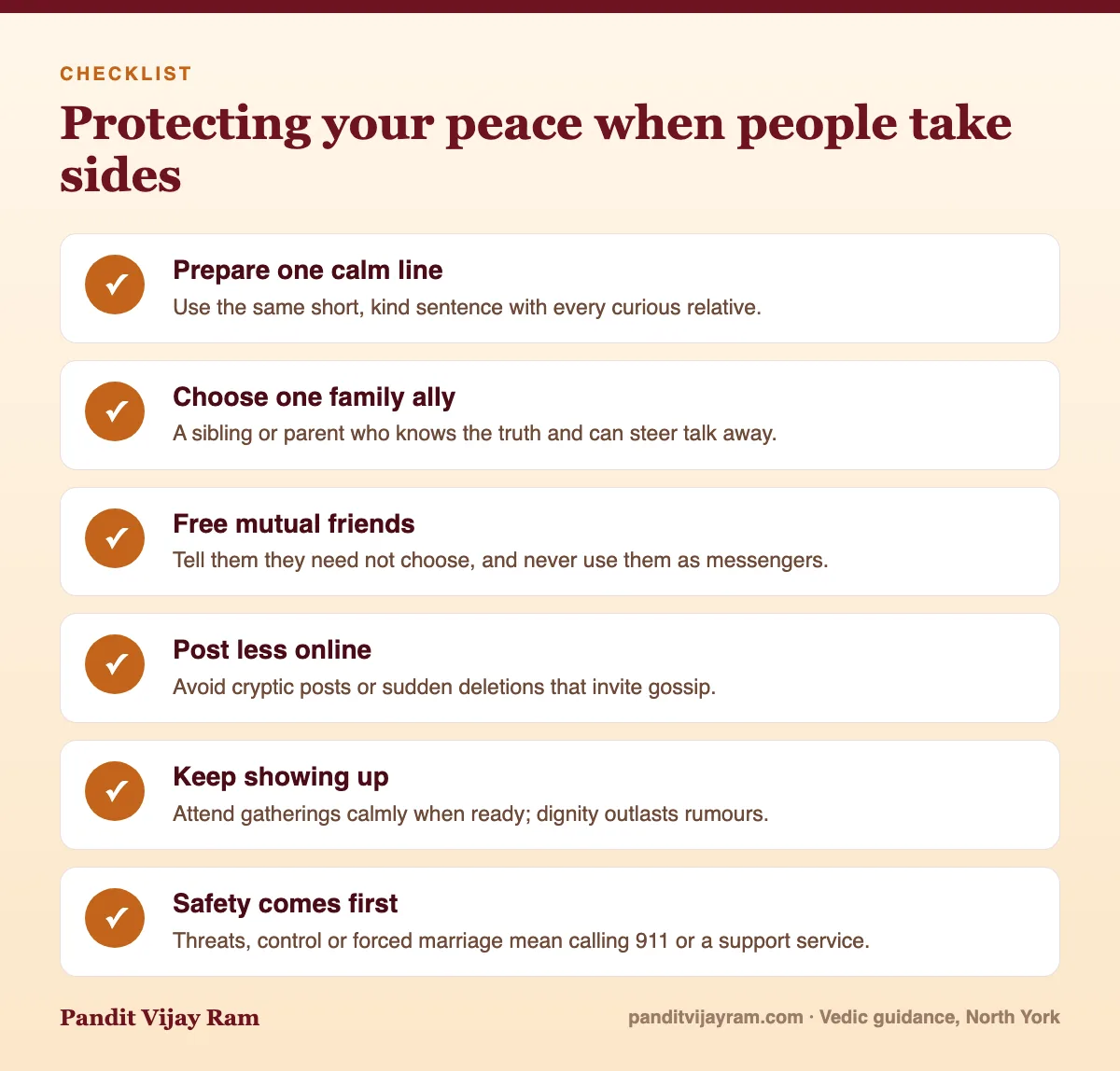
Stay calm, avoid defending every detail, and offer one short, dignified line: the relationship ended and you are focusing on healing. Ask a trusted parent or sibling to quietly correct false stories for you. If a relative keeps blaming, limit your time with them for a while. You owe nobody a full explanation.
Relatives often blame the person they can reach. They may say you were too independent, too modern, too picky or not respectful enough to the other family. These comments sting because they often echo your own doubts.
Try these short replies, which close the topic without rudeness:
- "It didn't work out, and we both deserve to move forward. Thank you for caring."
- "I'm not discussing the details, but I'm doing okay."
- "I know you mean well. I'd rather talk about something else today."
- "I'm not going to say anything bad about them, and I'd appreciate the same."
Say the line once, then change the subject. If they push, repeat it in the same calm tone. Arguing your case invites debate; a steady sentence ends it.
It helps to have one ally in the family, perhaps a sibling, cousin or parent, who knows the truth and can quietly say "Let's leave it" when the topic comes up at gatherings.
Where the blame turns into constant tension at home, or parents and adult children stop speaking, the family problem consultation can help by looking at the whole household calmly. Home practices such as those in daily prayers for family peace also give everyone a shared moment that is not about the breakup.
What should I do about mutual friends after a breakup?
Let mutual friends stay friends with both of you if they wish. Do not ask them to report on your ex, pass messages or choose. Tell them directly what you need, such as advance notice if your ex will be at an event. Accept that some friendships will drift, and invest in those that feel supportive.
Friend groups often wobble after a breakup. Here is a fair way to handle it:
- Release them from choosing. Tell close friends: "You don't need to pick a side. I won't put you in the middle."
- Do not use them as messengers. Asking friends to pass notes or relay feelings to your ex puts them in an unfair spot and can feel like pressure to the other person. The article on trying to reach an ex through family or friends explains why this usually backfires.
- Stop asking for updates. "Is she seeing someone?" keeps the wound open. Ask friends not to share news about your ex unless it is truly necessary.
- Plan for shared events. Ask hosts for a quiet heads-up if your ex is coming, so you can decide whether to attend.
- Watch who carries stories. If a friend keeps repeating what your ex said about you, that friend is feeding conflict. Gently step back.
Some friendships will fade, especially those that came through your ex. That is a real loss, and part of the wider grief explained in understanding relationship grief. Spend more time with your own long-standing friends, and be open to new people through work, classes or community service.
How do I handle gossip in my community after a breakup?
Accept that some gossip is beyond your control, and focus on what you can manage: what you share, who you share it with, and how you respond. Do not reply to rumours online. Keep social media quiet for a while. Stay visible and calm at gatherings, and most stories lose interest within weeks.
Community gossip feels intense because it reaches places you cannot follow: family WhatsApp groups, temple kitchens, wedding tables, even relatives in India, Guyana or Trinidad. A few practical steps make it more bearable.
- Share on a need-to-know basis. Tell close family the basic facts. Tell everyone else only that it has ended.
- Go quiet online. Avoid cryptic posts, sad quotes or sudden photo deletions that invite speculation. Simply post less for a while.
- Do not retaliate. Spreading your own version about your ex escalates the cycle and damages your reputation more than theirs.
- Keep showing up. Attending a puja, a festival or a family dinner with calm dignity sends a stronger message than any explanation.
- Remember the shelf life. Communities move on to the next story quickly, often within a festival season.
If the gossip is false and seriously damaging, such as claims that harm your job or safety, speak to the person directly or ask an elder to intervene. Persistent harassment or threats should be reported to police.
Many families also bring their worries to prayer. Offering a lamp and asking for patience and a clear conscience helps you stay steady when others are not. Envy and ill will from people around you are discussed in negative energy from someone's jealousy, with boundaries as the first remedy.
When does family involvement after a breakup become unsafe?
Family involvement becomes unsafe when it includes threats, forced contact, confiscating your phone or documents, pressure to marry someone quickly, or harm against you or your former partner. Concerns about family honour never justify control or violence. In immediate danger call 911, and use the GTA domestic violence help guide for confidential support.
Most family reactions after a breakup are painful but not dangerous. Some cross a line. Watch for these signs:
- Relatives threatening you or your former partner, or their family.
- Being locked in, followed, or having your phone, passport or money taken.
- Pressure to agree to a quick marriage to "fix" the family's reputation.
- Being told you will be disowned or harmed if you see certain people.
- Your ex's family turning up at your home or workplace uninvited and refusing to leave.
These are safety issues, not family disagreements. You have the right to make your own choices as an adult. Forced marriage is illegal in Canada. If you are in danger, call 911. For confidential support and safety planning, the GTA domestic violence help guide lists verified services.
If the situation is tense but not dangerous, a neutral family counsellor or mediator can help both sides talk. A trusted community elder sometimes plays that role well too, provided they listen to you rather than simply defend the family name.
Spiritual guidance can be part of calming a household, but never at the cost of your safety. A genuine practitioner will always put protection and the law first.
The bottom line
Family after breakup can bring blame, divided friends and community gossip, but you can protect your peace. Understanding why people take sides helps you respond calmly with short, dignified replies. Releasing mutual friends from choosing and staying quiet online lets stories fade. If involvement turns into threats or control, treat it as a safety matter and seek help.
Key takeaways
- People take sides to make sense of a loss; it is rarely about you alone.
- One calm sentence ends more conversations than a full defence.
- Never use mutual friends or relatives as messengers to your ex.
- Posting less online lets community gossip fade faster.
- Threats, forced contact or forced marriage are safety issues; call 911.