
Ex Back Through Friends and Family: When a Go-Between Helps

In many of our communities, couples have always had help. An aunt smooths things over, an elder brother speaks to the other family, a trusted friend sits both people down for tea. So when a relationship ends, it is natural to wonder whether you could win your ex back through family or friends. Some people who visit me in North York arrive with a relative already lined up to make the call. Before that happens, it is worth thinking carefully. This guide explains when a go-between genuinely helps a couple, when involving others turns into pressure, how to ask a mediator in a fair way, what a go-between must never do, and what role a pandit can play between two families. In more than forty years of standing between families at weddings, disputes and reconciliations, I have seen elders heal rifts that the couple could not, and I have seen well-meaning relatives make everything far worse. The difference almost always comes down to one thing: whether both partners wanted the help, or only one did.
Can family or friends help you get your ex back?
They can, but only in certain situations. A trusted go-between helps most when both partners still care, when misunderstandings or family tensions caused the split, and when each side needs a calm person to speak through. They cannot change a decision your ex has made freely, and trying to do so through others usually hardens it.
The tradition of a third party in relationships runs deep. In South Asian families, elders and matchmakers have long helped arrange and repair marriages. In Caribbean and Latino households, a godparent, respected aunt or family friend often plays a similar role. Within Muslim families, a wali or community elder may be asked to help. These roles exist because a calm outsider can sometimes hear what two hurt people cannot say to each other.
A go-between tends to help when:
- Both partners are open to talking but stuck in pride or misunderstanding.
- The breakup involved the families, for example a dispute over wedding plans, money or where to live.
- Communication broke down after harsh words, and both want a safer setting to speak.
- There are practical matters such as returning gifts, shared property or children that need a neutral helper.
A go-between rarely helps when your ex ended things because their feelings changed, when they have asked for no contact, or when they have moved on to someone new. In those cases, a relative calling on your behalf can feel like an ambush.
If the families themselves ended the relationship, the questions are different again. Our guide on getting back together after family disapproval looks at adult choice and how to approach parents. For the wider step-by-step process, see our pillar guide on how to get your ex back.

When does involving family in a breakup help, and when does it hurt?
Involving family helps when both partners consent, the mediator is respected by both sides, and the conversation stays private and calm. It hurts when one partner has refused, when relatives use guilt, shame or threats, when news spreads through the community, or when elders decide for the couple. Consent from both people is the dividing line.
Here is a simple comparison to test your plan against:
- Helpful: your ex agreed that a named aunt could speak with both of you. Harmful: your mother calls your ex's mother without asking either of you.
- Helpful: one private meeting with a calm elder. Harmful: repeated visits, calls and messages from different relatives.
- Helpful: the mediator shares feelings and listens. Harmful: the mediator carries ultimatums, threats or reminders of family honour.
- Helpful: the discussion stays between the people involved. Harmful: the story becomes gossip at the temple, gurdwara or community centre.
- Helpful: the couple decides. Harmful: the parents decide and expect the couple to comply.
Families taking sides after a breakup is common, and it can make reconciliation harder even when both partners want it. Our guide to when family takes sides after a breakup explains how to set boundaries kindly.
A quiet question to ask yourself: am I asking for help because we both want it, or because my ex said no and I hope someone else can change their mind? If it is the second, the kindest choice is to stop. Sending relatives to someone who has refused can feel to them like being surrounded, and in some cases it crosses into harassment.
How do you ask a mediator to help reconcile a couple?
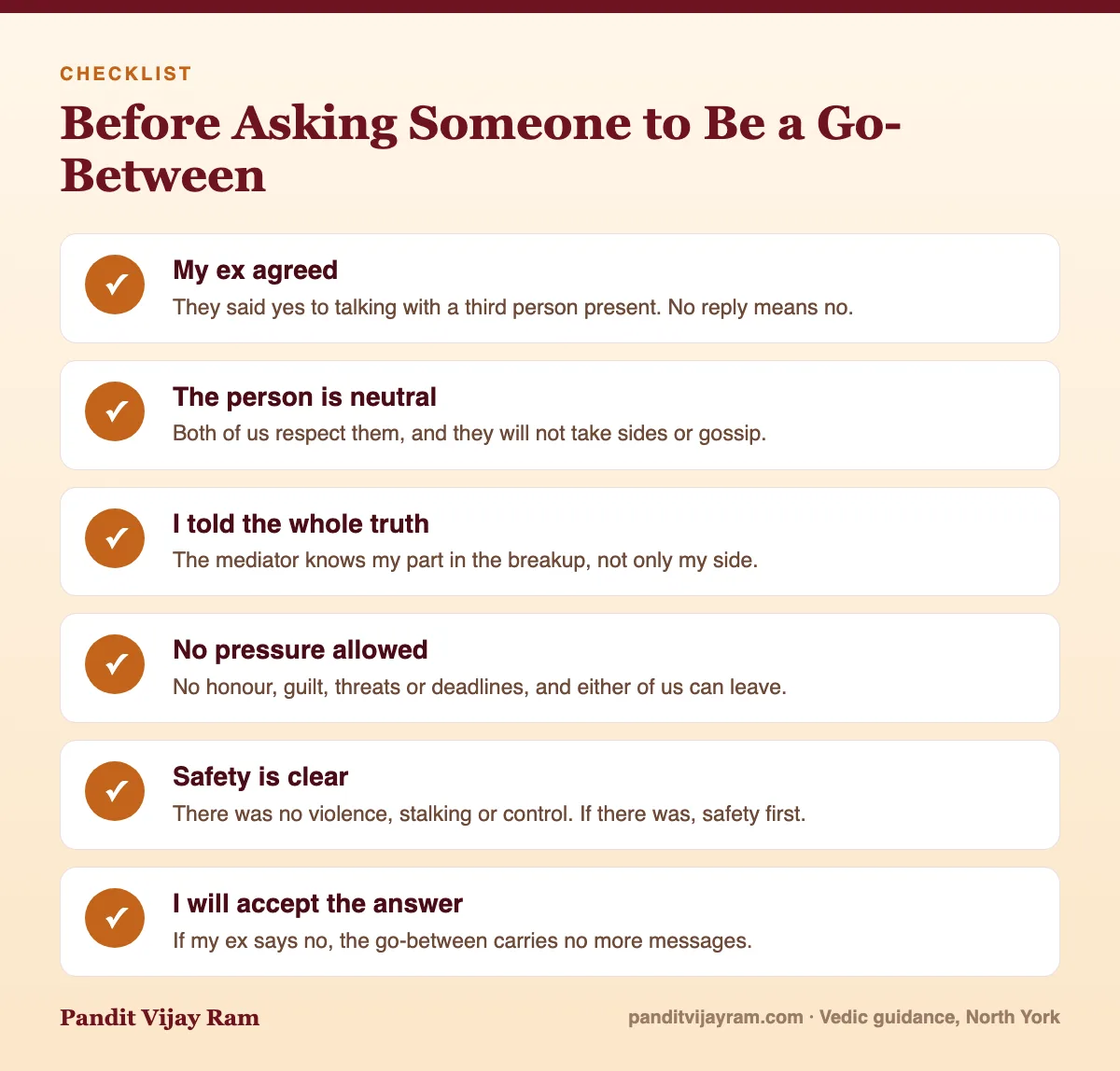
First make sure your ex is open to it, either by asking directly or by letting the mediator ask once. Choose someone neutral whom both of you trust, brief them on your own part honestly, agree simple ground rules, and hold one calm meeting. Accept the outcome, including a decision to stay apart.
A fair process protects everyone, including the go-between. Follow these steps in order:
- Check consent. Ask your ex, by one respectful message, whether they would be willing to talk with a trusted person present. If they decline or do not reply, stop here.
- Choose the right person. Someone both of you respect, who can keep confidences and will not take sides. A close friend of only one partner is rarely neutral.
- Be honest with them. Tell the mediator what you did wrong, not just what your ex did. A go-between misled by one side cannot help.
- Agree ground rules. No shouting, no bringing up family honour, no pressure for an answer on the day, and either person can leave.
- Hold one meeting. A neutral, private place. Keep it to an hour or so. Listen more than you speak.
- Respect the outcome. If your ex wants more time, give it. If they say no, ask the mediator to carry no further messages.
For married couples, especially where children, property or support are involved, a trained family mediator or a family therapist may be more suitable than a relative. Our guide to legal clinics and legal aid for family matters in the GTA explains where to start.
If your families are generally in conflict, our family problem consultation can help you look at the wider pattern before anyone approaches the other side.
What should a go-between never do in a couple's breakup?
A go-between should never pressure, threaten, shame or deceive either partner. They must not pass messages from someone who has been refused, invoke family honour, push someone into marriage, or hide abuse in the name of keeping the peace. If either person is afraid, the role becomes supporting safety, not reconciliation.
Kind intentions can still cause harm. A go-between steps outside a healthy role when they:
- Tell your ex they are ruining the family's name or that people are talking.
- Suggest consequences, such as being cut off, losing an inheritance or harming someone's reputation.
- Keep delivering messages after your ex has said they do not want them.
- Pressure a person into engagement, marriage or returning to a spouse.
- Minimise violence or control as an ordinary marital problem.
- Share private details with others to build support for one side.
Forced marriage is a criminal offence in Canada, and pressure through family that removes someone's free choice can be part of it. Everyone has the right to say no to a relationship, whatever their family wants.
If the relationship ended because of violence, threats or control, a go-between should not encourage reunion at all. The priority is helping the person who was harmed stay safe. Our guide to domestic violence help in the GTA lists shelters and helplines, and 911 is for immediate danger.
If you are the person being pressured through relatives to go back to an ex, you are allowed to ask them to stop, to speak to a counsellor, and to involve police if the pressure turns into threats or harassment.
What role can a pandit play between two families after a breakup?
A pandit can offer a calm, neutral space, insight from both partners' charts, and prayer for harmony that both people want. Traditionally a family priest helped households talk respectfully. He should not take sides, carry pressure, perform rituals to bend someone's will, or meet one family to work on a partner who has already refused.
In many families the pandit was once a natural mediator. He knew both households, performed their ceremonies and could speak frankly to elders. That role still has value when it is used with care.
When both partners and, where relevant, both families want help, I can:
- Meet the couple together, in person or by video, so each can speak while the other listens.
- Read both kundlis to describe tendencies in temperament and timing, framed as understanding rather than a verdict.
- Suggest shared prayer, such as a joint Ganesha puja for a fresh start, or a Shiva-Parvati prayer for patience in partnership.
- Help families find language that lowers tension, especially across generations raised in different countries.
Sometimes a chart becomes a bridge for parents who trust astrology, as our guide on convincing parents for a love marriage describes. Even then, the chart informs the decision; it does not make it.
What I decline: speaking to an ex who has refused contact, telling a family that the stars demand a reunion, or performing anything meant to control a person. A get ex love back consultation with me begins with understanding where both people stand and respecting the answer.
The bottom line
Getting an ex back through family or friends can work when both partners consent and the go-between is neutral, private and calm. It harms when one person has said no, when relatives use guilt, honour or threats, or when the story spreads. A fair process checks consent first, chooses a trusted mediator and accepts the answer. A pandit can help both families talk, but never by pressure or by rituals to change someone's choice.
Key takeaways
- A go-between helps only when both partners agree to the help.
- Messages carried after a refusal can become pressure or harassment.
- Choose a neutral mediator and be honest with them about your own part.
- Family honour, threats and forced decisions have no place in reconciliation.
- A pandit can offer neutral space and shared prayer, never control.