
Mars and Venus in Your Kundli: Passion, Conflict and Lost Love
When a relationship ends in sparks and slammed doors, people often ask me for a Venus Mars kundli love reading, hoping the chart will explain why the passion and the fights came together. It is a fair question, and the chart does have something to say. Many of the people who ask are clients in North York and across the GTA who have already read three websites that disagree. This guide sets out what Shukra and Mangal stand for, how a conjunction, an aspect or a sign exchange between them is read in Parashari astrology, why those contacts are linked with both attraction and arguments, and what they cannot tell you about a lost love. In more than forty years of Vedic practice I have seen strong Mars and Venus contacts in the charts of very happy couples and of people who struggle, so I treat them as a description of temperament, not a sentence. You will also find practical remedies aimed at your own steadiness, and a plain note on when a counsellor will help more than any planet.
What do Mars and Venus represent in a Vedic birth chart?
In Vedic astrology Venus, or Shukra, signifies love, beauty, pleasure, comfort and the marriage partner, and it is the classical karaka of the spouse. Mars, or Mangal, signifies energy, courage, desire, competition and anger. Read together, they describe how a person feels attraction and how quickly that feeling turns into action or friction.
Each planet has its own signs and dignities, and these shape how it behaves. Venus owns Taurus and Libra, is exalted in Pisces and debilitated in Virgo. Mars owns Aries and Scorpio, is exalted in Capricorn and debilitated in Cancer. A Venus in Pisces tends to love with devotion; a Venus in Virgo may love through service and critique.
In the natural friendship table used by Parashari astrologers, Mars and Venus are neutral towards each other. That matters. They are not enemies, so their meeting is not automatically harmful, but neither is it effortless. The result depends on the house they occupy, the signs involved and which houses they rule for your ascendant.
- Venus answers what you find beautiful, how you show affection and what comfort means to you.
- Mars answers how you pursue, how you defend yourself and how fast your temper rises.
- The 7th house and its lord answer how partnership itself unfolds, so they are always read alongside both planets.
A reader also checks the Moon, because emotional security colours everything Venus and Mars promise. If you are new to these terms, the guide to Venus and the 7th house covers the partnership house in more depth.
What does a Mars Venus conjunction mean in a kundli?
A Mars–Venus conjunction, both planets in the same sign, is usually read as strong romantic and physical energy, a quick spark of attraction and a creative or artistic drive. The same placement can bring impatience in love, jealousy or a pattern of intense beginnings that cool quickly. The sign and house decide which side shows more.
Vedic astrology counts a conjunction by sign, so two planets anywhere in the same sign are joined. Many readers give more weight when they are within a few degrees, or in the same nakshatra, because the blend is then closer and more noticeable in daily life.
Some practical patterns I look for:
- In Venus's own signs (Taurus, Libra): Venus is comfortable and tends to soften Mars, so warmth and charm usually lead.
- In Mars's own signs (Aries, Scorpio): Mars is stronger, so desire can be direct, possessive or competitive.
- In the 1st, 5th or 7th house: romance becomes a visible theme of the life, for better and for worse.
- In the 6th, 8th or 12th house: the energy can turn inward, secretive or tied to disputes, and it needs careful judgement.
The planets' lordships also count. For a Libra ascendant, Venus is the ascendant lord and Mars rules the 2nd and 7th, so a conjunction speaks loudly about marriage. For a Capricorn ascendant, Venus is a yogakaraka while Mars rules the 4th and 11th, which shifts the meaning towards home and gains.
Western astrology also treats Mars–Venus contacts as a classic marker of attraction, but it uses degree-based aspects and the tropical zodiac, so the same person may see different placements in each system.
How are Venus Mars aspects and sign exchanges read?
In Parashari astrology Mars casts full aspects on the 4th, 7th and 8th signs from itself, while Venus aspects only the 7th. So Mars can influence Venus from three positions, and the two aspect each other when they stand opposite. A sign exchange, called parivartana, links them more tightly than an aspect.
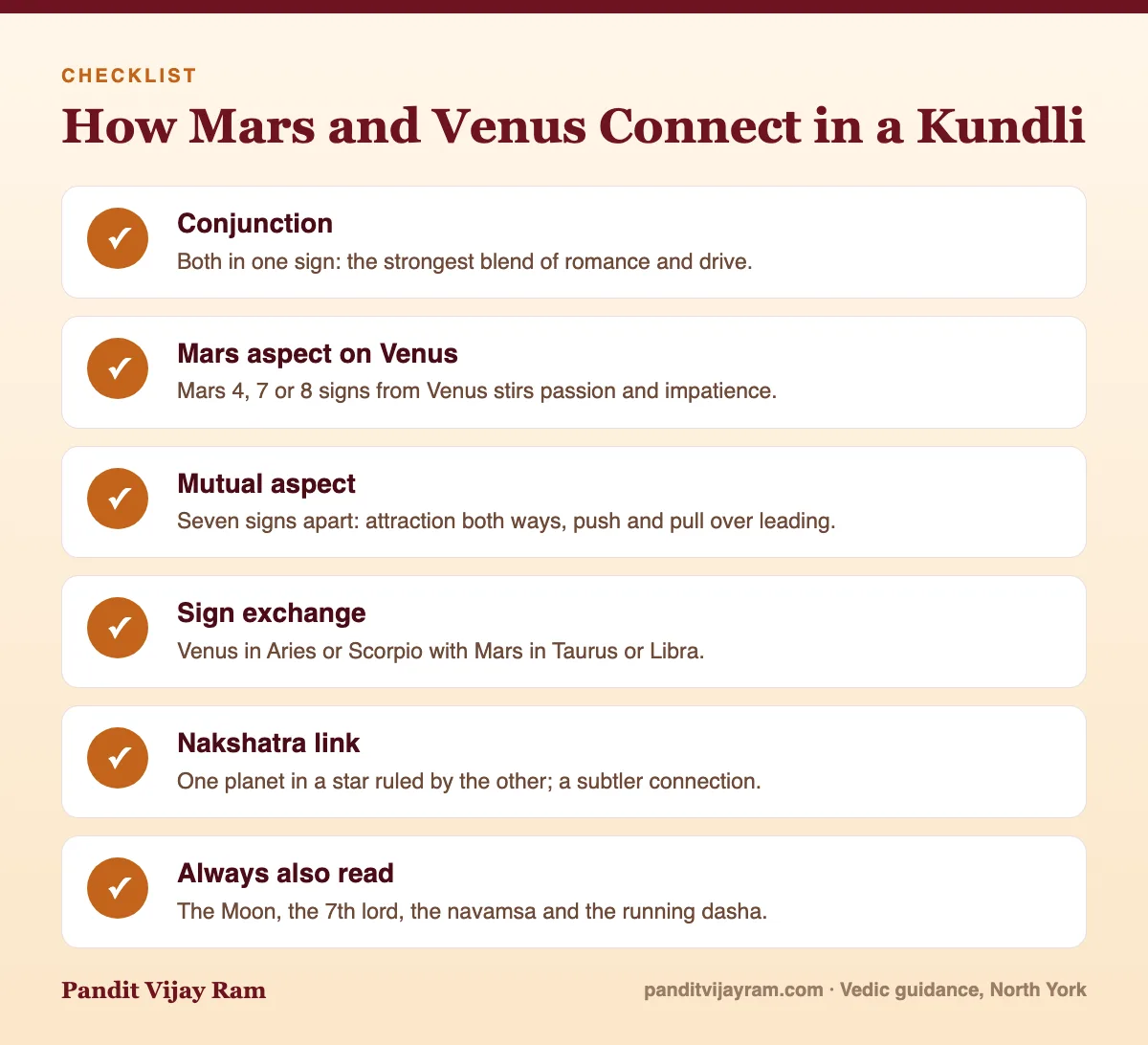
Here is the simple decision list I use when a client asks whether their Mars and Venus are talking to each other:
- Same sign: a conjunction, the strongest blend, read as above.
- Mars four, seven or eight signs from Venus: Mars aspects Venus. Passion is stirred, and so is irritation when the two people want different paces.
- Exactly opposite (seven signs apart): a mutual aspect. Attraction tends to run both ways, along with a push and pull over who leads.
- Sign exchange: Venus in Aries or Scorpio while Mars sits in Taurus or Libra. Each planet behaves partly like the other, so tenderness and assertion become hard to separate.
- Nakshatra links: Venus in a Mars-ruled star (Mrigashira, Chitra, Dhanishta) or Mars in a Venus-ruled star (Bharani, Purva Phalguni, Purva Ashadha). Subtler, but many readers note it.
- No contact: the two work separately, and love and drive may show up in different parts of life.
None of these is good or bad on its own. Benefic aspects from Jupiter, a strong ascendant lord and a stable Moon usually make even an intense contact workable. Schools differ on how much weight nakshatra links deserve, and some readers also check the navamsa, which our D9 chart explainer covers.
Can Mars and Venus explain fights or a lost love?
Mars and Venus can describe a temperament that loves intensely and argues quickly, but they do not explain a breakup on their own. Most endings involve two people's choices, stress, family pressure and timing. In a chart, the running dasha, the 7th lord and the Moon usually matter more than a single Mars–Venus contact.
After a painful breakup it is tempting to find one planet to blame. I understand that wish, but I gently refuse it. A conjunction of Mars and Venus is present for a whole lifetime, yet relationships begin and end at particular times. That timing comes from the dasha and from transits acting through it, which the guide to dasha periods and breakups explains.
What the pair can show is a pattern worth noticing. Someone with Mars strongly afflicting Venus may move fast, feel jealousy sharply or say hurtful things in the heat of a quarrel. Seeing that pattern gives you something to work on: slower beginnings, a pause before you reply, clearer words about what you need.
Mars in the 7th house is a separate topic with its own literature, tied to Manglik discussions. Read Mars in the 7th house and the article on Manglik and non-Manglik couples before assuming the worst.
Two honest limits. First, a chart describes you; it cannot describe what your former partner is feeling today. Second, if arguments ever involved threats, fear or being controlled, that is not a planetary matter. Please put your safety first and speak with someone you trust or the police.
What remedies help a difficult Mars Venus combination?
Remedies for a tense Mars–Venus combination aim at your own balance: Hanuman or Kartikeya worship and physical exercise to channel Mars, Friday Lakshmi or Durga prayer to steady Venus, calm speech in arguments, and charity. Gemstones such as red coral or diamond are considered only after a full chart reading, never on a guess.
I usually suggest two simple practices together, one for each planet. On Tuesdays, recite the Hanuman Chalisa or offer a lamp to Hanuman, and use some of Mars's heat in honest physical effort: a run, a swim, a game. On Fridays, light a ghee lamp before Lakshmi or Durga, wear something clean and light, and give white food such as rice or sweets to someone in need.
Alongside the ritual, I ask for one behavioural vow. Common choices are no messages sent in anger, a ten-minute pause before replying in a quarrel, or one kind act a day for the people you live with. These matter more than the number of mantras.
Gemstones are the step people want first and should take last. Red coral strengthens Mars and a diamond strengthens Venus, but strengthening the wrong planet for your ascendant can make an already heated pattern hotter. A full kundli reading checks lordships and dignity before any stone is discussed.
If you and a partner both want to understand how your temperaments meet, a relationship compatibility reading compares the two charts. It offers insight for both of you, not a way to change the other person's mind, and it works best alongside honest conversation or couples counselling.
The bottom line
A Venus Mars kundli love reading describes how attraction and assertion mix in your temperament, through conjunctions, aspects and sign exchanges. The house, sign, lordships and the Moon decide whether that mix tends towards warmth or friction. Timing comes from the dasha, so a single placement cannot explain why a relationship ended. The most useful remedies steady your own speech and energy, with gemstones considered last and only after a full reading.
Key takeaways
- Venus shows affection and what you value; Mars shows drive and temper.
- Mars aspects the 4th, 7th and 8th signs from itself; Venus aspects only the 7th.
- A Mars–Venus contact describes a temperament, not the fate of a relationship.
- Breakup timing is read through dashas and transits, not one natal placement.
- Remedies focus on your own calm, speech and effort before any gemstone.