
Compatibility Beyond the Kundli: Values, Money and Family Plans

Families often bring me two horoscopes and one question: do the gunas match? I am happy to read the charts, but I always add a second question of my own. Have the two of you talked about money, children and parents yet? The relationship compatibility questions in this guide are the ones I ask couples in North York before or after we look at the kundli. You will find a checklist covering values, finances, family plans, faith and daily habits, along with guidance on telling a true deal breaker from something you can work out together. In more than forty years of practice I have seen well-matched charts struggle because nobody discussed who would care for ageing parents, and modest scores thrive because the couple had already planned their life honestly. A kundli is one lens. These conversations are another, and they cost nothing but courage. Work through them slowly, perhaps over several evenings, and come back to the ones that feel uncomfortable. That discomfort is often exactly where the most useful talk is waiting.
What relationship compatibility questions should couples ask before marriage?
Start with five areas: core values, money, children, extended family and where you will live. Within each, ask what you expect, what you fear and what you could not accept. Write the answers down separately, then compare them together. Differences are normal; hidden differences are what cause trouble later.
Here is a starter list. You do not need perfect agreement, only honest answers.
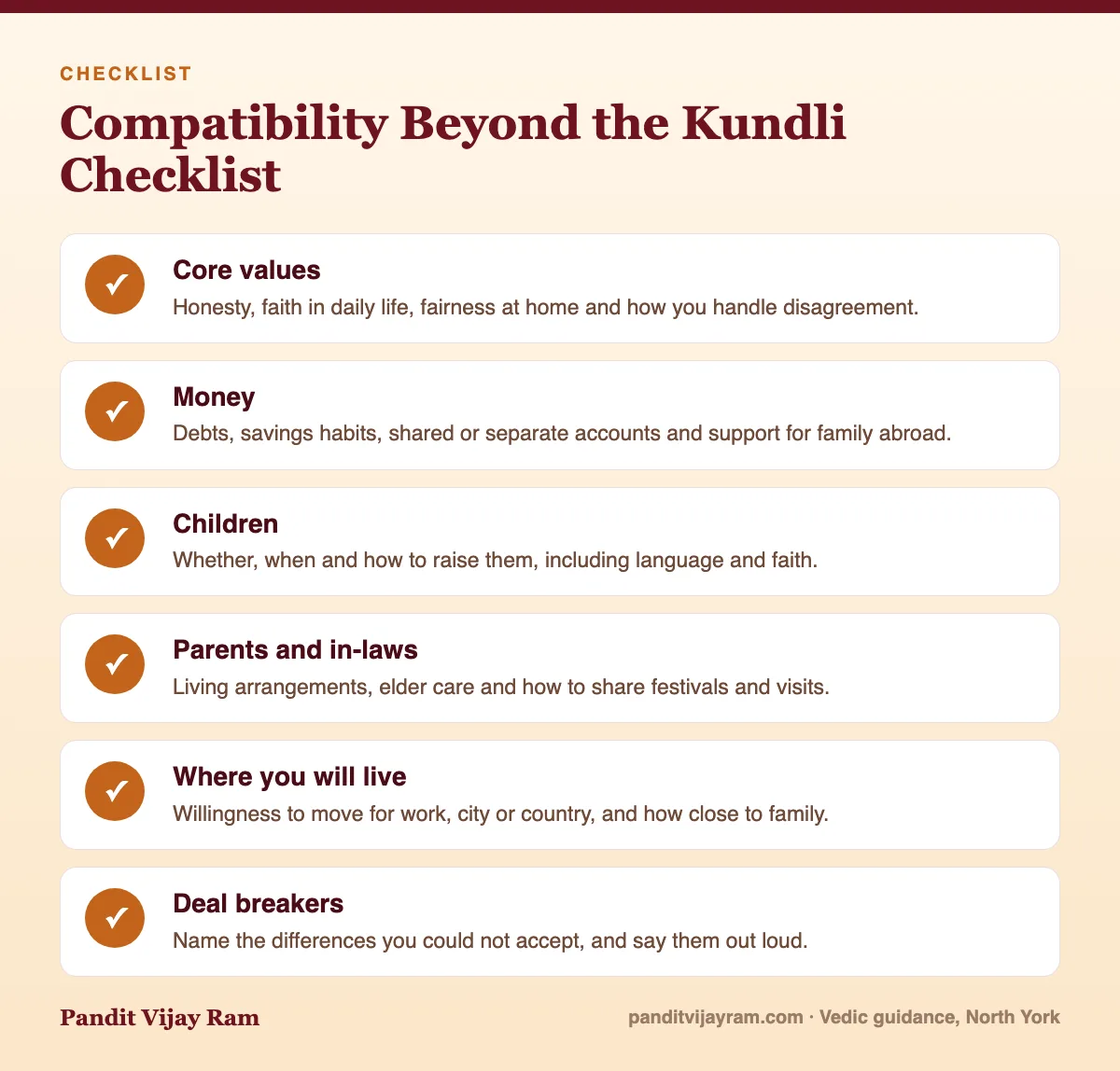
- Values: What does a good marriage look like to you? How important is faith in daily life? What does fairness at home mean?
- Money: Do you carry debt? Do you support family abroad? Will we share accounts?
- Children: Do you want children, and roughly when? How would we raise them in faith and language?
- Family: Will we live with parents? Who cares for elders when they need help?
- Place: Would either of us move cities or countries for work?
- Daily life: How do you rest, celebrate and handle stress?
Many couples find it easier to answer on paper first. Each person writes alone, then you swap. This avoids one partner simply agreeing to keep the peace.
If you are meeting through an arranged introduction, some of these questions can be raised gently at early meetings. Our guide to preparing for an arranged marriage first meeting suggests how to ask without sounding like an interview.

How do you know if your values are compatible?
Values compatibility shows in behaviour more than words. Notice how each of you treats waiters, siblings and people who disagree. Ask how you would handle a moral dilemma at work or a family quarrel. Shared core values, such as honesty, respect and fairness, matter more than shared hobbies or the same favourite food.
It helps to separate values from preferences. A value is something you would sacrifice for, like honesty or caring for your parents. A preference is something you enjoy, like a type of holiday. Couples can differ on preferences quite happily.
Questions that bring values to the surface:
- When you were angry with a family member, what did you do?
- Have you ever kept a secret from a partner, and why?
- How do you think chores and earning should be divided?
- How strictly do you keep fasts, food rules or prayer times?
- What would you do if our parents disagreed with a decision we both made?
In bicultural and second-generation couples, values can overlap while habits differ. One partner may see joint family living as love; the other may see it as a loss of privacy. Both are holding a real value. Our post on cultural differences in a relationship explores this in depth.
Watch for one thing in particular. If a partner mocks your values, or insists theirs must always win, that is a respect problem. It is worth naming early.
What money questions should couples discuss before marriage?
Discuss income, debts, savings habits, credit, family obligations and how you will share expenses. In many South Asian families the big question is support for parents or siblings abroad. Agree on how decisions are made, what each person can spend freely, and how you will talk when money is tight.
Money is one of the most common sources of conflict I hear about, and it is rarely about the numbers. It is about trust and fairness.
- Disclose debts. Student loans, credit cards and family loans should be on the table before the wedding.
- Talk about remittances. If one of you sends money home, discuss how much, how often and whether it is a gift or a duty.
- Choose a system. Joint, separate or a mix of both. Any system works if both agree to it.
- Set a check-in. A monthly money talk keeps small worries from growing.
- Plan for wedding costs. Decide who pays for what before families make promises.
When one partner controls all the money, hides income or blocks the other from working, that is not a compatibility issue. It can be a form of abuse. Our guide on money fights in couples covers everyday disagreements and points to help for the harder situations.
For budgeting itself, a non-profit credit counsellor or a fee-only financial planner can give neutral advice. An astrologer should never tell you how to invest.
How should couples talk about children and family plans?
Talk early about whether you want children, roughly how many, and how you would raise them. Discuss living arrangements with parents, who would provide childcare and how elder care would be shared. Be honest about health concerns that might affect plans, and agree that either of you can raise these topics again.
Family plans often feel too personal for early conversations, yet they shape almost everything else.
Children
- Do you both want children? Is the answer yes, no or not sure?
- If you face fertility challenges, would you consider medical help or adoption?
- Which languages, festivals and faith traditions would you pass on?
Parents and in-laws
- Will either set of parents live with you, now or later?
- How involved will grandparents be in raising children?
- How will you share festivals and visits between two families?
These questions matter most for couples who will step into a joint household. Our guide to adjusting to a new family after marriage describes what that first year can feel like.
If either of you has a health condition that could affect pregnancy, work or caregiving, it is kinder to mention it now than after the wedding. Plans change, and that is fine. The point is not to sign a contract. It is to learn how your partner thinks, and whether you can revisit a plan together without blame when life shifts.
What are deal breakers, and where does the kundli fit in?
A deal breaker is a difference you cannot live with even after honest discussion, such as opposite views on having children or a partner who refuses to stop drinking. The kundli can highlight tendencies worth discussing, but it should not override what the two of you have seen and said to each other.
A simple way to sort your answers is to place each difference in one of three groups:
- Easy to share: different hobbies, food tastes, sleep times.
- Needs negotiation: where to live, how often to visit family, how to divide chores.
- Deal breakers: opposite wishes about children, dishonesty about finances or past marriages, addiction without willingness to seek help, any threat or violence.
Many couples find a premarital counsellor useful for the middle group. Our post on premarital counselling explains what sessions cover and how to find a registered professional.
The kundli adds a different kind of insight. A careful reading can show where temperaments may rub, which periods may be demanding, and which strengths you can lean on. Vijay Ram ji's relationship compatibility readings are offered in that spirit: tendencies to understand, never a verdict. If you are curious about the pop-astrology version, our guide to zodiac compatibility myths explains why Sun-sign pairings are not worth worrying about.
The bottom line
Relationship compatibility questions about values, money and family plans reveal things no chart can, so ask them early and answer honestly. Sorting differences into easy, negotiable and deal-breaker groups keeps the talk calm and practical. A kundli reading can sit alongside this work as a lens on tendencies, while the daily choices remain yours to make together.
Key takeaways
- Ask about values, money, children, family and location before marriage.
- Write answers separately first, then compare them together.
- Remittances and joint finances deserve a frank talk early on.
- Sort differences into easy, negotiable and deal-breaker groups.
- Use the kundli as one lens, never as a substitute for honest conversation.