
Uneasy After Using a Ouija Board: What to Do Now

It started as a laugh at a sleepover or a dare after a horror film. Then the planchette moved, a name was spelled out, and now you cannot shake the feeling that something followed you home. If you feel uneasy after a Ouija board session, you are far from the first. Parents and young adults in North York, Vaughan and Mississauga have asked me the same question for years, often quietly and a little ashamed. There is nothing to be ashamed of. This guide explains what actually moves the planchette, why fear can linger for days after a session, which reactions are normal and which suggest you need extra support, and a gentle step-by-step routine to close the experience with prayer. It is written to calm you down, not to scare you further. In more than forty years of practice I have found that the people who recover fastest are those who stop replaying the session in their minds and return quickly to ordinary routines, prayer and sleep.
What actually moves the planchette on a Ouija board?
Researchers explain the movement through the ideomotor effect: small muscle movements we make without realising, guided by expectation. When several people rest their fingers on a light planchette, these tiny pushes add up and steer it towards letters. Each player honestly feels they are not moving it, which is why the experience seems so convincing.
The talking board was sold as a parlour game, and its pointer, the planchette, glides very easily on a smooth surface. That is part of why it feels uncanny.
The ideomotor effect has been studied for a long time. It is the same reason a pendulum held over a map seems to swing on its own, or a dowsing rod dips. Expectation, hope and fear all nudge the muscles slightly.
Why the messages feel personal
- Shared knowledge. Players know each other's crushes, worries and family names, so answers draw on what the group already knows.
- Group momentum. Once a word starts, everyone unconsciously helps finish it.
- Selective memory. The one striking message is remembered; the nonsense letters are forgotten.
- Atmosphere. Darkness, candles and spooky music prime everyone to expect something frightening.
Knowing this does not make your reaction foolish. The mind responds to a frightening story as if it were a real threat. Recognising how the board works simply gives you firmer ground to stand on while you calm down.
Many faith traditions, including Hindu, Muslim and Christian ones, discourage calling on spirits for entertainment. That advice is less about the board having power and more about not inviting fear into the home.

Why do I feel scared or watched after playing Ouija?
After a session, the mind stays primed for danger. Ordinary creaks, shadows and dreams suddenly seem connected to the board, and every coincidence feels like proof. This is suggestion working in reverse. The fear is real, but it usually eases within days when you stop checking for signs and return to normal sleep and routines.
Psychologists call this kind of loop confirmation bias: once we expect something, we notice everything that seems to fit and ignore everything that does not.
Common reactions in the days after
- trouble falling asleep or frightening dreams;
- jumping at small noises in the house;
- feeling a presence in the room where you played;
- replaying the messages and searching online for their meaning;
- a knot of guilt, especially if family or faith frowns on the board.
These are normal stress responses, and they tend to fade. What keeps them going is feeding them: watching more horror videos, holding another session to ask the spirit to leave, or reading endless online stories of people who say they were harmed.
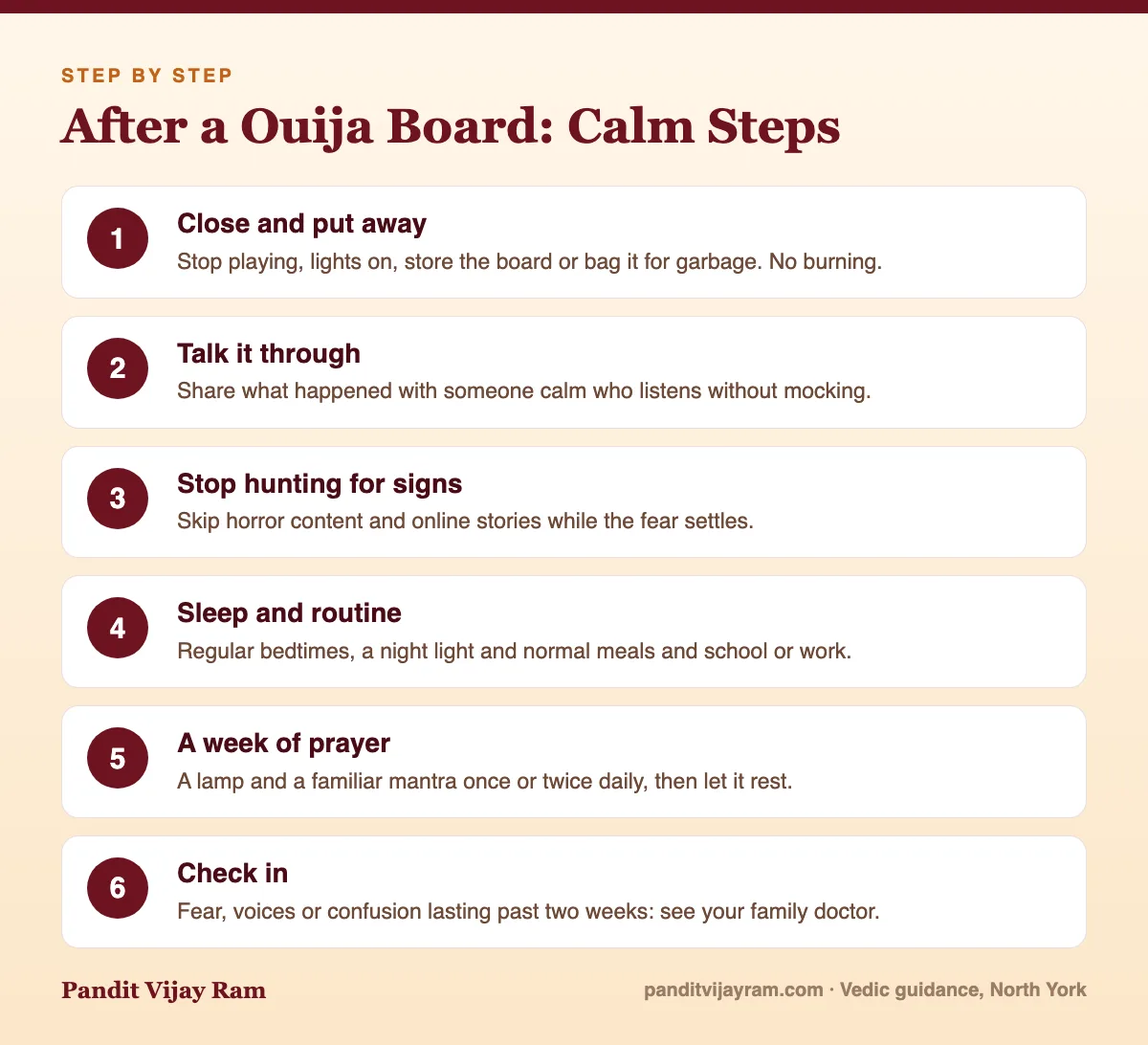
Talk to someone you trust. A parent, sibling, friend or faith leader who listens without mocking can lower the fear quickly. If you are a parent, keep your tone calm. Shouting or warning a teenager about demons usually makes the fear worse and the secrecy deeper.
For a broader self-check on lingering unease, see entity attachment or anxiety. If the main symptom is sensing someone nearby, feeling a presence in the house covers the practical checks.
Should I throw away or burn a Ouija board?
You may simply put it away or place it in household garbage or recycling. There is no need to break it into pieces, bury it or burn it. Burning painted boards indoors or on a balcony releases fumes and is a fire risk. If it belongs to someone else, return it without drama.
Online stories suggest elaborate disposal rituals: salt circles, holy water, burying in a churchyard, breaking the board into seven pieces. None of these is necessary, and some are unsafe.
Sensible options
- Store it away in a cupboard or garage if you are not ready to decide. Out of sight is often enough.
- Bin it. Wrap it in a bag and put it in your regular garbage. Cardboard boxes can go in recycling according to your city's rules.
- Return it to the friend who owns it, without warnings or accusations.
- Sprinkle a little salt water or Ganga jal on the bag before disposal and say a short prayer if that gives you peace.
Avoid
- burning the board in a fireplace, balcony, backyard pit or condo;
- dropping it into a lake or river;
- leaving it outside someone else's door.
Disposing of the board is about closing a chapter, not defeating an enemy. Once it is gone, avoid checking whether it has come back or reading meaning into small coincidences. The routine in the first seven days after a cleansing is a good model for the week that follows.
Can a Ouija board cause real harm or attach a spirit to you?
Evidence does not show that the board itself harms anyone. Belief traditions vary: some hold that inviting spirits can attract unwanted influence, and I take that concern seriously. In practice, the harm I see comes from fear, lost sleep and anxiety. Those respond well to calm routines, prayer and, where needed, a doctor's support.
I want to be honest in both directions. I will not tell anyone that their tradition's warnings are nonsense, and I will not tell anyone that a board game has placed a spirit on them.
What I watch for instead
- Sleep. Is the person sleeping six to nine hours, or lying awake listening?
- Daily life. Are school, work and meals carrying on, or has fear taken over?
- Mood. Is there ongoing panic, low mood or withdrawal from friends?
- Thinking. Is there hearing voices, feeling controlled or strong beliefs others do not share?
If the first two are improving within a week or two, the experience is fading as expected. If panic, low mood or poor sleep continue for more than a couple of weeks, see your family doctor. If someone hears voices, seems confused, talks about harming themselves or behaves very differently, treat it as a health concern first. Call or text 988 for the Suicide Crisis Helpline, or 911 in an emergency. The careful approach in possession or mental illness explains why.
Spiritual protection can sit alongside all of this. Prayer gives the mind a steady place to rest and reminds a frightened person that they are not alone.
What protective prayer should I say after using a Ouija board?
Use a prayer from your own faith that you already find comforting. Hindu families often choose the Hanuman Chalisa, the Gayatri mantra or Om Namah Shivaya, with a lamp lit at the prayer place. Recite it calmly once or twice a day for a week, and then let the matter rest.
A short, steady practice works far better than an intense one. The aim is to replace the frightening memory with a peaceful daily habit.
A gentle Hindu routine
- Bathe or wash your hands, feet and face.
- Light a ghee diya or a battery lamp at the prayer place in the morning or at dusk.
- Recite the Hanuman Chalisa once, or Om Namah Shivaya on a mala of 108 beads, slowly and without rushing.
- Offer a flower or a little prasad and sit quietly for a minute.
- Sprinkle a few drops of Ganga jal in the room where the board was used.
Families who prefer a longer recitation can follow the guide on Hanuman Chalisa and Sundarkand for home protection. Muslim, Sikh and Christian readers can use the prayers their own community recommends; the principle of calm regularity is the same.
If unease persists after a few weeks of good sleep, prayer and medical review where needed, a consultation can look at the wider picture. The spirit and ghost removal page describes how that begins, and other guides are listed in the magic and entities hub.
The bottom line
A Ouija board session can leave real fear behind, even though the planchette's movement is explained by the ideomotor effect and the messages by shared expectation. Put the board away or in the bin without burning it, stop searching for signs, and return to normal sleep and routines. Watch sleep, mood and thinking, and involve a doctor if fear persists or unusual symptoms appear. A calm week of familiar prayer then helps close the experience peacefully.
Key takeaways
- The planchette moves through tiny unconscious muscle movements called the ideomotor effect.
- Lingering fear after a session is a normal stress response that usually fades.
- Store or bin the board; never burn it indoors or on a balcony.
- Persistent panic, voices or confusion are health concerns first.
- A week of calm, familiar prayer helps close the chapter.