
Entity Attachment or Anxiety? A Gentle Self-Check

It can start with a tight chest on the subway, a feeling of being watched at home, or a heaviness that follows you from room to room. You search late at night, read about spirit attachment, and suddenly every symptom seems to fit. If you have been wondering about entity attachment vs anxiety, you are not foolish, and you are certainly not alone. People from North York, Willowdale and Vaughan come to me with exactly this worry, often after weeks of poor sleep and quiet fear. In this guide you will find a gentle self-check that helps sort what you are feeling, a plain description of how anxiety shows up in the body and mind, the first steps that ease it, how Vedic tradition understands spiritual heaviness, and when it makes sense to speak to a practitioner. In more than forty years of practice I have learned that easing anxiety first never closes the door to spiritual help. It simply makes the next step clearer, and it protects you from people who might take advantage of fear.
What does entity attachment mean?
Entity attachment is a belief, found in several spiritual traditions, that a spirit or unseen presence can cling to a person and affect their mood, energy or behaviour. In Hindu terms people may speak of a bhoot, preta or upadrava. It is a matter of faith, not a medical diagnosis, and it shares many symptoms with ordinary stress.
The phrase entity attachment is mostly used in modern energy-healing circles. Older traditions use their own words. In Hindu households, people might say a bhoot or pret has caught someone, or speak of upadrava, a troubling disturbance. Muslim families may speak of jinn. Caribbean and Latino families have their own vocabulary.
What people describe is often similar across traditions:
- feeling watched, followed or not alone;
- sudden heaviness, tiredness or a weight on the chest or shoulders;
- mood changes that seem to come from outside;
- disturbing dreams or waking at the same hour;
- reluctance to pray, or feeling worse near sacred things.
Here is the honest difficulty: almost every one of these is also a recognised feature of anxiety, stress, grief or poor sleep. That does not mean spiritual experiences are imaginary. It means the safest path is to look after your health first, so that whatever remains can be seen clearly. A short glossary of traditional terms is in the guide to bhoot, pret and pishach.

Can anxiety make you feel like something is attached to you?
Yes. Anxiety keeps the nervous system on alert, so the body produces real sensations: pressure on the chest, a racing heart, tingling, a cold or hot rush, and a strong feeling that something is wrong or watching. Some people also feel detached from themselves or their surroundings. These feelings are frightening but common and treatable.
When the mind senses danger, it prepares the body to respond. That system is very useful when there is a real threat. When it stays switched on for weeks, from money worries, family conflict, overwork or loneliness, the body keeps producing danger signals with nothing to point at. The brain then searches for a reason, and a spiritual explanation can feel like the only one that fits.
Common features of anxiety that people describe as an attachment:
- Hypervigilance. Noticing every sound and shadow, feeling eyes on your back.
- Physical weight. Muscle tension in the shoulders and chest that feels like something pressing down.
- Depersonalisation. A sense of watching yourself from outside, or of the world looking unreal.
- Panic attacks. Sudden waves of fear with pounding heart, breathlessness and a feeling of doom, often at night.
- Intrusive thoughts. Unwanted, upsetting thoughts that feel foreign, which can be part of anxiety or obsessive-compulsive patterns.
Anxiety and low mood often travel together. If you also feel hopeless, empty or unable to enjoy anything, the guide on negative energy or depression may help, and please see your family doctor.
How can I tell if it is anxiety or an entity attachment?
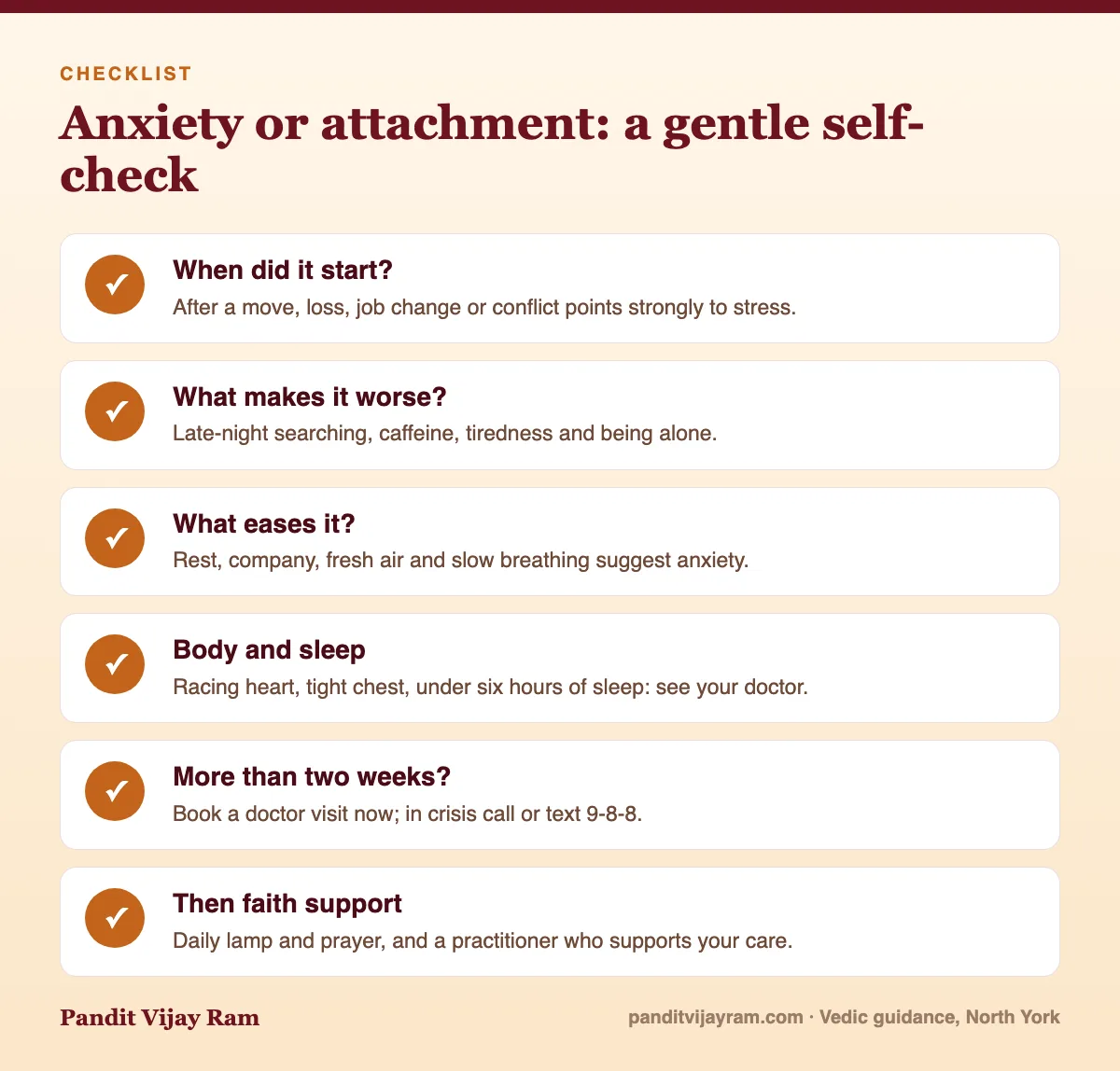
Use a simple self-check. Notice when the feeling started, what makes it worse, what eases it, and how your body, sleep and routine have changed. If it rises with stress, late-night searching, caffeine or poor sleep, and eases with rest, company or breathing, anxiety is very likely playing a large part.
This self-check is not a diagnosis, and it cannot rule a spiritual cause in or out. It helps you see patterns, which is useful whichever way you understand them. Answer honestly, perhaps writing your answers down.
- Timing. Did it begin during or after a stressful event, such as a job change, move, loss, illness or relationship trouble?
- Triggers. Does it get worse after reading about spirits online, after coffee or energy drinks, or when you are alone and tired?
- Relief. Does it ease when you are with people you trust, outdoors, busy, or after a good night's sleep?
- Body signs. Do you have a racing heart, shallow breathing, stomach upset, tight muscles or headaches?
- Sleep. Are you sleeping fewer than six hours, waking repeatedly, or using your phone late at night?
- Spread. Is it only you, or do several people in the home notice the same thing at the same time?
- Duration. Has it lasted more than two weeks and begun to affect work, study or relationships?
A plain rule: if most answers to 1 to 5 are yes, start with anxiety care and give it a few weeks. If question 7 is yes, book a doctor's appointment now. If you ever have thoughts of ending your life, call or text 9-8-8 in Canada, or 911 if you are in immediate danger.
What helps anxiety first?
Start with your family doctor, who can check physical causes such as thyroid problems, medication effects or heart rhythm, and discuss counselling or treatment. Meanwhile, protect sleep, cut caffeine, stop late-night searching about spirits, move your body daily and practise slow breathing. Talking to someone you trust lightens the load considerably.
Anxiety responds well to care, and the first steps are within reach for most people.
- See your family doctor. Some physical conditions, including an overactive thyroid, low blood sugar and certain medications, can mimic anxiety. Your doctor can also refer you for counselling, such as cognitive behavioural therapy.
- Guard your sleep. Keep a regular bedtime, put the phone outside the bedroom and avoid heavy meals late.
- Reduce stimulants. Coffee, strong tea, energy drinks and nicotine all raise the body's alarm level.
- Stop the late-night research. Reading lists of spirit attachment signs at midnight almost always makes the feeling worse.
- Breathe slowly. Breathe in for a count of four and out for a count of six, for five minutes. Gentle practices such as pranayama for energetic cleansing combine breath and calm.
- Stay connected. Tell one person what you are experiencing. Isolation feeds fear.
These steps are not a rejection of faith. Many devotees find that once their nervous system settles, their prayer becomes steadier and more joyful too.
How does Vedic tradition understand spiritual heaviness?
Vedic tradition considers several possible sources of heaviness: difficult planetary periods in the horoscope, the evil eye or nazar, ancestral imbalance, disturbed surroundings, and occasionally the influence of unsettled spirits. It treats the mind and body as part of the picture, and its remedies are prayer, mantra, cleansing and steady, sattvic routine.
A careful Vedic reading does not leap to the most dramatic explanation. When someone tells me they feel something is attached, I think through several possibilities in order.
- Mind and body. Ayurveda and the yoga tradition both describe how agitation, poor sleep and heavy food disturb the mind. These are addressed first.
- Planetary periods. A dasha or transit involving Rahu, Ketu or Saturn is traditionally linked with fear, confusion and heaviness. A kundli reading can show this.
- Nazar. Envy or excessive praise is believed to leave a person drained.
- Surroundings. A cluttered or neglected home, or recent upheaval, can feel heavy.
- Unsettled spirits. Considered only after the others, and still answered with prayer rather than fear.
The remedies are gentle: a daily lamp, the Hanuman Chalisa or Durga's names, a cleansing bath, a protective thread, and simple, regular meals. An aura cleansing session is one way some people combine prayer with a sense of renewal. The magic and entities hub collects related guides, including on feeling a presence in the house.
When should I see a spiritual practitioner?
Consider a practitioner once you have seen your doctor, started looking after sleep and stress, and still feel a heaviness you would like to address through your faith. A trustworthy practitioner will ask about your health, will never tell you to stop treatment, and will suggest steps in proportion to what you describe.
Spiritual guidance can be a real comfort, especially when someone's faith is central to how they cope. It works best as a partner to health care, not a rival.
Signs you have found a responsible practitioner:
- they ask about your sleep, health, stress and what you have already tried;
- they are comfortable with you seeing a doctor or counsellor, and encourage it;
- they explain what they suggest and why, in plain language;
- they do not name a terrifying entity on the first call or demand urgent payment.
Red flags to walk away from: pressure to keep everything secret from family, instructions to stop medication, escalating fees for each new discovery, and warnings that something terrible will happen if you do not act today.
When people come to me with this question, I usually suggest a few weeks of anxiety care alongside a simple daily prayer, then a review. The negative energy removal service describes how a consultation is approached. If behaviour changes are severe, the guide to possession or mental illness explains why urgent medical care comes first.
The bottom line
The question of entity attachment vs anxiety is best answered gently and in order. Anxiety produces vivid physical and emotional sensations that can feel like something clinging to you, and it responds well to a doctor's care, better sleep and calmer habits. Once that care is under way, Vedic prayer and a responsible practitioner can support you, without fear, secrecy or pressure.
Key takeaways
- Anxiety can produce a strong sense of being watched, heavy or not yourself.
- Use the self-check to notice timing, triggers, relief, sleep and duration.
- See your family doctor first; some physical conditions mimic anxiety.
- Vedic tradition considers mind, planets, nazar and surroundings before spirits.
- A good practitioner supports medical care and never sells fear.