
Home Protection With Hanuman Chalisa and Sundarkand Path

For many Hindu families, the Hanuman Chalisa for home protection is the first prayer they reach for when the house feels unsettled. Grandparents recite it at dusk, children learn it by heart, and on hard nights a whole family may say it together. People in North York and across the GTA often ask me how to do this properly. How many times? Which days? Can a Sundarkand path be held in a townhouse or condo? What if nobody can read Awadhi well? In more than forty years of guiding families, I have found that this practice is gentle, inexpensive and deeply steadying, and that the rules people worry about are usually less strict than they fear. This guide explains what the tradition says about Hanuman and the home, how to recite the Chalisa day to day, what the Sundarkand is, a clear plan for organising a family path, how these compare with the Bajrang Baan, and when prayer needs practical help beside it.
Does reciting the Hanuman Chalisa protect your home?
In Hindu devotion, Hanuman is Sankat Mochan, the remover of troubles, and the Chalisa itself says that spirits do not come near where his name is spoken. Families recite it as a prayer for protection and courage. It is an act of faith that steadies a household, not a substitute for locks, alarms or police.
The Hanuman Chalisa was composed by the poet-saint Tulsidas in Awadhi. Its forty verses, framed by opening and closing couplets, praise Hanuman's strength, devotion to Rama and readiness to help. One line families often quote for the home is bhoot pisach nikat nahin aavai, Mahabir jab naam sunavai: ghosts and spirits do not come close when the name of the great hero is heard.
In practice, this is how households tend to experience it:
- A shared rhythm. Reciting together at dusk gives the family a fixed calm moment each week.
- Courage for fears. Children afraid of the dark and adults anxious after bad news often feel steadier after the recitation.
- A protective intention. In the tradition, the sound of the name fills the home and discourages heaviness.
Be clear about the limits. If you have had a break-in, threats or harassment, call the police and secure the home. If someone in the family is frightened all the time or cannot sleep for weeks, see a family doctor. Prayer belongs alongside those steps.
The cleansing and protection hub lists other home practices that pair well with recitation.

How many times should you read the Hanuman Chalisa, and on which days?
Tuesday and Saturday are the traditional days for Hanuman, and many families recite once each morning or at dusk with a lamp. For a specific concern, people take a vow of seven, eleven or a hundred and eight recitations, often spread across days. Steadiness matters more than a large one-time count.
A simple home recitation needs very little. Here is a typical setting:
- Time. After your morning bath, or at dusk when the evening lamp is lit. Brahma muhurta, before sunrise, is especially valued but not required.
- Place. In front of a Hanuman image or Ram darbar, facing east or north if you can.
- Offerings. A ghee or sesame-oil diya, red flowers, and sindoor mixed with jasmine oil if you follow that custom. Jaggery and roasted chana are the classic prasad.
- Count. One recitation daily is a full practice. For a vow, many choose eleven on a Tuesday, or one hundred and eight over a set period.
Rules people over-worry about:
- Pronunciation. Do your best and keep going. A transliterated text or audio recording helps you learn.
- Who may recite. Anyone, of any age or gender. Some families keep particular customs around menstruation or sutak; follow your own household's view.
- Diet. Many avoid meat and alcohol on Tuesdays and Saturdays. That is a devotional choice, not a condition of being heard.
For other mantras that suit everyday protection, see the guide to mantras for negative energy removal.
What is the Sundarkand path and why do families hold it at home?
The Sundarkand is the fifth book of the Ramayana. In Tulsidas's Ramcharitmanas it tells of Hanuman leaping to Lanka, finding Sita and returning with hope. Families sing it together at home for a new house, before a major event, during illness or hardship, and simply to bring the household together under Hanuman's protection.
The word sundar means beautiful, and devotees say this is the most beautiful part of the epic because it is the turning point: despair becomes hope through Hanuman's courage and humility. That theme is why it is so closely tied to home protection. It is a story of crossing an impossible distance and bringing good news back.
A full Sundarkand path in the Ramcharitmanas runs to around sixty dohas with their chaupais. Sung by a group with harmonium and dholak, it typically takes two to three hours. Read briskly by a few people, it can be shorter.
Families usually arrange a path for occasions like these:
- Moving into a new home, often alongside the griha pravesh described in the new house cleansing guide.
- A difficult season such as illness, job loss or a family dispute.
- Before exams, surgery, a court date or a long journey.
- A monthly or yearly family gathering, simply for blessing.
Some households recite one or two chapters each Tuesday rather than the whole book at once. That is entirely valid and suits busy GTA schedules.
How do you organise a Sundarkand path at home?
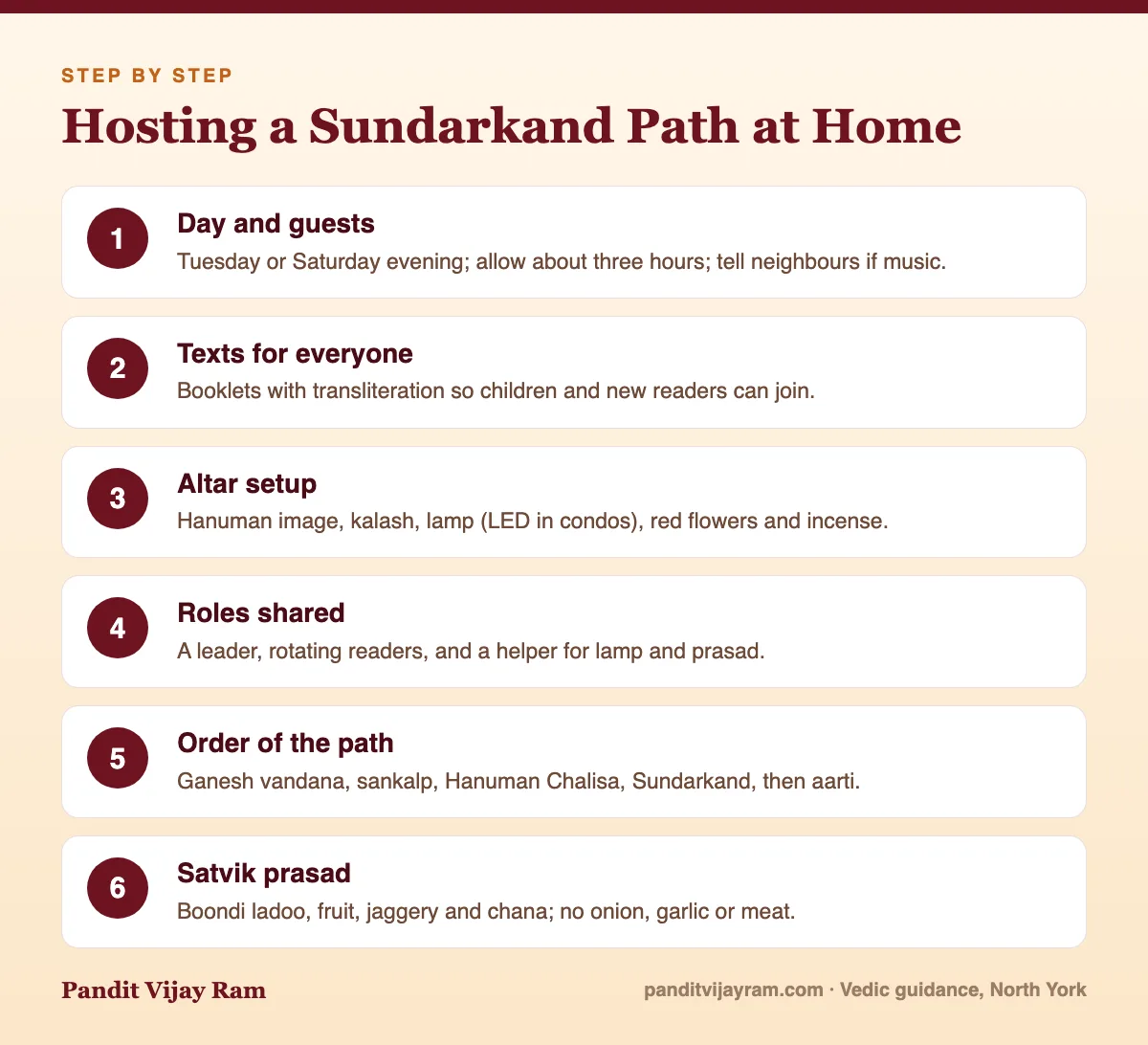
Pick a Tuesday or Saturday, invite family and friends, and prepare a clean space with a Hanuman or Ram darbar image, kalash, lamp and copies of the text. Begin with Ganesh vandana and the Hanuman Chalisa, read or sing the Sundarkand together, finish with aarti, and share satvik prasad.
A family path is less formal than people expect. This order keeps it smooth:
- Choose the day and time. Tuesday or Saturday evening suits most families. Allow three hours, and tell neighbours in a semi-detached or condo if music will be involved.
- Gather texts. Printed Ramcharitmanas or Sundarkand booklets, ideally with transliteration. Phones work, but paper keeps attention better.
- Prepare the space. A low table with a red cloth, Hanuman image, kalash with mango leaves and coconut, diya, flowers and incense. In a condo, use an LED lamp.
- Assign roles. One person leads, others take turns. Children can read the dohas. Someone looks after the lamp and prasad.
- Follow the sequence. Ganesh vandana, a sankalp stating the family's intention, the Hanuman Chalisa, the Sundarkand, then Hanuman aarti.
- Close with prasad. Boondi ladoo, jaggery and chana, fruit. Keep food satvik: no onion, garlic, meat or alcohol.
A priest is not required, though some families like one to lead the sankalp and aarti. Vijay Ram ji can do this through the Hanuman puja and havan service, or guide the family over video.
Which is better for home protection: Hanuman Chalisa, Sundarkand or Bajrang Baan?
The Hanuman Chalisa suits daily or weekly home recitation. The Sundarkand suits occasions and family gatherings. The Bajrang Baan is a more intense invocation that tradition reserves for serious trouble and usually recommends with guidance. For ordinary home protection, steady Chalisa recitation with an occasional Sundarkand is the balanced choice.
Think of these three as different tools rather than a ladder of strength:
- Hanuman Chalisa. About ten minutes. Daily, Tuesday and Saturday. Anyone can recite it without preparation. Best for building a steady protective habit.
- Sundarkand path. Two to three hours sung, shorter read. Occasions, new homes, family gatherings, hard seasons. Best for bringing the household together.
- Bajrang Baan. Short but forceful in tone, calling on Hanuman to act against enemies and harm. Traditionally used with restraint and steady purpose. The separate guide to Bajrang Baan and protective recitations explains its cautions.
A simple decision rule: if nothing specific is wrong, recite the Chalisa. If the family is facing something heavy, add a Sundarkand. If a reading suggests deliberate harm, ask a practitioner before starting the Bajrang Baan.
And if the house keeps feeling troubled despite steady practice, look at practical causes again, from sleep to money worries to damp, then consider a consultation. For how often to repeat any home routine, see how often to do spiritual cleansing.
The bottom line
Reciting the Hanuman Chalisa for home protection works best as a steady Tuesday and Saturday habit rather than an emergency measure. A Sundarkand path, organised simply with family, texts, a lamp and satvik prasad, marks new homes and hard seasons. Keep the Bajrang Baan for serious situations with guidance. Let prayer sit beside practical safety, medical care and police help when those are needed.
Key takeaways
- Tuesday and Saturday recitation of the Hanuman Chalisa is the core home practice.
- Steady daily or weekly recitation matters more than a large one-time count.
- A Sundarkand path suits new homes, hardships and family gatherings.
- A family can hold a path without a priest by following a clear sequence.
- Recitation complements locks, police, doctors and practical repairs.