
Kaal Sarp Dosh: Curse or Chart Pattern? An Honest Explainer

Few phrases in Indian astrology cause as much alarm as kaal sarp dosh. People hear it at a family function, from a website, or from an astrologer who mentions it in passing, and suddenly every delay in life seems to have a name. Some are told they must travel to a distant temple at once. Others are told their children will suffer too. Families in North York regularly bring me printouts with the words circled in red. This explainer looks at the pattern calmly. It describes how kaal sarp is defined and its twelve named types, and it is honest about the fact that the classical texts most Vedic astrologers rely on do not mention it. It explains how a careful reading weighs the pattern against the rest of the chart, when a Kaal Sarp puja can be a reasonable choice for peace of mind, and how to recognise fear-selling around it. In more than forty years of practice, I have read many charts with this pattern belonging to people who lead full, successful lives. A label in a chart is not a life sentence.
What is kaal sarp dosh in a birth chart?
Kaal sarp dosh, or kaal sarp yoga, describes a chart in which the Sun, Moon, Mars, Mercury, Jupiter, Venus and Saturn all lie within the half of the zodiac running from Rahu to Ketu. Rahu is pictured as the serpent's head and Ketu as its tail. Kaal means time, and sarp means serpent.
Modern astrologers name twelve kinds of kaal sarp, depending on which house Rahu occupies:
- Anant: Rahu in the 1st house
- Kulik: 2nd
- Vasuki: 3rd
- Shankhpal: 4th
- Padma: 5th
- Mahapadma: 6th
- Takshak: 7th
- Karkotak: 8th
- Shankhachud: 9th
- Ghatak: 10th
- Vishdhar: 11th
- Sheshnag: 12th
The names come from the great serpents of Hindu mythology, which helps explain the emotional force of the idea.
Astrologers also distinguish degrees of the pattern:
- Full. Every planet sits strictly between the nodes.
- Partial. One planet sits outside, or exactly on a node. Many astrologers say this breaks or weakens the pattern.
- Direction. Some separate charts where planets are hemmed from Rahu toward Ketu from those running Ketu toward Rahu, and treat the second as milder.
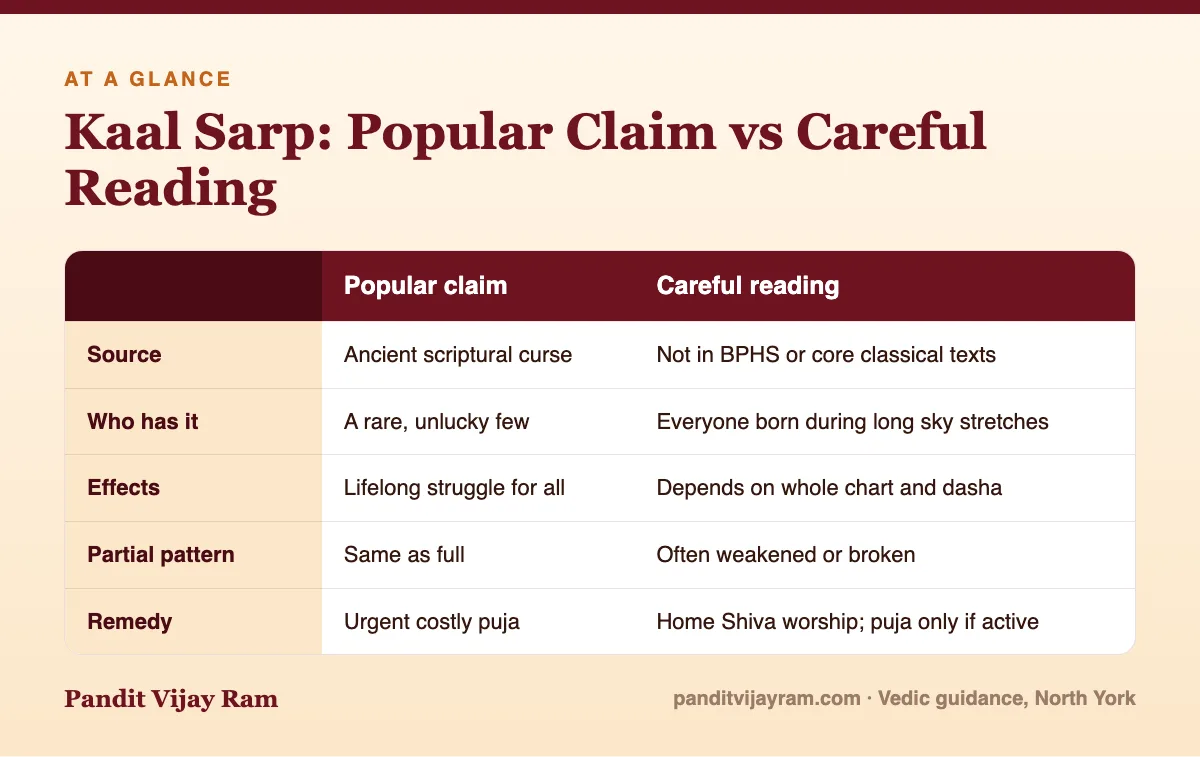
There is a simple astronomical point too. Because Jupiter, Saturn and the nodes move slowly, the pattern forms in the sky for stretches of weeks or months. Everyone born during those stretches shares it. That alone suggests it cannot carry one fixed fate for all of them. The guide to Rahu and Ketu afflictions explains the nodes themselves.

Is kaal sarp dosh mentioned in classical Vedic texts?
No. The pattern is not described in the Brihat Parashara Hora Shastra, Varahamihira's Brihat Jataka, Saravali or Phaladeepika, the core classical texts of Jyotish. The classical Sarpa yoga is a different pattern involving malefics in angular houses. Kaal sarp as a named dosh comes from comparatively recent astrological writing and popular practice.
This surprises many people, because the term is used so widely. It is worth being clear about what the absence means and what it does not.
- What it means. The rules that most astrologers learn for judging a chart, such as house lords, dashas, planetary strength and yogas from the classical texts, do not include kaal sarp. Claims that it is an ancient, scripturally fixed curse are not accurate.
- The Sarpa yoga confusion. Classical texts list a Sarpa yoga among the Nabhasa yogas, formed when malefic planets occupy three angular houses. It has nothing to do with the Rahu-Ketu axis, but the similar name causes mix-ups.
- What it does not mean. Jyotish has always grown through observation, and some sincere astrologers find the pattern useful as a description of a chart with intense focus. Others consider it overstated. Both views exist among respected practitioners.
My own approach is to treat kaal sarp as a feature worth noticing, never as a verdict. The nodes still matter, as they do in every chart, through their house, sign, conjunctions and periods.
If you have been told that an ancestral curse and kaal sarp are working together, the comparison of family curses and pitru dosh helps untangle those claims.
What are the effects of kaal sarp dosh, honestly?
Popular sources attribute delays, repeated struggle, sudden reversals, anxiety and snake dreams to kaal sarp. In practice, its effect depends on the rest of the chart. Strong house lords and a well-supported Moon often make the pattern barely noticeable. Many people with it lead successful, settled lives, and many people without it struggle.
When someone shows me a report listing frightening kaal sarp effects, I ask three questions before saying anything.
- Is the pattern complete? A planet sitting outside the axis, or tightly joined with a node, changes the picture for most astrologers.
- What else is the chart saying? An exalted or own-sign planet, a strong ascendant lord, or good Jupiter aspects often outweigh the pattern.
- What period is running? The themes of the nodes tend to surface mostly during Rahu or Ketu dasha or sub-periods, and when they transit sensitive points.
Where the pattern is active, people sometimes describe a life of intense swings: long effort, then sudden gains or reversals, with a feeling of being pushed by forces beyond their control. Many of the same people later describe that intensity as the source of their drive.
Snake dreams deserve a calm word. They are common in South-Asian families partly because snakes carry so much cultural meaning. A snake dream after reading about kaal sarp is far more likely to be the mind processing the worry than proof of anything.
Above all, delays in marriage, career or children have many ordinary causes. Treat those directly, with practical help and, where needed, a doctor or counsellor.
When is a kaal sarp puja reasonable?
A kaal sarp puja is reasonable when the pattern is complete, the nodes are stressed in the chart, their period is running, and the person wants a ritual for peace of mind. It is not needed just because the pattern exists. Simpler home practice, such as Shiva worship and the Mahamrityunjaya mantra, often serves well.
A practical decision rule:
- Probably unnecessary. Partial pattern, strong chart, no node period running, and no particular worry.
- Home practice is enough. Pattern present, mild stress, and a wish to do something devotional. Offer water or milk to a Shiva lingam on Mondays, chant Om Namah Shivaya or the Mahamrityunjaya mantra daily, and observe Nag Panchami with prayer.
- A formal puja is reasonable. Full pattern, nodes afflicting the Moon or ascendant, a Rahu or Ketu period underway, and real distress that a ritual may help settle.
Trimbakeshwar near Nashik and Mahakaleshwar in Ujjain are well-known places for this ritual, and many families plan it during a visit to India. It can also be performed properly in Canada as a Rahu-Ketu shanti with Shiva abhishek, sarpa prayers and havan. Travel is not required.
Our Kaal Sarp and Pitra Dosh service explains how the ritual is conducted and when it is suggested. For those who prefer a broader ritual, a puja or anushthan centred on Shiva can be arranged instead.
Whatever you choose, a puja is a prayer for steadiness. It does not change the planets' positions, and it should be done once with sincerity, not repeated out of fear.
How do you spot fear-selling around kaal sarp dosh?
Be cautious when kaal sarp is announced as a curse before the whole chart is discussed, when you are told disaster will follow without an immediate costly puja, or when a ritual is pushed repeatedly. An honest astrologer shows you the planet positions, explains doubts about the pattern and lets you decide in your own time.
Kaal sarp is one of the most commercialised terms in astrology. Watch for these signs:
- Diagnosis before data. You are told you have kaal sarp before your birth time has even been checked.
- Threats to family. Claims that your children, spouse or parents will be harmed unless you act now.
- One-size remedies. The same expensive puja offered to everyone regardless of the type or strength of the pattern.
- Repeat rituals. Being told the first puja did not work and another is needed, again and again.
- Secrecy. Refusing to explain which planets form the pattern, or discouraging a second opinion.
- Bundles. Gemstones, yantras and pujas sold together as a package.
If you feel pressured, pause. Get a second reading, ask to see the chart positions in writing, and discuss the decision with your family. If you have lost money to threats or false promises, the Canadian Anti-Fraud Centre takes reports.
The guide to spiritual scam warning signs covers wider patterns, and the evil eye and curses hub gathers related guides.
The bottom line
Kaal sarp dosh is a chart pattern, not a curse, and it does not appear in classical texts like the Brihat Parashara Hora Shastra. Its effects depend on the rest of the chart and the periods running, so many people with it live full lives. A puja can be reasonable for a strong, active pattern and real distress, while home Shiva worship suits most cases, and fear-based selling should always be questioned.
Key takeaways
- Kaal sarp means all seven planets fall on one side of the Rahu-Ketu axis.
- It is not described in BPHS or other core classical texts.
- The pattern forms in the sky for weeks at a time, so many people share it.
- A puja is reasonable only when the pattern is strong and active and you want it.
- Threats, urgency and repeated rituals are signs of fear-selling.