
Kala Jadu vs Nazar vs Graha Dosh: How to Tell Them Apart

When life turns difficult, families often use three words almost interchangeably: jadu, nazar and dosh. Yet they describe very different ideas, and mixing them up leads to the wrong remedy, unnecessary fear and sometimes suspicion of innocent people. Clients in North York, Brampton and Markham frequently ask me to explain kala jadu vs nazar, and where planetary affliction fits in. It is one of the most useful conversations I have, because once people understand the difference, they usually feel calmer straight away. This article compares the three side by side: what each one means in tradition, how it typically begins, what signs people associate with it, and which remedies suit it. You will also see how a Vedic reading separates them step by step, and what to consider when none of the three fits. In more than forty years of practice I have found graha dosh and ordinary life pressures to be far more common than black magic, and nazar to be far gentler than most people fear.
What is the difference between kala jadu and nazar?
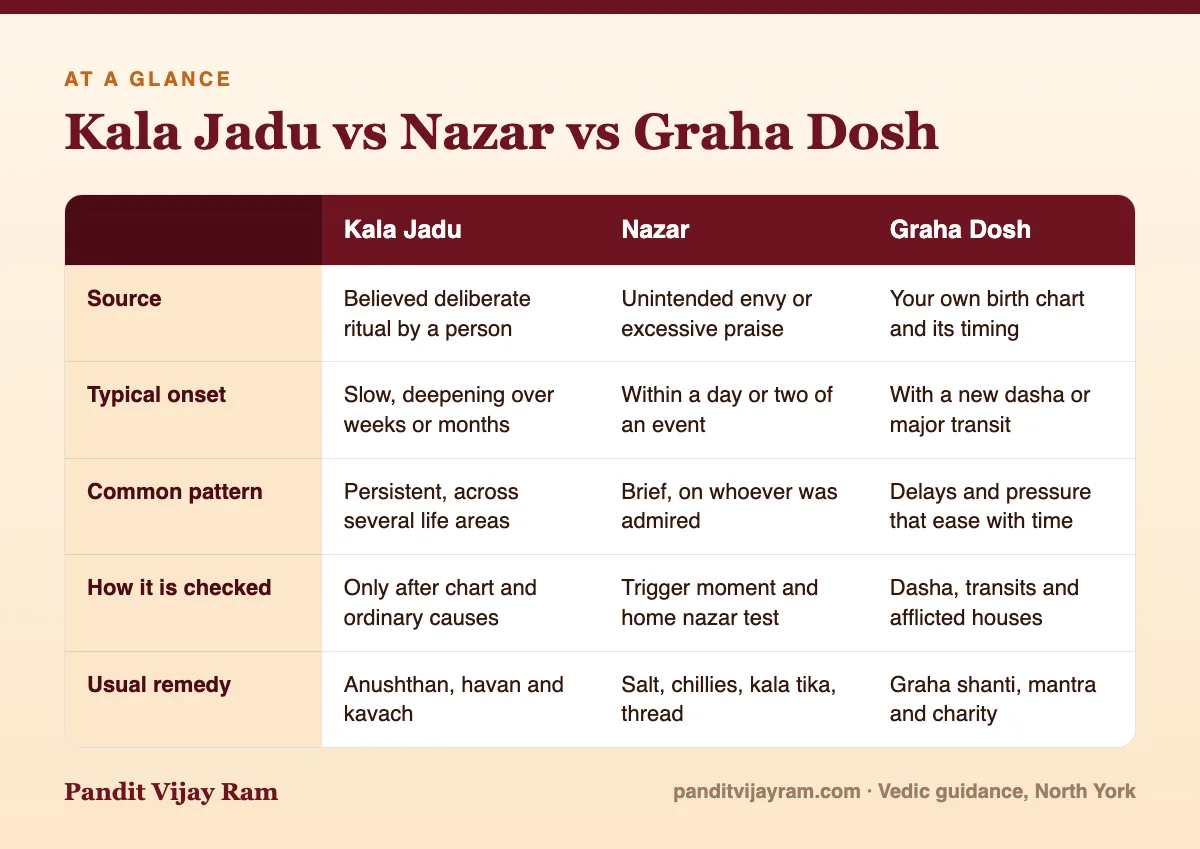
Kala jadu, or black magic, is believed to be intentional: someone performs a ritual to harm you. Nazar, the evil eye, is usually unintentional: envy or excessive praise, even from a loving relative, is thought to unsettle you. Jadu is said to persist until removed, while nazar typically passes quickly with simple home remedies.
The key distinction is intent. In folk belief, kala jadu requires a person who wants harm and a ritual to carry it. Nazar needs neither. A grandmother admiring a chubby baby, a colleague envying a promotion or guests praising a new house can all, in the traditional view, cast nazar without meaning any ill.
That difference shapes how people respond:
- Onset. Nazar is often linked to a specific event, such as a party, a photo shared online or a visit, with symptoms appearing within a day or two. Jadu is usually described as a slower, deepening pattern over weeks or months.
- Who is affected. Nazar tends to settle on whoever was admired: a baby, a bride, a new car, a thriving shop. Jadu is described as targeting a person or a household repeatedly.
- Intensity. Nazar is commonly experienced as sudden tiredness, crankiness in children, a minor mishap or a dip in business. Jadu is associated with persistent heaviness across several areas of life.
- Remedy. Nazar is traditionally removed at home with salt, red chillies, alum or a lemon circled around the person. Jadu traditionally calls for structured prayer, puja and protection.
You can learn the gentle home methods in how to remove nazar at home, and the deeper background on intentional harm in what black magic is in the Vedic view.

What is graha dosh and how is it different from black magic?
Graha dosh is an affliction in your own birth chart, such as a troubled Saturn, Rahu or Mars placement, or a hard dasha period. Unlike black magic, nobody else causes it. It reflects timing and karma in Jyotish, and it is addressed through graha shanti, mantra, charity and sometimes gemstones chosen carefully.
Jyotish, the Vedic system of astrology, describes nine grahas whose positions at birth and movements through life shape different areas of experience. A dosh is a recognised difficulty in that pattern. Common examples include:
- Shani sade sati. Saturn's roughly seven-and-a-half-year passage around the natal Moon, associated with pressure, delays and lessons in patience.
- Mangal dosh. Mars placed in certain houses, traditionally discussed in marriage matching.
- Kaal sarp dosh. All planets falling between Rahu and Ketu, linked in tradition to obstacles and anxiety.
- Pitru dosh. Chart indications of unresolved ancestral karma.
- A difficult dasha. Entering the period of a weak or afflicted planet can make several years feel heavy.
Because graha dosh is about your own chart, it involves no enemy. That matters a great deal. Many people who fear jadu are actually in a hard planetary phase, and learning this lifts suspicion from family and neighbours.
Graha dosh also has a recognisable rhythm. Difficulties often begin when a dasha or major transit starts and ease when it ends, which a chart can show in advance. A run of repeated setbacks tied to timing is discussed in clearing a run of bad luck with graha shanti, and a full chart reading is available through the kundli and horoscope service.
How can I tell if it is kala jadu, nazar or graha dosh?
Ask three questions: did trouble follow a specific moment of praise or envy, did it start with a new planetary period, or does it show a deliberate, repeated pattern linked to a conflict? Short and event-linked suggests nazar; timed to the chart suggests graha dosh; persistent and unexplained suggests a closer look for jadu.
This simple decision guide is what I walk families through before any ritual.
- Rule out the ordinary first. Illness, poor sleep, money pressure, conflict at home and seasonal low mood explain a large share of what people bring to me. See a doctor for physical or emotional symptoms.
- Look for a trigger moment. Did symptoms start a day or two after a celebration, a viral photo, a new purchase or lavish praise? If so, and they ease after a home nazar remedy, nazar is the likely explanation.
- Check the timing against the chart. Did the trouble begin around the start of a Saturn transit, a Rahu dasha or a similar phase? If the chart shows a clear match, graha dosh is the more probable cause.
- Consider the pattern. Is there a long, deepening difficulty across health, home, money and relationships that neither the chart nor ordinary causes explain? Only then does a closer assessment for kala jadu make sense.
- Remember overlap. A person in a hard dasha may also feel nazar more easily. The categories are guides, not boxes.
Remedies differ by cause, which is why the distinction matters. Treating graha dosh as jadu wastes effort and creates fear, while treating jadu as mere nazar can leave a persistent concern unaddressed. Related terms such as curse and hex are compared in spell vs curse vs hex removal.
How does an astrologer separate black magic from evil eye and planetary problems?
A careful astrologer combines an interview, the birth chart and observation. The interview establishes when trouble began and what else changed. The chart shows dasha, transits and afflicted houses. Traditional nazar checks and a look at the home add detail. Only what remains unexplained is considered as possible jadu.
When someone sits with me, I follow roughly the same order every time.
- Listening. I ask what is happening, when it started, who is affected and what has been tried. I also ask about doctors, sleep, work and relationships.
- Timeline. I map events against dates. Nazar usually has a short fuse. Graha dosh lines up with planetary changes. Jadu is described as an unexplained, persistent pattern.
- Chart review. I examine the current mahadasha and antardasha, Saturn and Rahu transits, and houses linked to the complaint, such as the sixth for conflict and illness, the eighth for sudden upheaval and the twelfth for loss and sleep.
- Simple nazar checks. Traditional methods such as circling salt or alum and observing it in fire are folk practices. I treat them as one gentle indicator, never as proof.
- Home and routine. Clutter, a dark or damp entrance, broken items and Vastu imbalances can contribute to heaviness.
Most readings end with a clear answer: mainly graha dosh, mainly nazar, mainly ordinary stress, or a mix. A genuine jadu concern is possible but less common, and I explain my reasoning openly. The evil eye and nazar removal service covers the lighter remedies.
What are the remedies for kala jadu, nazar and graha dosh?
Nazar is traditionally removed with salt, red chillies, alum or a lemon, plus a kala tika or black thread. Graha dosh calls for graha shanti puja, planet-specific mantras, charity and fasting on the ruling weekday. Kala jadu is addressed through structured prayer such as a Hanuman or Durga anushthan, havan and a protective kavach.
Matching the remedy to the cause is the whole point of telling them apart.
- For nazar. Circle a fistful of rock salt or seven red chillies around the person seven times and discard it safely. Apply a small kala tika behind a child's ear. Tie a black thread on the wrist or ankle. Recite the Hanuman Chalisa once. These are light, quick and suitable at home.
- For graha dosh. Identify the planet involved, then use its traditional remedies: Shani mantras and mustard-oil lamps on Saturdays for Saturn, Rahu mantras and charity for Rahu, Mangal remedies on Tuesdays for Mars. A graha shanti puja and, where suitable, a gemstone recommended after careful chart study can support this.
- For kala jadu. A structured anushthan of 21 or 41 days with daily mantra, a closing havan, home cleansing and a kavach is the usual approach, alongside a calm daily routine.
- For overlap. Begin with the gentlest remedy, observe for a week or two, and add more only if needed.
Whatever the cause, no remedy replaces medical, legal or financial help where those are needed. If you are struggling with low mood or thoughts of self-harm, see your family doctor or call or text 988. Further reading on evil eye and related concerns is collected in the evil eye and curses guides.
The bottom line
Kala jadu vs nazar comes down to intent and pattern: jadu is believed to be deliberate and persistent, while nazar is unintended and usually short-lived. Graha dosh involves no other person at all, arising from your own chart's timing and placements. A careful reading separates them through interview, timeline, chart and gentle checks, after ordinary causes are ruled out. Matching the remedy to the cause saves effort, money and needless suspicion.
Key takeaways
- Kala jadu implies deliberate harm; nazar is usually unintended envy or praise.
- Graha dosh comes from your own birth chart, not from anyone else.
- Event-linked, short-lived trouble most often points to nazar.
- Trouble that starts with a new dasha or transit often points to graha dosh.
- Ordinary health and life pressures should be checked before any of the three.