
Nazar During Pregnancy: Traditional Customs and What Comes First

Few times bring as much love and as much worry as a pregnancy. Grandmothers start saying nazar na lage under their breath, aunties ask you not to show the bump in photos, and someone suggests a remedy you have never heard of. Many expectant parents in North York and across the GTA come to me with questions about nazar during pregnancy, often torn between respecting their elders and following their midwife or doctor. The good news is that the two need not clash. In more than forty years of guiding families, I have found that the oldest customs around pregnancy are mostly about rest, discretion, prayer and community care, all of which sit comfortably beside modern medicine. This guide explains why pregnancy is believed to attract nazar, what godh bharai and its regional cousins mean, the everyday protective customs families keep, the remedies that are not safe in pregnancy, and the signs that mean you should call your care provider straight away.
Why is pregnancy believed to attract nazar?
Pregnancy is visible, joyful and deeply desired, which in folk belief makes it a magnet for attention. A glowing expectant mother draws praise, and a pregnancy can also stir painful feelings in someone longing for a child. Elders therefore treat this time as one needing extra protection, discretion and prayer.
Across Hindu, Sikh, Muslim and Christian South-Asian families, a few beliefs recur:
- Two lives are exposed. Nazar is thought to affect both mother and baby, which raises the stakes in the eyes of elders.
- Praise carries risk. Comments such as you are glowing or the bump looks perfect are traditionally answered with a blessing, to keep the praise from turning into nazar.
- Longing can sting. Elders gently note that a woman who has struggled to conceive may feel sorrow at someone else's news, not out of malice but from pain. Discretion protects her feelings as well as yours.
- The early months feel fragile. Because early loss is relatively common, families learned to wait before telling widely.
I would add something important. These beliefs grew from love and from an era when childbirth was far more dangerous than it is today. Protection then meant keeping the mother rested, fed and surrounded by care. That remains the most valuable protection now.
If you are worried that nazar has already affected you, it may help to read signs of nazar on a person, which sets out the ordinary causes to rule out first. In pregnancy, nausea, tiredness and mood changes are expected, and your care provider is the right person to judge what is normal.

What is godh bharai and how is it linked to nazar protection?
Godh bharai, meaning filling the lap, is a North Indian ceremony usually held in the seventh month. Women of the family fill the mother's lap with fruit, dry fruits, sweets and a coconut, bless her, and often do a gentle nazar utarna. Regional versions include seemantham and valaikaapu in the South and shaad in Bengal.
The ceremonies share a purpose: to bless the mother, celebrate the coming child and surround the family with good wishes, which in folk thinking also turns away envy.
- Godh bharai. The mother sits in new clothes, often red or green, while older married women place fruit, dry fruits, sweets, a coconut and bangles in her lap. Songs are sung, and elders may circle salt or a few coins over her head.
- Seemantham and valaikaapu. In Tamil, Telugu and Kannada homes, glass bangles are slipped onto the mother's wrists. Their soft chime is said to soothe the baby and keep troubling influences at bay. Seemantham draws on the Vedic samskara of simantonnayana, the parting of the mother's hair with blessings.
- Shaad. In Bengali families, the mother is fed her favourite dishes, sometimes cooked by her own mother, as a loving send-off before birth.
- Gujarati simant. A similar blessing in the seventh month, often followed by the mother visiting her parents' home.
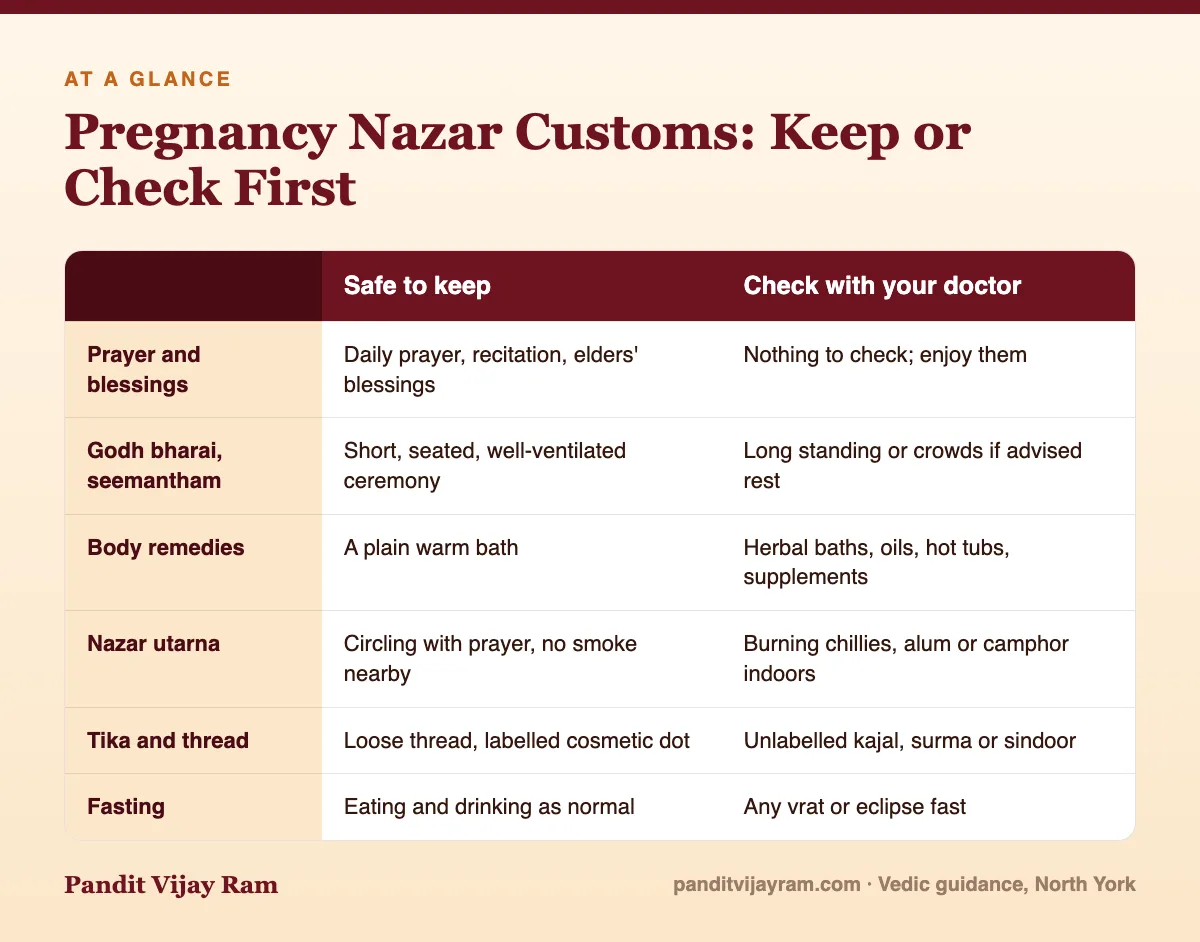
For nazar specifically, families may add a small kala tika behind the mother's ear and finish with a quiet nazar utarna by an elder. If chillies or alum are used, keep the smoke well away from her. The guide to kala tika against nazar explains lead risks in some kajal, which matter more in pregnancy.
Keep the event comfortable: short, seated, well ventilated, with food and water at hand.
What other nazar customs do families follow during pregnancy?
Common customs include keeping the news within the family for the first months, avoiding showing off the bump, answering praise with a blessing, a black or red protective thread, daily prayer or recitation, and staying indoors during an eclipse. Most are harmless and comforting; a few are best adapted for modern life and safety.
Here are customs I hear about often, with a few gentle notes:
- Waiting to announce. Telling only close family in the early months is sensible for emotional reasons too. Sharing publicly later is your choice; see nazar after sharing good news online for a balanced view.
- A protective thread. A red kalava or black thread on the wrist. Keep it loose, as hands and feet can swell, and cut it off if it tightens.
- Prayer and recitation. Many Hindu mothers recite the Hanuman Chalisa or listen to the Garbha Rakshambika prayer known in Tamil homes. Muslim mothers often recite Surah Maryam or the last three surahs. Sikh mothers may listen to Sukhmani Sahib. Calm, regular prayer is wholly safe.
- Eclipses. Many families ask the mother to stay indoors and rest during a grahan. This is a matter of faith with no known medical basis, and rest does no harm. Skipping meals or water for hours during it is not advisable.
- Avoiding dusk outings or certain trees. Folk beliefs vary by village. Where they cause stress or isolation, they can be relaxed.
- Not buying baby items early. A widespread custom. It is fine to follow, though practical preparation such as a car seat matters before the due date.
For couples who are still hoping to conceive, the santan prapti page describes prayer-based support offered alongside medical fertility care.
Which nazar remedies should pregnant women avoid?
Avoid any herbal drink, powder or supplement, ritual bath with herbs or oils, very hot baths, heavy smoke from chillies, camphor or incense, long fasts, unlabelled kajal or sindoor that may contain lead, and anything pressed on you by a practitioner. Check every remedy that touches the body with your doctor or midwife first.
Some remedies that are harmless for others carry real risk in pregnancy. Please treat this list seriously:
- Herbs and supplements. Many herbs used in folk remedies, and some sold as protective or purifying, are not tested in pregnancy and some are known to be unsafe. Do not take any without your care provider's approval.
- Ritual baths. Baths with neem, turmeric, salts, essential oils or herbal infusions may irritate skin or carry unknown effects. Very hot water raises body temperature, which is a concern especially early on. A plain warm bath is fine.
- Smoke. Burning chillies, alum, camphor, guggul or heavy incense produces smoke and fumes. Keep the mother out of the room or skip the burning step entirely.
- Fasting. Long vrats or skipping water affect blood sugar and hydration. Speak with your doctor before fasting at all.
- Lead. Some kajal, surma and sindoor sold abroad or without labels can contain lead, which crosses to the baby. Use labelled products or skip them.
- Practitioner pressure. Anyone who says your baby is cursed and urges costly rituals is exploiting fear. The guide to scam warning signs lists the red flags.
What remains is still a rich practice: prayer, a lamp in a ventilated room, blessings from elders, a protective thread kept loose, and the support of family. None of these needs anything ingested, inhaled or rubbed into the skin.
When should a pregnant woman call a doctor instead of doing a nazar remedy?
Call your doctor, midwife or hospital right away for bleeding, fluid leaking, severe or persistent headache, blurred vision, sudden swelling, fever, strong abdominal pain, or reduced baby movements later in pregnancy. Call 911 for heavy bleeding or collapse. Lasting low mood or anxiety also deserves care. Customs can wait; these cannot.
Many families hesitate to bother the doctor, or an elder suggests trying a remedy first. Please do not wait. A simple rule I share with every expectant family:
- Body changes that feel wrong. Bleeding, cramping, fluid, a headache that will not shift, vision changes, sudden swelling of the face or hands, fever or burning when passing urine. Call your care provider or go to the hospital's labour and delivery unit.
- The baby moving less. In later pregnancy, fewer movements than usual are a reason to call the same day, not to try nazar utarna.
- Mood and mind. Persistent sadness, worry, panic or not feeling like yourself can be perinatal depression or anxiety, which is common and treatable. Tell your doctor or midwife. If you have thoughts of harming yourself, call or text 9-8-8 at any hour.
- Ordinary discomfort. Tiredness, nausea, back ache and poor sleep are typical. Your care provider can advise; rest and support help.
Once you are safe and checked, there is every room for faith. Prayer, a gentle blessing from elders and a calm home are good for any mother. If worries about nazar or family tension continue, a consultation through evil eye and nazar removal can offer prayer-based support that never interferes with your medical care. More guides on protection for mothers and babies sit in the evil eye and curses hub, including care for babies and new mothers.
The bottom line
Nazar during pregnancy is a belief rooted in love and caution: an expectant mother is precious, admired and in need of protection. The customs that grew from it, such as quiet early months, godh bharai, seemantham, blessings and prayer, sit comfortably beside modern prenatal care. Herbs, ritual baths, smoke, fasting and unlabelled cosmetics are best avoided, and any warning sign means calling your doctor or midwife first.
Key takeaways
- Pregnancy is traditionally seen as a time of heightened nazar because it draws attention.
- Godh bharai, seemantham, valaikaapu and shaad bless the mother and turn away envy.
- Prayer, discretion, blessings and a loose protective thread are safe customs.
- Avoid herbs, herbal baths, hot baths, smoke, long fasts and unlabelled kajal or sindoor.
- Bleeding, severe headache, fewer movements or low mood mean calling a doctor first.