
Nazar After Sharing Good News Online: The Modern Evil Eye Question

You post the engagement ring, the new house keys or the first photo of your baby, and the likes pour in. Then the week goes wrong, and an aunt messages: why did you put it online? Many people in North York and across the GTA now type nazar social media into a search bar after exactly this moment. It is a fair question, and it deserves a calm answer rather than a fearful one. The instinct behind it is old. South-Asian, Middle Eastern and Mediterranean families have always kept certain news quiet until the right time. In more than forty years of guidance I have watched that instinct carry over into the digital age, sometimes wisely and sometimes as needless worry. This article looks at whether the evil eye can travel through a screen, why elders valued discretion, the very real practical risks of oversharing, the baby-photo question, and a balanced set of habits that let you share joy without anxiety.
Can you get nazar from posting on social media?
Many families believe so, reasoning that nazar comes from attention and envy, and social media multiplies both. Tradition offers no fixed rule about photos or screens. What is certain is that public posts reach far more people than any wedding hall, including people whose feelings towards you are mixed. That alone justifies care.
Older teachings describe nazar as a force carried by the gaze and by the feeling behind it. When people ask whether a photo carries that gaze, I answer honestly: traditions differ, and none of the classical sources were written with phones in mind. Some elders say an image is an extension of the person and can draw nazar as the person would. Others say the harm needs physical presence.
What we can say with more confidence is this:
- Reach is enormous. A single post may be seen by hundreds of people you barely know, along with friends of friends and strangers.
- Mixed feelings are normal. Even people who love you may feel a pang of comparison. A cousin struggling with infertility sees your scan; a friend who lost a job sees your promotion.
- Attention invites comment. Some comments are kind; others are pointed, competitive or nosy.
So whether you approach this as a spiritual concern or a social one, the advice converges. The more you broadcast, the more attention you invite, and not all attention is benign. That is not a reason for fear. It is a reason for thought before posting.
If you are already feeling unwell after a celebration, the guide on feeling unwell after praise looks at both the tradition and the psychology. For other nazar topics, browse the evil eye and curses hub.

Why did elders keep good news private?
Elders kept good news quiet out of humility, protection from envy and plain caution. Pregnancies were not announced early, engagements were kept within the family until finalised, and newborns were shown to few visitors in the first weeks. Saying nazar na lage, Mashallah or touching wood after praise was part of the same instinct.
Discretion was woven into daily life across many communities:
- Pregnancy. Many families waited until the early months had passed, partly from fear of nazar and partly because early loss is common and painful to explain publicly. The customs around this are covered in nazar during pregnancy.
- Newborns. The forty-day rest, known in North India as sawa mahina and in Muslim families as chilla, kept mother and baby at home with limited visitors.
- Marriages. A rishta was discussed quietly until both families agreed. Broadcasting too early risked gossip if it fell through.
- Money and success. Traders did not discuss earnings. Students did not boast of marks. A new car might be shown first at the temple, not to the neighbours.
Accompanying these was a vocabulary of humility. Hindu and Sikh elders say nazar na lage or Waheguru mehar kare. Muslim families say Mashallah to acknowledge that a blessing comes from God. Greek and Turkish grandmothers pretend to spit lightly three times. English speakers knock on wood.
The wisdom underneath is practical as well as spiritual: news shared before it is secure can bring disappointment, gossip or pressure. It also protects those around us who may be hurting. Elders were not hiding their joy; they were choosing when and with whom to share it.
What are the real risks of oversharing good news online?
Beyond any spiritual concern, oversharing can expose your location, home, children's details and finances to strangers. It can attract scammers who target visible wealth, give burglars a signal that you are away, invite comparison and resentment among relatives, and create pressure to keep posting. These risks are well documented and easy to reduce.
A short list of what can go wrong, and the simple fix for each:
- Location exposure. Photos can carry location data, and backgrounds often show street signs, house numbers or a child's school. Turn off location tags and check what is visible before posting.
- Away-from-home signals. Holiday posts in real time tell everyone your home is empty. Post after you return.
- Identity details. A baby's full name, birth date and hospital, or a boarding pass with a barcode, can help identity thieves. Share less detail.
- Scam targeting. Visible new wealth, such as a car, a house, wedding jewellery, makes people more likely to receive investment, romance or fake-psychic scams. The Canadian Anti-Fraud Centre lists common patterns.
- Family friction. A relative left out of an announcement, or one going through a hard time, may feel hurt. Telling close family first, privately, avoids most of this.
- Comparison and pressure. Constant sharing invites constant checking of likes and comments, which affects mood and sleep for many people.
None of this requires giving up social media. It asks for a little thought before you press share. The Office of the Privacy Commissioner of Canada publishes clear, practical advice on managing what you post and who sees it. When I talk with families about digital nazar, I find these practical steps calm them more than any ritual, because they put control back in their hands.
Is it bad to post baby photos online because of nazar?
Many families avoid posting a newborn's face, especially in the first forty days, both for nazar and for privacy. A child cannot consent, and images shared today stay online for years. Sharing in a private family group, hiding the face, or waiting a while are all reasonable middle paths that honour both concerns.
This is the question I hear most from young parents, often caught between excited friends who want photos and grandparents who are horrified at the idea.
Points to weigh:
- Tradition. Many South-Asian, Middle Eastern and Turkish families keep the baby largely out of view for the first weeks. Posting widely can upset elders who hold this custom closely.
- Consent. Your child will grow up and may not want baby photos, bath pictures or tantrum videos public. Sharing children's lives online is sometimes called sharenting, and child-welfare and privacy experts encourage restraint.
- Safety. Photos with names, schools or locations can be misused. Images can be copied and reshared beyond your control.
Middle paths many families choose:
- Share in a private family chat or a close-friends list instead of a public profile.
- Post the baby's hand, feet or back instead of the face.
- Wait until after the forty days or the naming ceremony.
- Add a kala tika or a small blue eye in the photo if that comforts you; the guide to kala tika against nazar covers safe use of the custom itself.
Whatever you decide, decide together as parents, and explain it kindly to relatives. If a baby seems unwell after a busy round of visitors or posts, see a doctor first; the cause is far more likely to be ordinary.
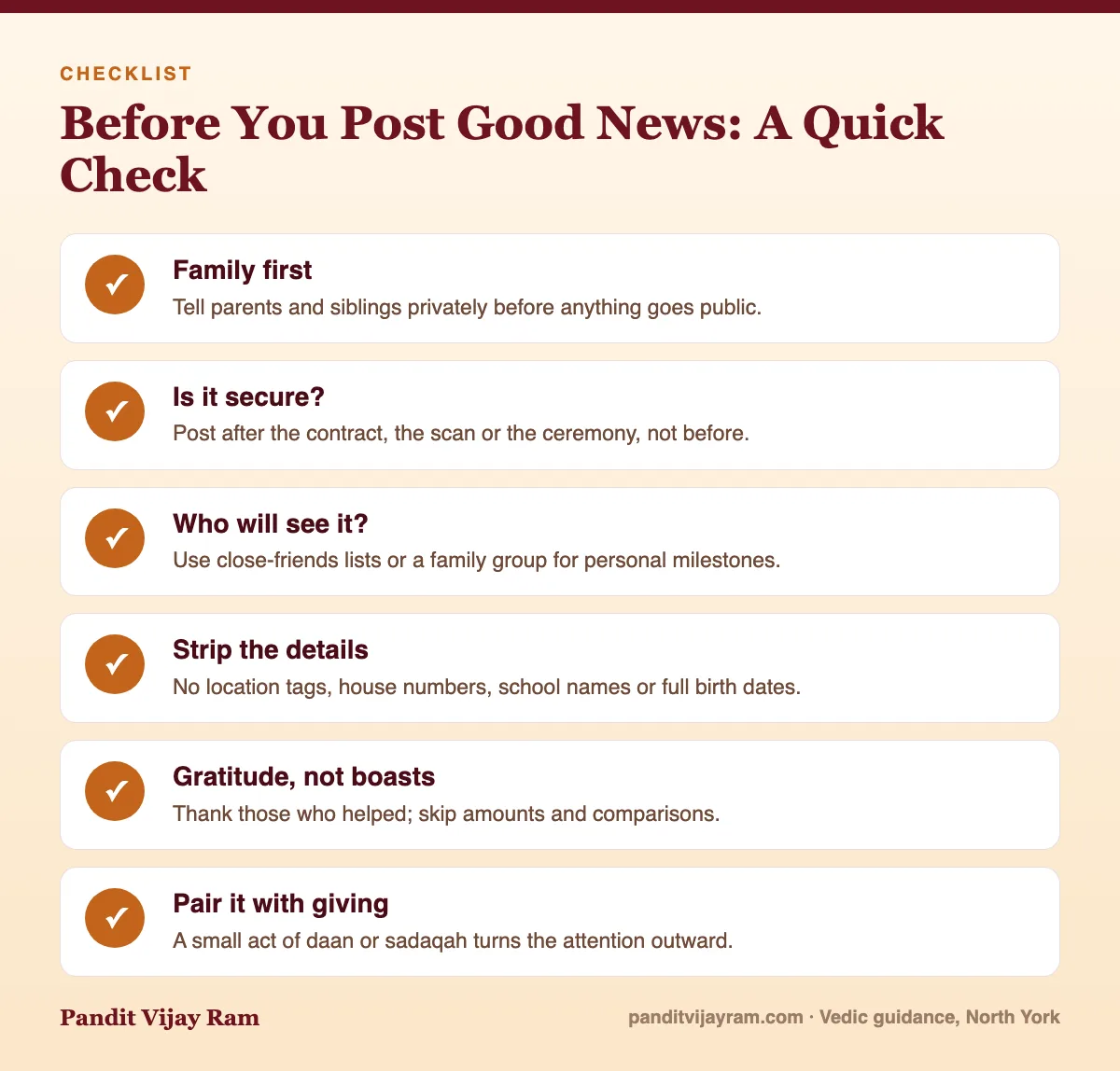
How can you share good news online without worrying about nazar?
Share selectively and with gratitude. Tell close family first in private, post after events are secure, use close-friends lists, leave out location and personal details, and pair good news with a short prayer or act of charity. If worry about envy is making you anxious or withdrawn, talk to someone you trust or a doctor.
A balanced set of habits I suggest, mixing old wisdom with modern sense:
- Private first, public later. Phone or visit parents and siblings before posting anything. This respects relationships and settles nerves.
- Post when it is secure. After the contract is signed, the scan is clear, the wedding has happened.
- Choose the audience. Most platforms allow lists or groups. Use them for personal milestones.
- Share gratitude, not boasts. A post that thanks family, teachers or God lands very differently from one that ranks you above others.
- Give when you receive. Many traditions pair good news with daan or sadaqah, a gift to someone in need. It is a beautiful way to turn attention outward.
- Keep a daily practice. A lamp and a short prayer each morning provide steady protection, whether or not you post that day.
Equally important is what not to do. Do not delete everything in panic when a week goes badly; look first at the ordinary reasons. Do not read every critical comment as a curse. And do not let fear of nazar isolate you from people who genuinely care.
If symptoms such as low mood, sleeplessness or fear keep returning, a family doctor should be your first call. When those checks are clear and you still sense envy affecting your life, a consultation through evil eye and nazar removal can help, alongside the practical steps above. The checklist in signs of nazar on a person is a useful first read.
The bottom line
The question of nazar and social media is an old instinct meeting a new tool: the belief that broadcasting blessings invites envy. Elders kept pregnancies, engagements and newborns private for spiritual and practical reasons, and those reasons still hold online. Selective sharing, attention to privacy, gratitude and charity protect you from both envy and the very real risks of oversharing, without asking you to hide your joy.
Key takeaways
- Many families believe online attention can carry nazar; traditions differ on screens.
- Elders kept good news private out of humility, protection and plain caution.
- Oversharing carries real risks: location, identity, scams, family friction and comparison.
- For baby photos, private groups, hidden faces or waiting are reasonable middle paths.
- Share selectively with gratitude, give in charity and keep a daily prayer.