
Can a Mother Give Her Own Child Nazar?

A new mother watches her baby sleep, overwhelmed by how perfect he is, and that night he cries for hours. An aunt says gently, maybe it was your own nazar. It is a hard thing to hear when you are exhausted and already full of worry. Parents type the question can a mother give child nazar into their phones at three in the morning far more often than anyone admits. In North York and across the GTA, I meet mothers who quietly carry guilt about this belief. This article explains what tradition actually means by a mother's nazar, why it is never an accusation, which gentle customs mothers use, and which baby symptoms always need a doctor first. It also speaks to the anxiety many new parents feel, and where to find help for it. In more than forty years of guiding families, I have never once seen a mother's love harm a child, and I have seen her blessing calm a whole household.
Can a mother really give her own baby nazar?
In folk belief, yes, a mother's admiration is thought to be able to cast nazar, because nazar follows strong feeling rather than bad intention. But tradition treats it as accidental, mild and easily settled. It is not a fault, not a curse, and not a reason for a mother to hold back her affection.
To understand the belief, it helps to know how families think nazar works. It is not described as a weapon. It is described as an overflow of attention: a gaze so full of feeling that it unsettles whatever it rests on. Envy is one source. Love, oddly, is another.
That is why elders give advice like this:
- Do not stare at a sleeping baby for too long without saying a blessing.
- Do not list a baby's good qualities aloud to visitors.
- After saying how beautiful the child is, add nazar na lage, or tap the baby's cheek lightly.
There is a counterweight that is just as old. Many families say maa ki dua, a mother's prayer, is the strongest protection a child can have. In the same household where an aunt warns about a mother's nazar, the grandmother will ask the mother to circle her own hand over the baby and pray, because her blessing is believed to carry the most power.
So the belief is not that mothers are dangerous. It is that strong love should be expressed with a blessing attached. The same idea, applied to your own successes, is explored in can you give yourself nazar.

Why do elders say a mother's nazar is the strongest?
Elders reason that nobody looks at a child with more feeling than its mother, so if nazar follows intensity, hers would be strongest. The saying is meant as a reminder to bless, not a warning to keep away. In the same breath, families teach that a mother's prayer is also the child's strongest shield.
You may hear the phrase maa ki nazar sabse tez hoti hai, a mother's gaze is the sharpest. It is usually said lightly, often with a laugh, by a grandmother who has said it about her own children too.
Understood in context, the saying carries three gentle messages:
- Love deeply, but with gratitude. A child is a gift, and acknowledging that with a prayer keeps the gift in perspective.
- Do not show off. Mothers who post every milestone or compare their baby with others are being nudged towards discretion.
- You have power to protect. If your gaze is strong, so is your blessing.
Where the saying goes wrong is when it is used to blame a mother for an ordinary baby problem, such as colic, a cold or a bad night. That is unkind, and it is not what tradition intends. If a relative repeats it in a way that hurts, it is fair to say you would rather hear a blessing. Customs from the months before birth, including keeping news private, are covered in nazar customs during pregnancy, and the wider theme in the evil eye and curses hub.
What can a mother do to protect her baby from nazar?
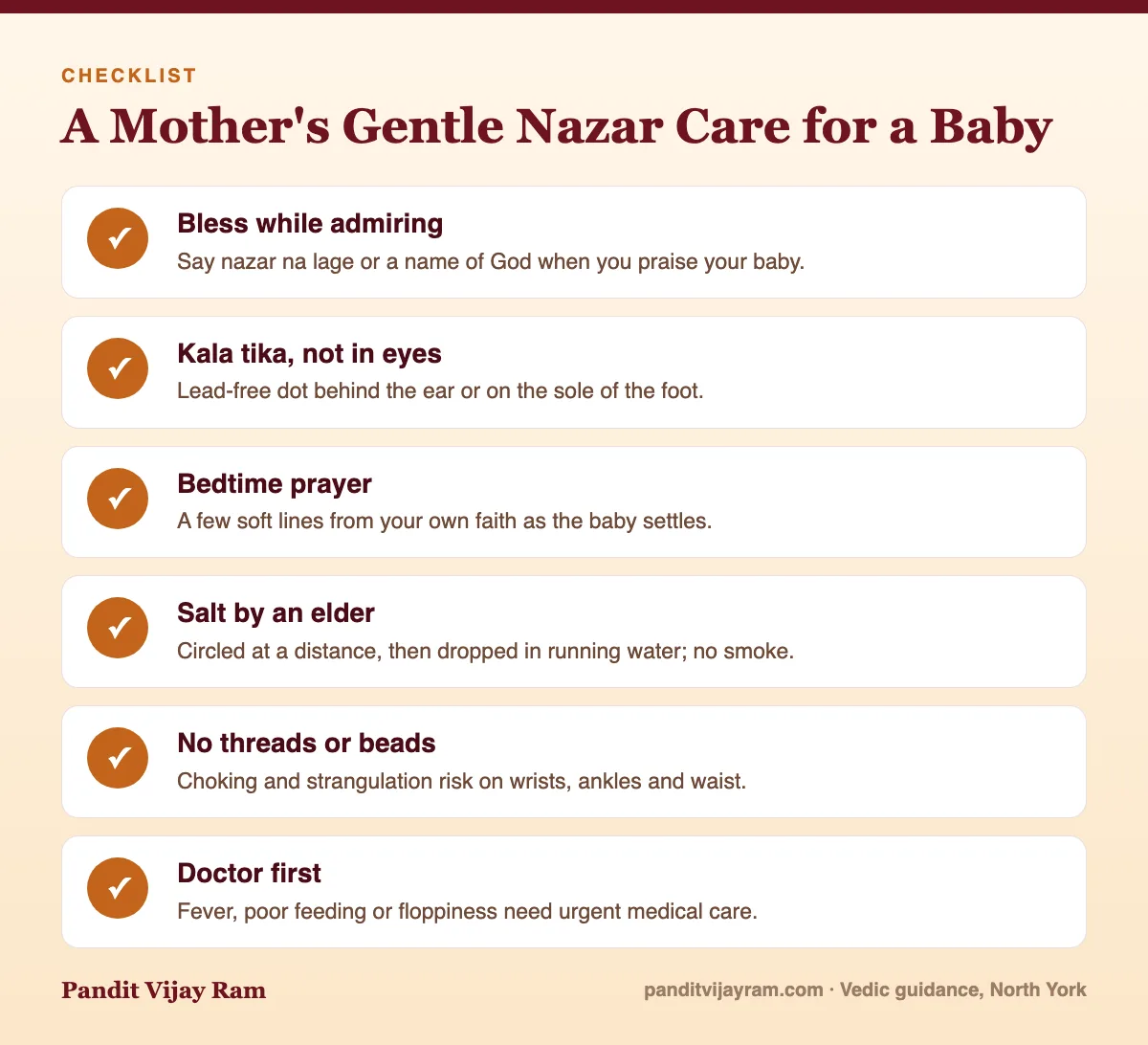
The gentlest customs are also the safest: a blessing whenever she admires her baby, a tiny kajal dot behind the ear or on the sole of the foot rather than near the eyes, a short prayer at bedtime, and letting an elder do salt nazar utarna at a safe distance. Avoid smoke, threads, beads and herbal remedies.
Here is a short list of customs that carry meaning without risk.
- Bless as you admire. Say nazar na lage, Masha'Allah or a name of God each time you praise your child. It becomes a loving habit.
- Kala tika, placed safely. A dot behind the left ear, on the sole of the foot or the back of the neck. Never put kajal or kohl inside a baby's eyes. Some traditional kohl products contain lead, so choose a cosmetic-grade, lead-free product or simply a soft eyeliner pencil.
- A bedtime prayer. A few lines to Gopal, the child Krishna, to Hanuman, or from your own faith, said softly while the baby settles.
- Elder's nazar utarna. A grandmother circling salt in her fist over the baby at a little distance, then dropping it into running water. No flames, chillies or smoke near the infant.
- Rest for the mother. Many traditions keep a new mother home for about forty days. That rest protects her recovery and the baby's routine.
What to avoid: black threads, beads or bracelets on a baby's wrist, ankle or waist, which are a choking and strangulation risk. Health Canada has warned against teething necklaces and bracelets for this reason. Avoid herbal baths, oils near the face and incense in the nursery. The black dot custom is explained further in the kala tika against nazar, and broader newborn customs in protecting babies and new mothers.
When is a baby's crying or fussiness not nazar?
Almost always, crying and fussiness have ordinary causes: hunger, wind, tiredness, a wet diaper, teething, growth spurts or a cold. Some signs always need a doctor straight away, including fever in a baby under three months, poor feeding, fewer wet diapers, unusual sleepiness, breathing difficulty or a rash that does not fade.
Nazar is a comfort to talk about at home. It should never delay medical care for a baby, because infants can become unwell quickly.
A simple decision rule many families find useful:
- Ordinary fussiness: settles with feeding, burping, a diaper change, cuddling or sleep. A nazar custom alongside is harmless if it comforts you.
- Call your doctor or Health811 if crying is unusual for your baby and lasts for hours, if feeding drops off, or if you are simply worried. In Ontario, Health811 is free and answers at any hour by phone.
- Go to emergency or call 911 for a fever of 38°C or higher in a baby under three months, a baby who is floppy or hard to wake, breathing that looks laboured, blue lips, a seizure, or signs of dehydration such as a sunken soft spot or very few wet diapers.
Outside Ontario, use your province's health line. Your family doctor or paediatrician knows your baby best.
Once a doctor has checked your child, there is still space for faith. A grandmother's prayer, a lamp at the family shrine or a gentle nazar utarna can sit beside medical care. If worry about nazar stays with you after your baby is well, the nazar removal service offers calm guidance from the Vedic side.
Is it normal for a new mother to worry about harming her baby with her own eyes?
Worry is very common after birth, and some mothers experience intrusive, frightening thoughts about harming their baby, including through nazar. These thoughts are a known feature of postpartum anxiety and do not mean anything is wrong with your love. If the worry is constant or affects sleep and eating, speak with your doctor.
The first months with a baby bring sleep loss, huge hormonal shifts and a sudden sense of total responsibility. It is natural to scan for danger. For some mothers, that scanning attaches to cultural fears, and the thought that their own gaze could hurt their child becomes hard to shake.
Signs that the worry needs more than reassurance:
- You avoid looking at, holding or praising your baby because of fear.
- You repeat rituals or checks many times a day and feel unable to stop.
- You feel low, tearful, numb or hopeless most days for more than two weeks.
- You are not sleeping even when the baby sleeps.
- You have thoughts of harming yourself.
Postpartum anxiety and depression are common, treatable and nothing to be ashamed of. Talk with your family doctor, midwife or public health nurse. If you feel unsafe, call or text 9-8-8 at any time, or go to emergency.
From the spiritual side, my gentle advice is this. Your love is a blessing, not a danger. Hold your baby, admire her, say a short prayer, and let your family take some of the load so you can rest.
The bottom line
Families who ask whether a mother can give child nazar are describing a belief about love, not blame. Tradition answers it by pairing admiration with a blessing, using safe customs like a hidden kala tika and a bedtime prayer. A baby's symptoms always go to a doctor first, and a mother's lasting fear deserves care and support of its own.
Key takeaways
- Folk belief says intense love can cast nazar, but never treats it as the mother's fault.
- A mother's prayer is traditionally seen as the strongest protection for a child.
- Keep kajal away from a baby's eyes and avoid threads, beads, smoke and herbs.
- Fever, poor feeding or unusual sleepiness in a baby needs medical care right away.
- Constant fear of harming your baby can be postpartum anxiety; speak to your doctor.