
Hamsa, Nazar Battu and Evil Eye Beads: Protective Symbols Compared

A friend gives you a hamsa for your new condo, your mother hangs a blue glass eye in the car and your uncle insists on a fierce-faced nazar battu above the shop. People in North York often ask me about hamsa vs evil eye, and where the nazar battu fits, because diaspora homes now mix symbols from many traditions. That mixing is natural in a city like Toronto, yet each symbol has its own story and its own sense of where it belongs. In more than forty years of guiding families I have learned that respect for a symbol's origin makes it more meaningful, not less. This guide compares the three most common protective symbols side by side: where each comes from, what it represents, how it is placed, and what the communities who created it would want you to know. It also covers a few related charms, from the South-Indian painted pumpkin to the Latino azabache, and ends with simple guidance on choosing and using them with care.
What is the difference between a hamsa and an evil eye?
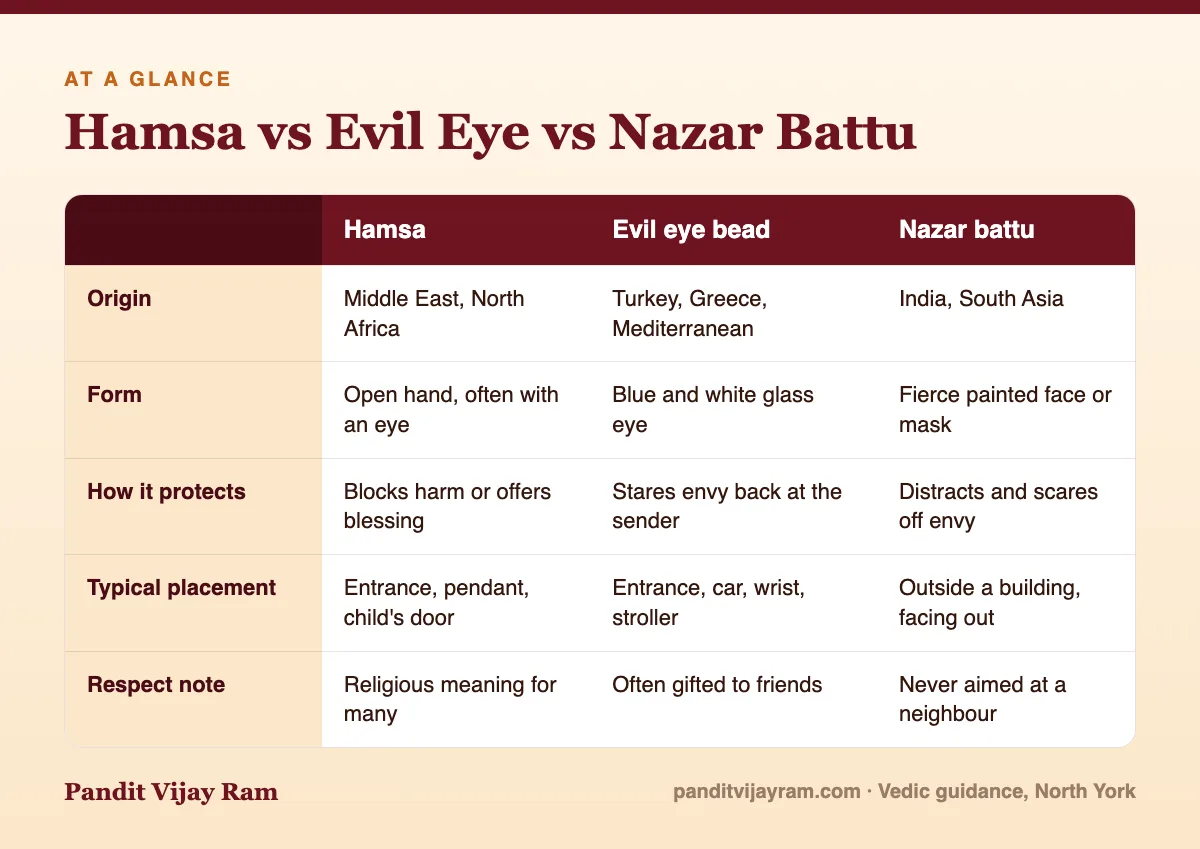
A hamsa is an open right hand, often with an eye in the palm, used by Jewish, Muslim and some Christian communities of the Middle East and North Africa. The evil eye bead is a stand-alone blue glass eye. The hand blocks or blesses; the eye stares back at envy. They are often combined.
The word hamsa comes from the Arabic and Hebrew root for five, after the five fingers. It is known in Muslim communities as the Hand of Fatima, after the Prophet's daughter, and in Jewish communities as the Hand of Miriam, after the sister of Moses. Its use as a protective sign in North Africa and the Levant is very old.
Key differences at a glance:
- Shape. Hamsa: a symmetrical hand, thumb and little finger often curved outward. Evil eye: concentric circles of dark blue, white and light blue.
- Message. The hand says stop, or offers blessing. The eye reflects the harmful gaze back.
- Material. Hamsas are made in silver, brass, ceramic and fabric. The Turkish eye, nazar boncuğu, is traditionally glass.
- Religious weight. The hamsa carries religious associations for many Jewish and Muslim families. The blue eye is more often cultural than religious.
You will often see the two merged: a hamsa with a blue eye at its centre. That combined form is popular in Israel, Morocco and Turkey alike.
A popular belief says a hamsa with fingers pointing up guards against harm, while one with fingers down invites blessing and abundance. This is widely repeated rather than ancient doctrine. For more on wearing the eye as jewellery, see evil eye bracelets and which hand to choose.

What is a nazar battu and why is it hung on new buildings?
A nazar battu is a fierce, often grinning or tongue-out face, usually painted black and red, hung on houses, shops and construction sites in India. In South India it is called drishti bommai. Its frightening look is meant to absorb or scare off envious attention before it reaches a new home or business.
Where the hamsa and blue eye work by blocking or reflecting, the nazar battu works by distraction and ferocity. Its features are deliberately exaggerated: bulging eyes, sharp teeth, a lolling tongue, sometimes horns or a moustache. Passers-by look at the ugly face rather than admiring, and envying, the beautiful new building behind it.
Many observers link its look to the kirtimukha, the fierce face of glory carved above temple doorways in South and Southeast Asia, which guards the threshold. Whether or not there is a direct line, the idea is the same: a guardian at the entrance.
Common forms you will see:
- Moulded masks of plastic, clay or fibreglass hung above a front door or gate.
- Painted ash gourds with a face drawn on, hung at construction sites in Karnataka and Tamil Nadu.
- Scarecrow-style dolls on half-built houses in rural areas.
- Small car versions hung from rear-view mirrors or bumpers on trucks.
In North India, the related everyday guard is the lemon-and-chilli string; the guide to nimbu mirchi at the door explains it. For shop owners thinking about these symbols at a grand opening, nazar on a new business or shop covers business-specific customs.
Which protective symbol should you choose?
Choose the symbol that belongs to your own tradition or that you understand and respect. Hindu and Sikh families usually find nazar battu, nimbu mirchi or a blessed thread most natural. Jewish and Muslim families may prefer the hamsa or recitation. The blue eye suits anyone wanting a gentle, widely shared sign.
A simple decision guide I share when families ask:
- Start with your own heritage. A symbol your grandparents used carries memory and meaning. That connection is itself part of the protection.
- Match the symbol to the place. A nazar battu is made for the outside of a building, facing the street. A hamsa or blue eye suits an entrance hall, a car or a wrist. Neither belongs in a crib.
- Consider your faith's view of amulets. Some Islamic scholars discourage reliance on amulets and recommend recitation instead. Some Hindu families prefer mantra and a lamp to any object. Both are valid; the guide to nazar in Muslim tradition explains the Islamic view respectfully.
- Consider neighbours and building rules. A grinning mask on a condo door may upset neighbours or break the rules. A small blue eye inside the door frame rarely does.
- Do not stack symbols out of fear. One meaningful item, kept with care, is better than ten hung in panic.
A symbol is a sign of faith, not a substitute for attention to real problems. If business is slow, look at location, pricing and service. If a family feels tense, look at communication. When those are in order and envy still seems to cast a shadow, a consultation through evil eye and nazar removal can add structured spiritual protection.
Where should you hang a hamsa, evil eye or nazar battu?
Hang a nazar battu high on the outside of the main entrance, facing out. Place a hamsa or blue eye just inside or beside the front door, in the car, or on a keychain. Keep all of them clean and off the floor, and never place a sacred-feeling symbol in a bathroom.
Placement customs differ, but a few patterns are shared:
- Nazar battu. Above the main door or gate, on the front of a shop, or on scaffolding during construction. Always facing outward, towards the street. Families rarely bring it inside, because its fierce look is not meant for living rooms.
- Hamsa. At the entrance, often opposite the front door, or above a child's door. In Jewish homes it may hang near, but is distinct from, the mezuzah on the doorpost. Some people wear it as a pendant.
- Blue eye. Hung near the entrance, from a car's rear-view mirror where it does not block the view, on a baby's stroller canopy, or above a shop till.
Care is simple. Dust symbols regularly; a grimy guardian sends the wrong message. Replace a cracked bead or a faded mask. Wipe ceramic and metal with a soft cloth rather than soaking them.
Safety matters too. Mirror-hung items should be short enough to stay clear of your sightline, and heavy masks must be fixed firmly so wind or a slammed door cannot drop them on anyone. In condos and rented units, check the rules before fixing anything to the corridor side of a door; the inside of the frame works just as well for most families.
Is it respectful to use a protective symbol from another culture?
Usually yes, when it is done with understanding. Turkish, Greek, Jewish, Muslim and South-Asian communities commonly gift their protective symbols to friends. Respect means learning where a symbol comes from, keeping it in a dignified place, not mocking its look, and not selling it as a ritual cure for serious problems.
Toronto is a city where a Gujarati family may have a Greek neighbour, a Moroccan colleague and a Mexican godparent. Sharing protective symbols is part of that friendship, and most traditions welcome it. A few habits keep it respectful:
- Know the name and origin. Calling a hamsa a hamsa, rather than a lucky hand, honours the people who made it.
- Keep it in a dignified place. Off the floor, out of bathrooms, not used as a doormat or a joke.
- Do not strip religious meaning carelessly. A hamsa with Hebrew or Arabic prayers on it is closer to a sacred object; treat it accordingly.
- Do not use symbols to frighten. Hanging a nazar battu pointed at a neighbour's house, as a quiet accusation, turns a guardian into an insult.
- Be wary of sellers. Anyone claiming a mass-produced symbol is specially charged and must be bought at a high price is selling fear.
Other cultures add their own guardians: the Italian horn-shaped cornicello, the Latino azabache fist of jet worn by babies, the Greek mati. If you are curious about how belief in the evil eye travels across these communities, the evil eye across cultures goes further. More guides sit in the evil eye and curses hub.
The bottom line
Comparing hamsa vs evil eye vs nazar battu shows three answers to one old worry: a hand that blocks, an eye that stares back, and a fierce face that distracts. Each comes from a different region and carries its own placement customs, with the nazar battu facing outward from a building and the hamsa and blue eye kept near the entrance or worn. Used with knowledge of their origins and without fear, all three can sit comfortably in a modern GTA home.
Key takeaways
- The hamsa is a protective hand from the Middle East and North Africa.
- The blue evil eye bead is a Turkish and Mediterranean glass amulet.
- The nazar battu is a fierce face hung outward on South-Asian buildings.
- Choose a symbol from your own tradition or one you understand and respect.
- One cared-for symbol is better than many hung out of fear.