
Evil Eye Bracelet: Does It Work, Which Hand and When to Replace It

Walk through any mall in the GTA and you will see the little blue eye on bracelets, phone cases and keychains. Many people in North York buy an evil eye bracelet as a gift, a fashion piece or a quiet act of faith, and then wonder which hand it belongs on and whether it actually protects them. Those are fair questions, and the honest answers are more interesting than the usual sales copy. In more than forty years of Vedic practice I have met families who wear the blue eye alongside a red kalava, a black thread and a taweez, and I respect each of those choices. What helps is knowing what each item is. This guide explains where the eye symbol comes from, which hand different traditions choose and why, the difference between a symbol and a ritually energised protection, how to clean, wear and gift a bracelet with respect, and the practical signs that it is time to replace one.
What does an evil eye bracelet mean?
An evil eye bracelet carries the nazar, a concentric blue, white and dark-blue eye that originated in the eastern Mediterranean and Turkey. The eye is meant to look back at an envious gaze and turn it away. Worn on the wrist, it signals a wish for protection, good fortune and humility about one's blessings.
The design most people know is the Turkish nazar boncuğu, a glass bead with rings of dark blue, white, light blue and a dark centre. Greek families call the same symbol mati. For centuries glassmakers in the region have produced these beads for doorways, cradles, horses and wrists.
The bracelet form grew popular much more recently, especially as the symbol moved into fashion. Today you will find it in several styles:
- Glass bead on cord. The closest to the traditional amulet, often sold in sets for families.
- Enamel or crystal on metal. Jewellery-shop versions in silver, gold or plated brass.
- Coloured variants. Shops now sell red, green, pink and purple eyes with assigned meanings. Those colour meanings are a modern marketing layer; the traditional eye is blue.
South-Asian readers may notice that the blue eye is not originally a Hindu custom. Our own traditions use the kala tika, black thread, nimbu mirchi and the nazar battu. Many diaspora families now combine them, and that is a natural meeting of cultures. For a side-by-side look at these symbols, read hamsa, nazar battu and evil eye beads compared, and see the evil eye and curses hub for related guides.

Which hand should you wear an evil eye bracelet on?
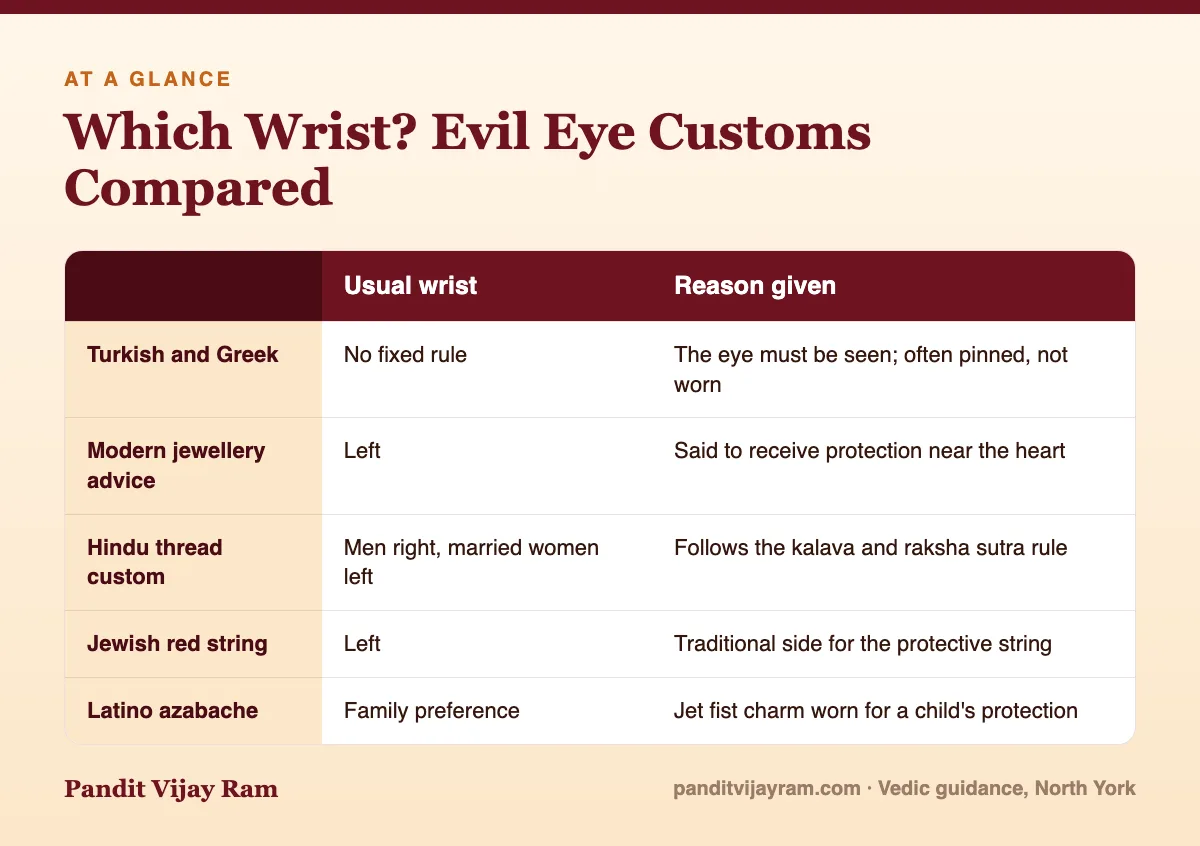
The most common modern advice is the left wrist, described as the receiving side closer to the heart, with the right wrist said to push harm away. Traditional Turkish and Greek practice has no strict rule. In South-Asian custom, hand choice usually follows the protective thread rule: right for men, left for married women.
Because the bracelet travels across cultures, each brings its own logic. A rough guide:
- Turkish and Greek homes. No fixed hand. The bead's job is to be seen, so many people pin it on clothing or hang it rather than wear it at all.
- Modern jewellery advice. Left to receive protection, right to deflect outward. This is a recent idea drawn from energy-healing language, not an old rule.
- Hindu thread custom. The red kalava or raksha sutra is tied on the right wrist for men and unmarried women and on the left for married women. Families often apply the same rule to any protective band. The guide to kalava and mauli thread explains the reasoning.
- Jewish red string. Traditionally worn on the left wrist, sometimes with a hamsa charm.
- Latino azabache. Jet-stone fist charms on a baby's bracelet, usually worn on whichever wrist the family prefers.
My own view is simple. Choose the wrist that feels comfortable and that suits your family's custom, then stop worrying about it. No tradition teaches that the wrong hand reverses protection or invites harm. A bracelet worn with calm faith on either wrist is better than one checked anxiously every hour. If you wear several protective items, a practical tip is to keep the kalava and the blue eye on different wrists so the thread does not fray against metal.
Does an evil eye bracelet actually protect you?
An evil eye bracelet is a symbol. It reminds the wearer to stay modest and mindful, and many people find it reassuring. In Vedic practice, a protective item becomes something more only when it is prepared with mantra and intention, as with a kavach or raksha sutra. A shop-bought bracelet has not been through that process.
It helps to separate three kinds of protective objects:
- A symbol. The blue eye, a hamsa, a nimbu mirchi. These work through meaning and reminder. They tell the world and the wearer that blessings are noticed and protected.
- A blessed item. A thread tied by a priest during a puja, or prasad-blessed beads. These carry the blessing of a ritual and a sankalp, the stated intention.
- An energised kavach. An amulet or yantra prepared with specific mantras, often over several days, for a named person. This is a deliberate ritual practice, described on the taweez and kavach page.
An evil eye bracelet from a mall kiosk belongs in the first group. That is not a criticism. Symbols matter. They shape how we behave, and a person who wears a reminder of modesty may share good news more carefully, which is the oldest protection against envy.
What a symbol cannot do is fix a problem that has another cause. If you are wearing three bracelets and still feel drained, look at sleep, work pressure, relationships and health first. Islamic scholars, I should add, differ on whether amulets are appropriate at all, and many Muslim families prefer recitation to objects; that choice deserves respect. If after ordinary causes are ruled out you still sense repeated envy affecting your life, a consultation through evil eye and nazar removal can look more closely.
How do you clean, wear and gift an evil eye bracelet?
Wipe the bead and metal with a soft, slightly damp cloth and dry it well; avoid soaking cord bracelets or leaving metal in salt water. Remove it for swimming, showers and heavy work. Gifting one is a traditional kindness in Turkish and Greek culture, and many believe a gifted eye carries extra goodwill.
Care depends on the material:
- Glass on cord. Wipe the glass, let the cord air dry, and keep it out of the shower. Wet cord weakens and frays quickly.
- Silver or gold. A jewellery cloth works. Avoid household cleaners and chlorine, which tarnish and pit metal.
- Plated or enamel pieces. Gentle wiping only. Salt water and soaking damage plating and loosen enamel.
Some people like to cleanse a bracelet spiritually as well. Common, gentle choices are passing it through incense smoke, keeping it overnight beside the home shrine, or holding it while reciting a short prayer. Salt bowls and long soaks, often suggested online, tend to ruin the piece. The guide to cleansing jewellery and gifts lists which methods suit which materials.
On gifting: in Turkey and Greece, a blue eye is a classic present for a new baby, a new home or a new shop. A popular belief holds that a gifted eye is stronger than one you buy for yourself, because it carries the giver's good wishes. Whether or not you hold that belief, the gesture is kind.
Two safety notes. Never put a bracelet, cord or bead on a baby or toddler; small parts are a choking hazard and cords can strangle. Pin the eye to the stroller canopy instead, firmly and out of reach. And if your skin itches under cheap metal, it may be a nickel allergy, not a spiritual reaction.
When should you replace an evil eye bracelet?
Replace an evil eye bracelet when the bead cracks or breaks, the colours fade badly, the cord frays, or it falls off and is lost. Folk belief says a cracked eye has absorbed something and done its job. Practically, a damaged clasp or cord means it will soon fail anyway, so replacement is simply sensible.
There is no fixed schedule. Some people keep the same bracelet for years; others change it when they feel the need for a fresh start, such as after a difficult season or before a new job. Common reasons to replace:
- A crack or chip. Folk custom reads this as the eye taking a hit on your behalf. Glass also chips from knocks on desks and doors, which is far more frequent. The article on what it means when an evil eye bead breaks covers both views.
- Faded colour. Sun, sweat and soap fade cheap paint and enamel.
- Frayed cord or loose clasp. Replace before it snaps and is lost.
- It no longer feels right. A valid reason. Faith objects should bring peace, not unease.
For the old bracelet, many people thank it quietly and dispose of it respectfully: wrapped in paper in the garbage, or buried in a garden pot. Glass beads should not go into the green bin or blue bin unless your municipality says so.
One caution I always give: if bracelets keep breaking and each break brings a wave of fear, it is time to step back. Constantly buying new protection can become its own source of anxiety. Notice the pattern, consider whether stress or worry is running high, and talk to someone you trust or to a counsellor if fear is starting to shape your days.
The bottom line
An evil eye bracelet is a protective symbol carrying the blue nazar eye, and it works through meaning, reminder and faith rather than ritual energising. The left wrist is the popular modern choice, but Turkish, Greek, Hindu, Jewish and Latino customs differ, and no tradition punishes the wrong hand. Care for it gently, keep it away from babies, and replace it when it cracks, fades or frays without letting each break become a source of fear.
Key takeaways
- The blue eye is a Turkish and Greek amulet that South-Asian families have adopted.
- Left wrist is the common modern choice; no tradition says the wrong hand causes harm.
- A shop bracelet is a symbol; a kavach is prepared with mantra for a specific person.
- Wipe gently, avoid salt soaks, and never put bracelets or beads on babies.
- Replace it when cracked, faded or frayed, without treating each break as an omen.