
Nazar in Muslim Tradition: Masha'Allah, Ruqyah and Protective Duas

Many Muslim families grew up hearing a grandmother say Masha'Allah the moment someone praised a child, without ever being told why. When a baby turns fussy after a busy gathering, or a new job starts badly, the question of nazar in Islam comes back with a mix of faith and worry. Readers in North York, Thornhill and across the GTA often ask me what their own tradition actually teaches, as distinct from customs picked up from neighbours. This guide sets out the core Islamic teaching on the evil eye, the words and duas the Sunnah recommends, what ruqyah is, and how scholars view amulets and beads. I am a Vedic practitioner, not an imam, and I write this with respect for a tradition that is not mine. In more than forty years of practice I have learned that people heal best inside their own faith, so I will point you to your own sources and scholars wherever that is the right step.
What does Islam teach about nazar and the evil eye?
Islamic teaching holds that the evil eye, al-'ayn, is real. A well-known hadith in Sahih Muslim states that if anything could outstrip destiny, it would be the evil eye. Yet nothing harms except by Allah's permission, so the believer's response is remembrance and trust, not suspicion of other people.
Scholars usually describe al-'ayn as harm that can follow a look of admiration or envy, sometimes without the person meaning any ill. That last point matters. In the classical sources, a loving parent or a close friend can cast it simply by forgetting to remember Allah while admiring something.
Envy, hasad, is treated as related but distinct. Hasad is a disease of the heart, the wish that a blessing be taken from someone. The evil eye can come from hasad, but it can also come from plain, careless admiration.
Many commentators read Surah al-Qalam, verse 51, as a reference to hostile eyes, and Surah al-Falaq closes by seeking refuge from the envier when he envies. The Prophet is reported to have taught specific words of refuge for his grandsons, Hasan and Husayn, asking protection by the perfect words of Allah from every devil, every harmful creature and every evil eye.
Three principles run through this teaching:
- Tawhid comes first. Only Allah protects or harms; amulets and people do not hold that power.
- Good opinion of others. Accusing a relative of envy without evidence is itself a wrong.
- Ordinary care still applies. Seeking medical treatment is part of the Sunnah, not a lack of faith.
For a wider look at how other faiths frame the same fear, the evil eye across cultures guide compares Mediterranean, Jewish, Latino and South Asian views.

Why do Muslims say Masha'Allah to prevent the evil eye?
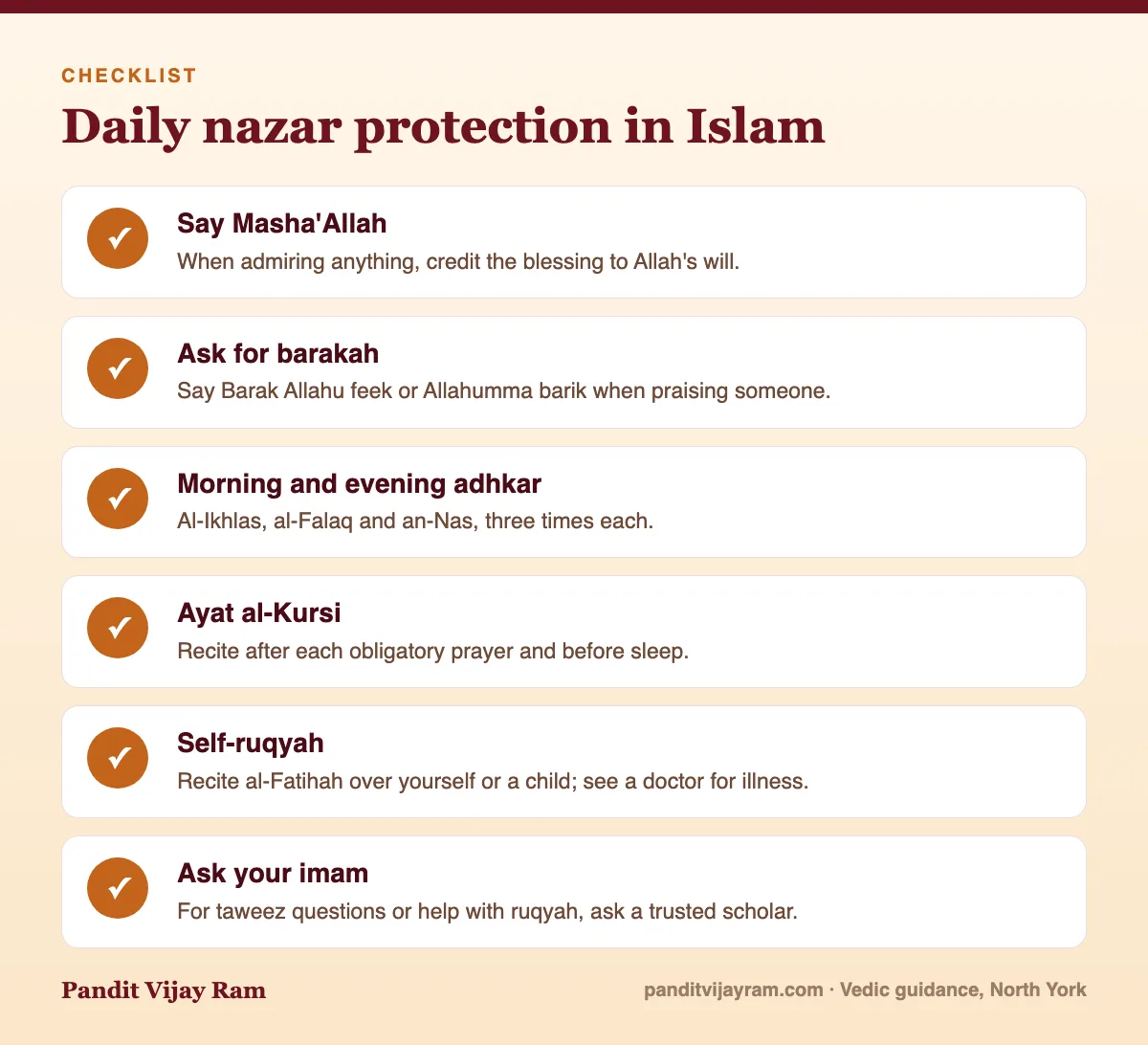
Masha'Allah means "what Allah has willed". Saying it when you admire something credits the blessing to Allah rather than to the person or object. The Sunnah also teaches asking for barakah, for example "Barak Allahu feek", so that praise becomes a prayer for the other person instead of a hidden risk.
The custom has a clear root. A hadith narrated in the Muwatta of Imam Malik tells of a companion, Amir ibn Rabi'ah, who admired Sahl ibn Hunayf while he bathed, and Sahl soon collapsed. The Prophet asked why Amir had not invoked blessing on his brother. He then told Amir to wash, and the water was poured over Sahl, who recovered.
From that account come two everyday habits:
- Bless what you admire. On seeing a beautiful baby, a new car or a good report card, say Masha'Allah, tabarak Allah, or ask Allah to bless it.
- Bless what you own. Surah al-Kahf, verse 39, has a man rebuked for not saying, on entering his garden, "Masha'Allah, la quwwata illa billah".
Scholars note that Masha'Allah is a statement of praise and humility, while Insha'Allah refers to the future. Both are often heard in GTA households of Pakistani, Somali, Afghan, Arab and Bangladeshi heritage, sometimes interchangeably. Children pick it up fastest when parents say it naturally rather than anxiously.
The habit also protects relationships. A guest who says Masha'Allah over your newborn is joining your joy, and you can receive it that way. If you want to know what other symptoms families traditionally read, the signs of nazar on a person article lists them with the ordinary causes to check first.
Which surahs and duas are recited for nazar protection?
The core recitations are Surah al-Falaq and Surah an-Nas, known together as al-Mu'awwidhatayn, often with Surah al-Ikhlas, plus Ayat al-Kursi from Surah al-Baqarah. Many Muslims recite the three short surahs three times morning and evening, and before sleep, blowing lightly into the palms and wiping over the body.
A simple daily pattern drawn from the morning and evening adhkar looks like this:
- After Fajr and after Maghrib: Surah al-Ikhlas, al-Falaq and an-Nas, three times each.
- Ayat al-Kursi (al-Baqarah 2:255) after each obligatory prayer and before sleep.
- For a child: the refuge the Prophet sought for Hasan and Husayn, "U'idhukuma bi kalimatillahi't-tammah", adapted to the child's name and gender.
- Before sleep: the three short surahs into cupped hands, then wiping over the head, face and body, as reported in Sahih al-Bukhari.
Surah al-Fatihah is also widely recited over someone who feels unwell, based on a hadith in which companions recited it for healing.
Pronunciation worries many people, especially converts and children raised in English. Learn from a teacher at your masjid or an Islamic school, and do your best meanwhile; scholars stress sincerity over perfect tajweed for personal du'a. Reciting in Arabic and reflecting on an English meaning together is common practice.
Hindu families have parallel recitations, such as the Hanuman Chalisa, described in our article on mantras for evil eye protection. I share it only so mixed households can see that both traditions answer fear with remembrance of God.
What is ruqyah for nazar and who can perform it?
Ruqyah is healing by recitation: reading Quranic verses and authentic duas over a person, sometimes over water or oil. Scholars describe lawful ruqyah as using Allah's words or names, in understandable language, with the belief that healing comes only from Allah. Any sincere Muslim may recite it for themselves or family.
Self-ruqyah is the first step most scholars recommend. You recite al-Fatihah, Ayat al-Kursi, the closing verses of al-Baqarah and the Mu'awwidhatayn, place a hand on the place of discomfort, and make du'a in your own words. Parents commonly recite over a child who is asleep.
Where a family wants help, many go to the imam of their local masjid or a known, trusted reciter in the community. Signs of a sound raqi include:
- recitation you can hear and recognise as Quran and du'a;
- no request for your mother's name for secret charts, no unknown words or symbols;
- encouragement to keep praying yourself and to keep seeing your doctor;
- no frightening claims about who harmed you.
The site has a ruqyah healing page describing how Vijay Ram ji offers recitation-based support, respectfully, to those who ask for it. Many Muslim readers will prefer a reciter from their own community, and that is a sound choice I fully respect.
Where a person is unsure what they are dealing with, the broader evil eye and nazar consultation starts with listening and ordinary causes. A decision between two paths may also suit istikhara, the prayer for guidance, which our istikhara guidance page explains.
Are evil eye beads and taweez allowed in Islam?
Scholars differ. Most hold that blue nazar beads and charms relied on for protection are forbidden, citing hadith against tamima. On Quranic taweez there is a genuine disagreement: some early scholars permitted verses worn respectfully, while many others discourage them to protect tawhid. Ask a scholar you trust and avoid anything with unknown writing.
The blue glass eye, popular from Turkey to Toronto's gift shops, sits uneasily with mainstream Islamic teaching. A hadith in the Musnad of Imam Ahmad warns against hanging a tamima, an amulet. Many families still keep one as decoration, but scholars generally advise against trusting it.
Quranic amulets are a different case. Some classical authorities allowed a verse written respectfully and worn without reliance on the object itself. Others, including many contemporary scholars, forbid them because the line between hope in Allah and hope in the object blurs, and because the verses are taken into washrooms.
A practical decision rule for your own household:
- If it contains numbers, grids, unknown names or symbols, do not wear it.
- If it is pure Quran, ask your imam whether your school permits it.
- Whatever you decide, keep daily adhkar as the real protection.
Our guide to caring for a taweez covers wearing, bathing and respectful disposal for families who keep one. Practitioners of any faith should explain what is written inside before you wear it.
Finally, if a child has a fever, stops feeding or seems unusually listless, see a doctor first, then recite. The Sunnah says Allah sent no disease without a remedy, and medicine is part of that mercy. More guides sit in the evil eye and curses hub.
The bottom line
Nazar in Islam is understood as real yet wholly under Allah's will, so the response is remembrance rather than fear or blame. Saying Masha'Allah, asking for barakah, and keeping the Mu'awwidhatayn and Ayat al-Kursi in daily adhkar form the heart of protection. Ruqyah is recitation any believer can do, with a trusted imam or reciter when help is needed, and medical care always sits alongside it.
Key takeaways
- Islamic teaching treats the evil eye as real but powerless without Allah's permission.
- Masha'Allah and a prayer for barakah turn admiration into blessing.
- Al-Falaq, an-Nas, al-Ikhlas and Ayat al-Kursi are the core daily recitations.
- Self-ruqyah comes first; a trusted imam or reciter can help further.
- Most scholars discourage blue beads; Quranic taweez is a debated question.