
Nimbu Mirchi at the Door: Meaning, Proper Use and Disposal

Walk past a shop on Gerrard Street or a home in Brampton and you may see it: one lemon and a few green chillies hanging on a black thread above the door. Nimbu mirchi is among the most recognisable protective customs in South-Asian life, yet many younger people in North York and across the GTA tell me they hang it without knowing why, or stopped because the lemon rotted on their condo door. Both reactions make sense. In four decades of advising families, I have treated this charm as what it is: a loving folk custom against the evil eye, simple to do well and easy to do carelessly. This article explains what nimbu mirchi means, where the custom comes from, how to make and hang it properly, when to change it and how to dispose of it under Canadian rules, how to adapt it for apartments, and where the custom ends and fear-selling begins.
What does hanging lemon and chilli at the door mean?
Hanging nimbu mirchi at the door is a folk protection against nazar, the harm believed to come from envious or admiring eyes. The sharp lemon and hot chillies are said to absorb or deflect that gaze before it enters. A popular story adds that Alakshmi, goddess of misfortune, is satisfied at the door and turns away.
The charm is usually one lemon with seven green chillies, threaded together and hung on the outside of the main entrance. Some families add a small piece of charcoal or a black thread. Shops, restaurants and trucks use it the same way.
There are two main explanations in circulation:
- Absorbing nazar. Sour and pungent things are believed to draw in and hold harmful attention. A passer-by's envious look lands on the bright charm instead of the home or the business.
- Feeding Alakshmi. In the folk story, Lakshmi brings prosperity while her elder sister Alakshmi brings poverty and quarrels. Lakshmi loves sweets, Alakshmi loves sour and spicy food. Offered her favourite at the door, Alakshmi eats and leaves, so she never enters.
The charm is closely related to the nazar battu, the fierce face or black doll hung on new buildings in South India, and to the blue eye bead of Turkey and Greece. Each tradition places something at the threshold to catch the eye first.
For broader background on how the evil eye differs from other kinds of harm, see the comparison of kala jadu, nazar and graha dosh.

Is nimbu mirchi a Vedic ritual or a folk totka?
Nimbu mirchi is a folk totka, a household remedy passed down by custom, rather than a ritual found in the Vedas. It is common in western and northern India and in the diaspora. That does not make it meaningless, but it means its rules come from family practice, not scripture.
Indian religious life has layers. The Vedas and later texts give mantras, yajnas and pujas. Alongside them runs a living body of lok parampara, folk tradition, made up of small acts that families repeat because their grandparents did. Nimbu mirchi belongs to this second layer, along with the kala tika on a baby and the pinch of salt waved around a child.
Being honest about this helps in three ways:
- No fixed rules. Whether the chillies number five or seven, or whether charcoal is included, varies by region. There is no single correct version.
- No priestly power needed. Anyone in the family can make and hang it. It does not need to be energised by a specialist.
- Modest scope. It is a gentle daily guard against everyday envy. It does not address chart problems, family conflict or serious harm.
You may also hear practical explanations, such as the idea that the citrus and chilli smell kept insects away from doorways. That is a popular suggestion rather than something well established. It is enough to understand the charm as faith expressed through a small, visible act.
More on home threshold customs is in the guide to main door cleansing and threshold rituals.
How do you make and hang nimbu mirchi correctly?
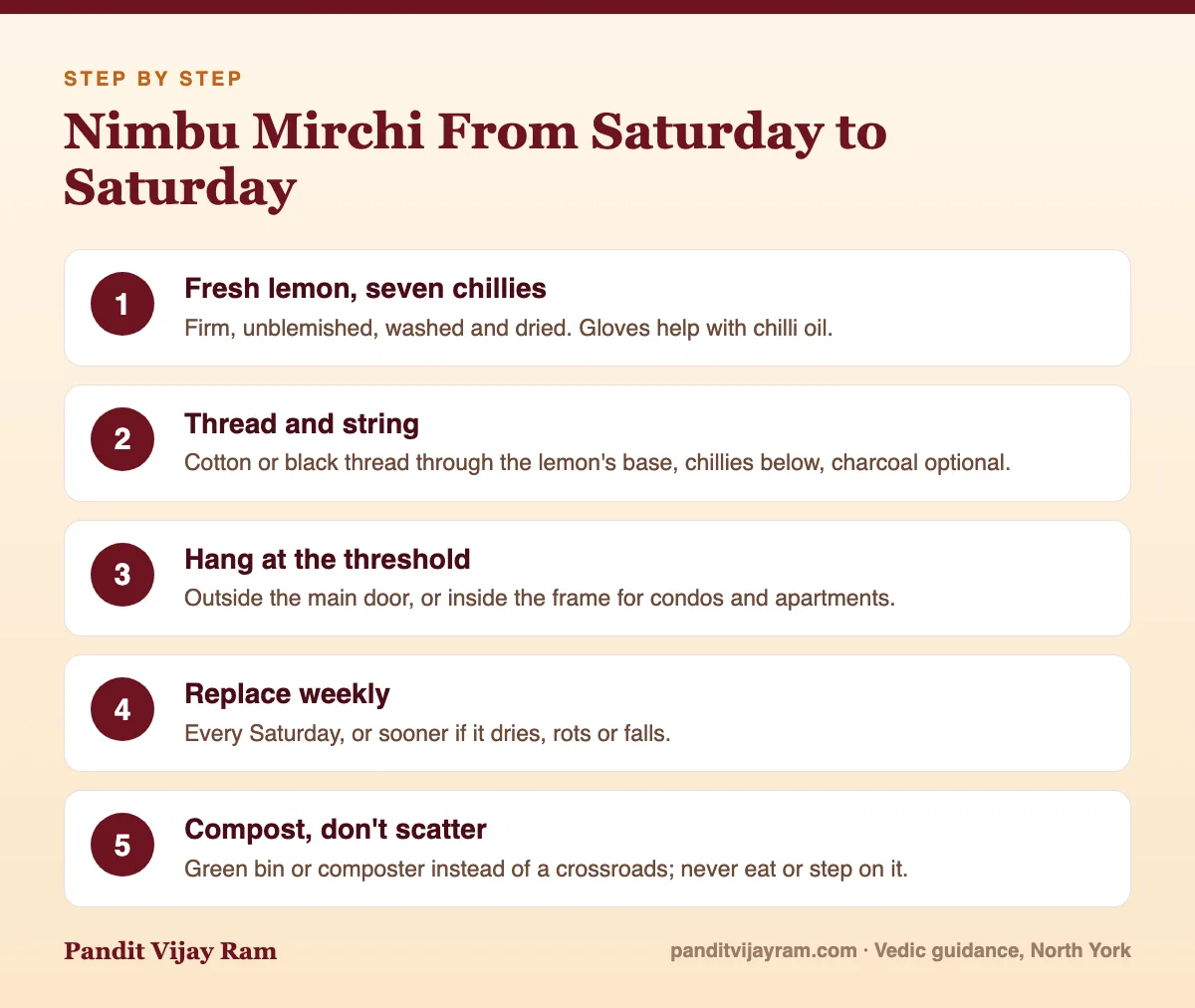
On a Saturday morning, take one firm fresh lemon and seven green chillies. Thread a clean needle and cotton thread through the lemon's base, then string the chillies below it, adding a piece of charcoal if your family does. Hang it centred above or beside the outside of the main door, off the ground.
Here is a careful method that suits most family customs:
- Choose fresh produce. A firm, unblemished lemon and seven bright green chillies with stems. Wash and dry them.
- Prepare the thread. Plain cotton or black thread, about thirty centimetres, on a large needle.
- String it. Pass the needle through the lemon near the stem end, then through each chilli just below its stem. Some families place the lemon at the bottom; follow your own.
- Add charcoal if customary. A small piece tied at the end is common in Maharashtra and Gujarat.
- Hang it outside. Centre it on the door frame or hang it from a hook beside the door, high enough that no one brushes it.
- Say a short prayer. Many people recite a line to Hanuman or Ganesh, or simply ask that the home be kept free of envy.
Wear gloves or wash your hands right afterwards. Chilli oil on the fingers is very painful if it reaches the eyes, especially a child's. Keep the needle and scraps away from small children and pets.
When should you change nimbu mirchi and how do you dispose of it?
Replace nimbu mirchi every Saturday, or sooner if it dries out, goes mouldy or falls. Take it down with care, keep it off the floor and do not eat it. In Canada, put the lemon and chillies in the green bin or compost rather than leaving them at a crossroads, and bin the thread.
Folk custom says the charm has done its work by the end of the week, having taken in whatever was directed at the home. That is why the old one is handled as something to remove, not reuse.
A respectful disposal routine:
- Take it down before hanging the new one. Lift it off the hook without letting it touch the ground.
- Do not eat or cook with it. Apart from custom, a lemon hanging outside for a week is not food-safe.
- Do not step on it. Many families say that stepping on a discarded nimbu mirchi brings the absorbed nazar onto you. Out of respect, simply avoid it.
- Compost, don't scatter. In India, people often leave it at a crossroads. In Toronto and the GTA, that is litter, and it attracts raccoons and gulls. Wrap it in paper and put it in the green bin or a backyard composter.
- Bin the thread and wash your hands.
On food waste: one lemon a week is a small amount, but some families feel uneasy about it. Composting returns it to the soil, which many find a fitting close. The guide on the lemon cleansing ritual for the body covers disposal of lemons used on a person, which follows a stricter custom.
Can you hang nimbu mirchi on a condo or apartment door?
Often not on the corridor side, because condo rules usually restrict door decorations and fresh fruit can attract fruit flies, stain the door and bother neighbours. Hang it just inside the door frame, use a small nazar battu or eye charm instead, or ask management. The intention matters more than the location.
A corridor in a North York tower is a shared, ventilated space. A week-old lemon on a painted steel door can drip, smell and draw insects, and building staff may remove it. Here are practical options:
- Inside the door. Hang the charm on the inner side of the frame, facing the entrance. Many families consider this equally valid.
- A tray, not a hook. Place it on a small dish on a shelf by the door, so any drips are contained.
- Permanent alternatives. A brass or fabric nimbu mirchi charm, a nazar battu face, or an eye bead can hang year-round. They do not need weekly replacement and produce no waste. Some families feel only the fresh version absorbs nazar; others are comfortable with a symbol.
- Ask first. Some buildings allow small door items. A short email to management avoids disputes.
For a house with a porch, the outside door is still traditional. Keep it clear of the doorbell camera and the mail slot.
The evil eye and curses hub lists other protective customs that suit small spaces.
When is nimbu mirchi not enough, and what are the warning signs of fear-selling?
Nimbu mirchi guards against everyday envy only. It cannot fix money trouble, illness, family conflict or a hard chart period. Be cautious if anyone sells an energised version at a high price, says your family is in danger without it, or insists that only they can make it work. A plain lemon and thread is enough.
The charm is comforting, but it is easy to lean on it for things it was never meant to carry. If business is failing, check pricing, staffing and location first. If a child keeps falling sick, see a doctor. If arguments fill the house, the cause is usually in what is being said.
Watch for these patterns, which have nothing to do with tradition:
- Someone claims your lemon turned black because of a curse and offers an expensive removal.
- A seller insists only their blessed nimbu mirchi works.
- You are told to keep the problem secret from your family.
- Fees rise each time you ask a question.
If you have lost money this way, the Canadian Anti-Fraud Centre takes reports.
If ordinary causes have been checked and you still feel the home or a family member is under heavy nazar, the older guide to removing nazar at home gives simple steps. Beyond that, the evil eye and nazar removal service begins with questions about daily life before any remedy.
The bottom line
Nimbu mirchi is a folk charm against the evil eye, made from one lemon and usually seven chillies and hung at the door. Make it fresh on Saturday, handle it with clean or gloved hands, and replace it weekly. In Canada, compost the old one instead of leaving it at a crossroads, and use an inside-the-door or symbolic version in condos. Treat it as a gentle guard, never as a reason for fear or large payments.
Key takeaways
- Nimbu mirchi is a folk totka against nazar, not a scriptural Vedic ritual.
- One fresh lemon and seven green chillies on cotton thread is the common form.
- Replace it every Saturday and keep the old one off the floor.
- Compost it in Canada rather than leaving it at an intersection.
- Condo dwellers can hang it inside the door or use a brass or fabric charm.