
How Often Should You Do a Spiritual Cleansing?

Once people discover that a lamp or a salt-water mop leaves a room feeling lighter, a fair question follows. Should they do it every day, every week, or only when things go wrong? Working out how often to do a spiritual cleansing matters, because too little lets clutter and tension pile up, while too much can turn a devotional habit into a source of worry. Many households I visit in North York and nearby suburbs fall into one of these two patterns. This article sets out a layered rhythm that busy families can actually keep. It covers the daily minimum, a weekly home routine, the monthly or lunar-cycle work that traditional households follow, and the extra occasions that call for a fresh start. It also explains when wanting more cleansing is a warning sign of dependence or anxiety. Over four decades of guiding families, I have seen that a small habit kept faithfully does more good than an elaborate ritual done in a panic and then dropped.
How often should you cleanse your energy?
Most people do well with three layers: a few minutes of personal practice each day, a fuller home cleansing once a week, and a deeper ritual about once a month or on a chosen lunar day. Extra cleansing is kept for clear events such as a move, a death, an illness or a serious quarrel.
Think of spiritual cleansing the way you think of housekeeping. You wipe the kitchen counter every day, clean the floors every week and do a deep clean a few times a year. Nobody scrubs the whole house every evening, and nobody should need to.
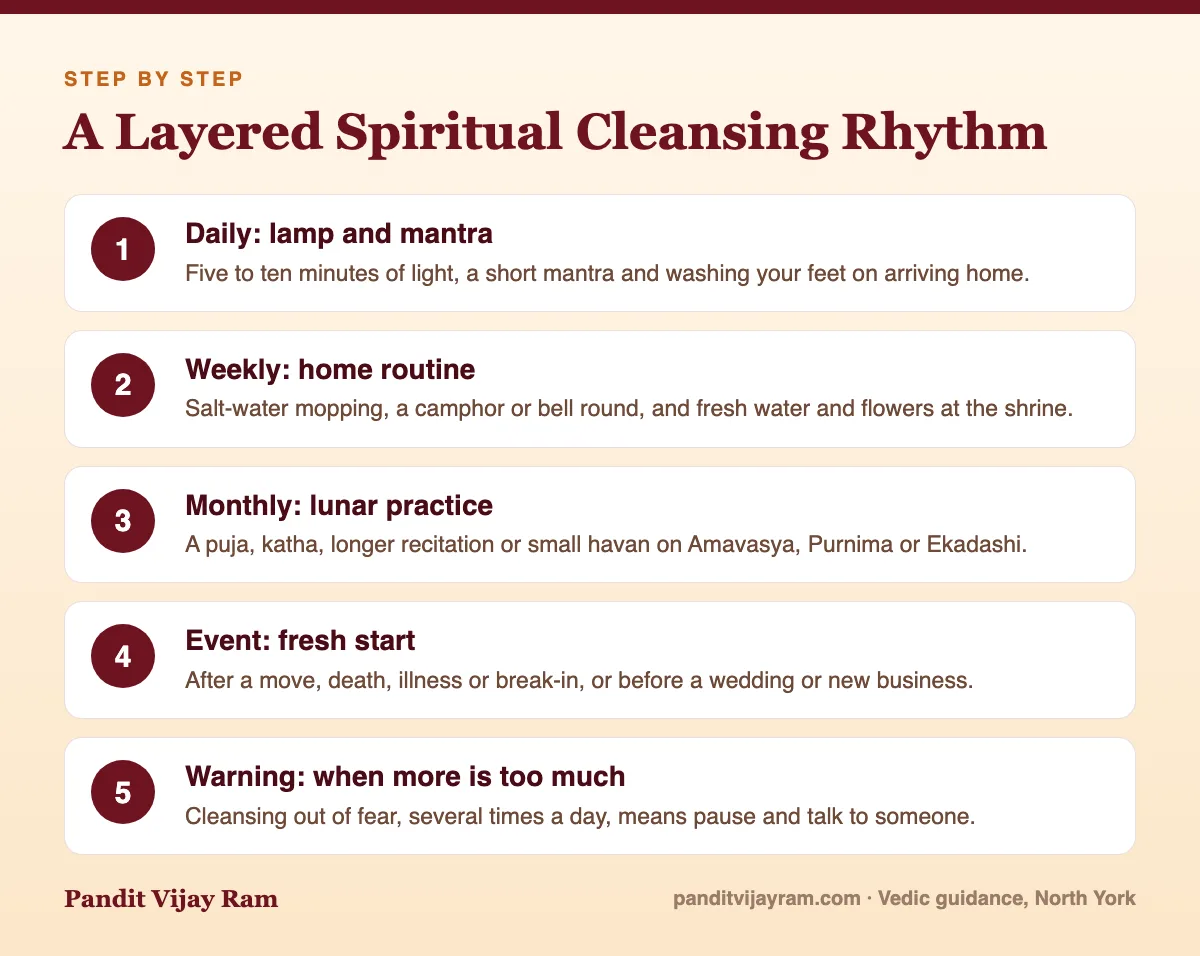
The layered rhythm looks like this:
- Daily, five to ten minutes: a ghee or sesame-oil lamp, a short mantra, and washing hands, face and feet when you come home.
- Weekly, thirty to sixty minutes: salt-water mopping of floors, a camphor or bell round through the rooms, and tidying the home shrine.
- Monthly or lunar, one to three hours: a family puja, a Satyanarayan katha, a longer recitation or a small havan.
- Occasional: after a death, a hospital stay, moving house or a frightening event.
If that feels like a lot, start with the daily layer alone for a month. People often find it is enough. The weekly layer can be shared out among family members so no one carries it all.
For the meaning behind these methods, our overview of what spiritual cleansing is explains the five families of practice. This article only addresses rhythm.

What should a daily spiritual cleansing routine include?
A daily routine needs only three things: light, sound and clean hands. Light a diya at dawn or dusk, chant one short mantra such as Om Namah Shivaya or the Gayatri mantra eleven times, and wash hands, face and feet when you come home. The whole routine takes under ten minutes.
Daily practice is about steadiness rather than strength. The goal is to keep residue from building, not to remove anything dramatic.
Morning. After bathing, light a lamp before the family deity. Many households use cotton wicks in ghee; sesame oil is traditional on Saturdays. Offer water to the sun from a copper lota if you have an east-facing window or balcony. Chant your chosen mantra while the lamp burns.
Evening. At sandhya, the time of dusk, light the lamp again. Ring a small bell once through the main rooms. Some families recite the Hanuman Chalisa at this time; our guide to home protection with the Hanuman Chalisa and Sundarkand explains that practice.
Coming home. Leave shoes at the door and wash your feet. It sounds simple, yet it marks the line between the outside world and the home.
Do not light anything you cannot watch. Snuff the lamp before you sleep or leave the house, and keep it away from curtains, children and pets. A battery lamp is an acceptable substitute in a condo where open flame is a concern; the intention matters more than the fuel.
Miss a day? Simply carry on the next. Guilt about a skipped lamp is not part of the tradition.
What does a weekly or monthly home cleansing look like?
A weekly home cleansing usually means salt-water mopping, a camphor or bell round and refreshing the shrine. Monthly work is deeper: a family puja, a longer recitation or a small havan, often timed to Amavasya, Purnima or Ekadashi. Many families pick one fixed weekday and one fixed lunar day.
Weekly routine. Choose one day and keep it. Many families pick Saturday or Sunday because the household is home. Dissolve a handful of rock salt in a bucket of water and mop hard floors, working from the back of the home towards the door. Our deep dive on salt-water mopping covers floor types and the days some families avoid. Then carry a lit camphor tablet on a steel plate clockwise through each room, with windows open. Finish by changing the water, flowers and cloth at the home mandir.
Monthly or lunar routine. Traditional households tie deeper work to the moon. Amavasya, the new moon, is linked to ancestors and the clearing of heaviness. Purnima, the full moon, suits gratitude and the Satyanarayan katha. Ekadashi is a day of fasting and prayer for many Vaishnava families. Our guide to the best day for spiritual cleansing explains these choices; always check a local panchang for exact timings in Toronto.
Seasonal markers. Navratri, Diwali cleaning and the start of a new year are natural times for a thorough home cleansing.
A monthly ritual does not have to be elaborate. Reading the Durga Saptashati over a weekend, or offering a short havan with family, is plenty.
Can you do too much spiritual cleansing?
Yes. If you are cleansing several times a day, feel anxious when you skip it, or keep adding new rituals because nothing feels enough, the practice has become a source of fear. That pattern calls for rest, a talk with someone you trust, and perhaps a doctor or counsellor rather than more ritual.
Cleansing is meant to bring calm. When it starts to feed worry, something has gone wrong. These are the warning signs I watch for:
- Cleansing the same room more than once a day because it still feels dirty.
- Feeling panic or dread if a lamp or ritual is missed.
- Spending money you cannot spare on new items, kits or rituals.
- Being told by someone that you need ever more sessions, each one more costly.
- Smoke irritating your eyes, throat or a family member's asthma, yet the routine continues.
- Ordinary events, such as a broken cup, being read as proof of a new attack.
Repeated checking and cleaning driven by fear can be a feature of anxiety or obsessive-compulsive patterns. That is not a spiritual failing. It deserves care, starting with your family doctor. If you ever feel hopeless or unsafe, call or text 988, the Suicide Crisis Helpline.
Physical over-cleansing has its own risks: smoke, heat and skin reactions from strong salt or herbal mixtures. Our article on spiritual cleansing side effects goes into these. The healthy direction is fewer, calmer rituals, not more.
When is an extra cleansing outside the routine a good idea?
An extra cleansing makes sense after a clear event: moving into a new home, a death in the family, a long illness, a burglary or a bitter quarrel. It also fits before a wedding, a new business or a major exam. Outside those occasions, the regular rhythm is usually enough.
Events give a natural reason for a fresh start. Here is a simple decision rule I share with families: if you can name the event and the date, an extra cleansing is reasonable. If you cannot name anything and simply feel uneasy, first look at sleep, health, money and relationships, then return to your normal routine.
Good occasions for an extra cleansing:
- Before moving into a new house or apartment, ideally while it is empty.
- After the sutak period that follows a death, when the family resumes worship.
- After someone returns from a long hospital stay.
- After a break-in, which can leave a home feeling violated as well as unsafe.
- Before a wedding, a griha pravesh or the opening of a shop.
For a larger ritual, such as a havan for the whole family or an anushthan over several days, a priest can plan timing and materials with you. The puja and anushthan page describes what that involves. If an event has left real fear, such as a threat from someone, contact the police first and the practitioner second.
More guides on rhythm and practice are collected on the cleansing and protection hub.
The bottom line
How often to do a spiritual cleansing comes down to layers: a brief daily lamp and mantra, a weekly home routine and a deeper monthly or lunar ritual. Extra cleansing belongs to clear events such as a move, a death or an illness. Needing ever more ritual is a warning sign of anxiety, and it calls for rest and real support.
Key takeaways
- Daily practice can be as small as a lamp, one mantra and washing your feet.
- A weekly home routine of salt-water mopping and a camphor round suits most families.
- Deeper monthly work often follows Amavasya, Purnima or Ekadashi; check a local panchang.
- An extra cleansing fits a named event, not a vague feeling of unease.
- Cleansing several times a day out of fear is a sign to pause and seek support.