
Spiritual Cleansing vs Energy Healing vs Puja: What's the Difference?
People often come to me asking for a cleansing when what they really want is a blessing, or asking for healing when the trouble is a tense house. The words overlap, and online they are used loosely. Understanding spiritual cleansing vs energy healing vs puja helps you ask for the right thing and avoid paying for something you do not need. Families in North York and the wider GTA come from many backgrounds, so some know Reiki, others know Sunday prayer, others grew up with a weekly puja. This guide explains what each practice is, what it aims to do and how it is done, then gives a clear decision guide. It also covers how the three fit together in a single ritual, and where none of them is the right answer. I have practised Vedic ritual for over forty years. One lesson keeps repeating: a clear intention, stated before the ritual begins, matters more than the name of the practice. Knowing the difference helps you form that intention.
What is the difference between spiritual cleansing and energy healing?
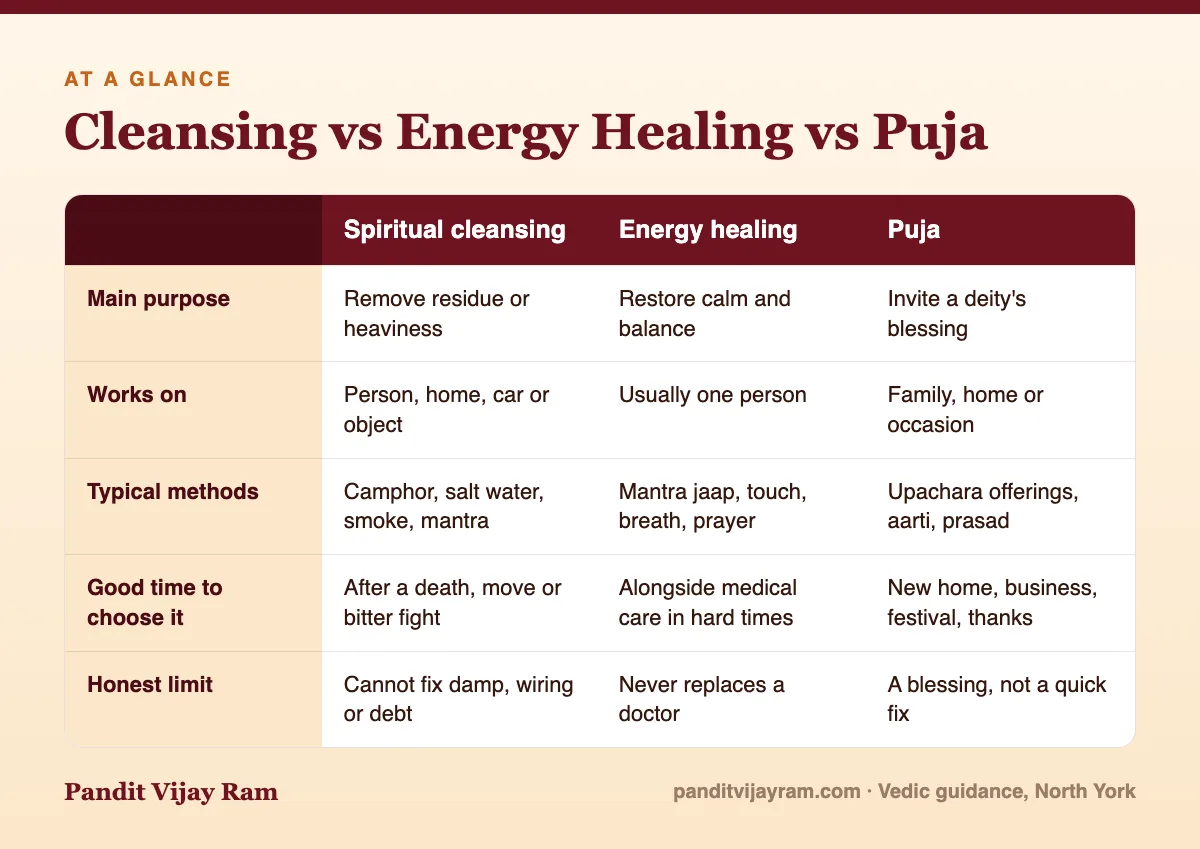
Spiritual cleansing removes something unwanted, such as heaviness in a room or residue after a hard event. Energy healing tries to restore something missing, such as calm, vitality or balance in a person. Cleansing works on people, homes and objects; energy healing almost always works on a person and their wellbeing.
A simple way to remember it: cleansing subtracts, healing adds.
Cleansing in the Vedic sense is shuddhi. It uses fire, water, sound, smoke and prayer. A camphor round through a home, salt-water mopping or a neem bath are all cleansing. It can be done for a person, a house, a car or a piece of jewellery. Our overview of what spiritual cleansing is covers the methods.
Energy healing is a broad modern label. It includes Japanese Reiki, pranic healing, some forms of chakra work, laying on of hands in Christian churches, and Vedic practices such as mantra jaap for a sick relative or Mahamrityunjaya prayer. The aim is to support a person's own strength and steadiness.
Two cautions apply. First, energy healing is not medical treatment. It may help someone feel calmer during illness, but it should never delay a doctor's visit or replace medicine. Second, many models of chakras and auras are recent adaptations. They draw on older tantric and yogic texts but are not identical to them. Our guide to chakra clearing vs aura clearing explains that history.
In practice I often pair them: a short cleansing to clear the space, then prayer for the person's wellbeing.
What is a puja and how is it different from a cleansing?
A puja is an act of worship in which a deity is invited, honoured with offerings and asked for blessing. Cleansing removes; puja invites. A puja usually begins with a short purification, called achaman and sthan shuddhi, but its centre is devotion, prayer and offering rather than removal.
A puja follows a clear structure, even in its shortest home form. The traditional sequence of offerings is called the upachara. A sixteen-step version, shodashopachara, includes invoking the deity, offering a seat, water for the feet and hands, a bath, clothing, sandalwood, flowers, incense, lamp, food and finally aarti and prostration. A five-step version, panchopachara, offers sandal, flowers, incense, lamp and food.
Before any of that, the priest purifies the space and the people. Water is sipped from the palm with mantras, a little is sprinkled on the seat and the materials, and a lamp is lit. That opening is a mini-cleansing. Then the puja proper begins.
So the difference is direction. A cleansing pushes something out. A puja draws something in: grace, protection, a sense of the sacred. Families choose a puja for a new home, a birthday, a recovery, a festival or simply gratitude.
Some pujas carry a protective purpose as well. Hanuman, Durga and Narasimha pujas are traditionally sought when people feel under pressure or afraid. Ganesha puja opens any new venture by clearing obstacles. The puja and anushthan page lists the ones Vijay Ram ji performs. A havan, the fire offering, sits between cleansing and puja; our guide to the havan for spiritual cleansing covers it.
Which ritual do I need: cleansing, healing or puja?
Choose cleansing if a place or object feels heavy or something unsettling happened there. Choose healing-focused prayer if a person feels drained or is going through illness alongside medical care. Choose puja to mark a beginning, give thanks or ask for blessing. When unsure, start with a short cleansing and a simple puja.
Use this decision rule. Read each line and stop at the first one that fits.
- Is there a safety, health or legal problem? Deal with it first: doctor, contractor, police or lawyer. No ritual replaces that.
- Did something unsettling happen in a place? A death, a break-in, a bitter fight, or a house that has stood empty. Choose a cleansing of that space.
- Does one person feel drained, low or frightened? After seeing a doctor, choose healing-focused prayer: mantra for that person, a bath ritual, or a session through the aura cleansing service.
- Are you starting something new? A house, a business, a marriage, a baby. Choose a puja, usually beginning with Ganesha.
- Do you simply want blessing or to give thanks? Choose a puja or a katha.
- Does a run of trouble track a planetary period? Choose a chart reading and graha shanti, which combines puja with mantra for a specific planet.
Many real situations call for two steps. A family moving into a resale home might do a cleansing while it is empty, then a griha pravesh puja on moving day. A relative home from hospital might receive a Mahamrityunjaya jaap alongside their medicine. The order matters: clear first, then invite.
Can cleansing, energy healing and puja be combined?
Yes, and traditional ritual usually does combine them. A full home ceremony often begins with purification, moves to puja and ends with a fire offering and prayer for the family's health. The key is a clear sankalp at the start, so everyone knows what the combined ritual is for.
A typical combined ritual in a home follows this outline:
- Purification. Achaman, sprinkling of ganga jal, a camphor or bell round through the rooms.
- Sankalp. The head of the family states the intention: names, place, purpose. This is the anchor for everything else.
- Ganesha puja. To clear obstacles before the main worship.
- Main puja. To the deity suited to the purpose, such as Lakshmi, Durga, Hanuman or Shiva.
- Havan. A fire offering with ghee and samagri, with mantras for peace and protection.
- Prayer for wellbeing. Often the Mahamrityunjaya mantra for the health of the family.
- Aarti and prasad. Closing in shared devotion.
What I avoid is mixing practices from different traditions without understanding them. Reiki attunements, Indigenous smudging and Vedic mantra each come from their own lineage with their own teachers. Respecting that means not blending them casually into a single "package".
Some families of mixed faith ask for a gentle ceremony that keeps Vedic purification and prayer but adds a reading from their own tradition. That is reasonable when discussed openly beforehand.
For a person who wants healing-focused prayer during illness, the health and wellbeing service explains how that works alongside, never instead of, medical care.
When is none of these the right answer?
None of these rituals is right when the cause is physical, financial, legal or a matter of safety. Mould, faulty wiring, an untreated illness, unpaid debts, an abusive relationship or a crisis of mental health all need practical help first. Ritual may comfort alongside that help, but it cannot stand in for it.
I turn people away from ritual more often than they expect. These are the situations where I say "not yet" or "not this":
- Health symptoms that have not been checked. Fatigue, pain, breathlessness, weight loss, poor sleep. See your family doctor first.
- Low mood that has lasted weeks. This may be depression, which is treatable. If you feel hopeless or unsafe, call or text 988 at any hour.
- A home problem. Damp, a gas smell, rodents or electrical faults are repairs, not spiritual matters.
- Fear of a person. Threats, stalking or violence go to the police. Protective prayer can come later.
- Money pressure. Never spend money you need for rent or food on a ritual, from anyone.
Also be careful when someone insists that you need all three, at length, immediately. Urgency and fear are sales tactics. A good practitioner explains choices, lets you decide and leaves you free to do nothing.
If you are unsure which category your situation falls into, a short conversation is the cheapest first step. Related reading, including the difference between energy clearing and energy cleansing, sits on the cleansing and protection hub.
The bottom line
Spiritual cleansing vs energy healing vs puja is a question of direction: cleansing removes, healing restores and puja invites blessing. Use the decision rule to match the ritual to the need, and remember that a combined ritual usually clears first and invites second. When the cause is health, safety, money or law, practical help must come before any of the three.
Key takeaways
- Cleansing removes residue, energy healing supports a person, and puja invites blessing.
- A puja begins with a short purification, but its heart is devotion and offering.
- Match the ritual to the need: place, person, new beginning or planetary period.
- Combined rituals work best with a clear sankalp stated at the start.
- Health, safety, money and legal problems need practical help before any ritual.