
Can a Spiritual Cleansing Go Wrong? Side Effects and Safe Practice

Most cleansing rituals are gentle. Even so, I am regularly asked whether something can go wrong, and the honest answer is yes. Spiritual cleansing side effects range from a sore throat after too much guggul smoke to the deeper damage done by people who exploit fear. Families in North York, like families everywhere, deserve a straight account of the risks before they light anything or hand over money. This article covers four kinds of harm: physical risks from fire, smoke and materials; emotional reactions; the trap of over-cleansing; and unsafe practitioners. For each, it explains what to watch for and what to do instead. It ends with clear guidance on when to see a doctor, call emergency services or report a scam. I have practised for more than forty years, and the cases that trouble me most were never caused by a mantra. They came from a closed room full of smoke, a frightened person told to keep paying, or a ritual pushed onto someone who needed a doctor.
Is spiritual cleansing dangerous?
A well-run spiritual cleansing is low risk. Danger comes from specific, avoidable situations: open flame left unattended, heavy smoke in a sealed room, harsh mixtures on the skin, rituals that replace medical care, and practitioners who use fear or physical force. Knowing these risks lets you keep the practice gentle and safe.
It helps to sort risks into four groups:
- Physical: burns, house fires, smoke inhalation, carbon monoxide from smouldering material, and skin or eye irritation from salt, turmeric, neem, camphor or lime.
- Emotional: tears, grief or fear stirred up by the ritual, which usually pass but can linger.
- Behavioural: cleansing over and over out of anxiety, spending beyond your means, or reading omens into everything.
- Human: practitioners who are untrained, careless or dishonest.
Most families only ever meet the first two, and in mild forms. The third and fourth are less common but do more damage.
A useful test: a cleansing should leave you calmer and better informed than before. If it leaves you frightened, injured, broke or more dependent on someone, it has gone wrong, whatever the explanation offered.
None of this means you should avoid cleansing. It means doing it with ordinary care, the same care you would use when cooking with oil or lighting a birthday candle. Our overview of what spiritual cleansing is explains the methods; this page focuses on what can go wrong with them.

What are the physical risks of smoke, fire and cleansing materials?
The main physical risks are burns and fire from lamps, camphor and havan, smoke irritation or asthma attacks from resins and samagri, carbon monoxide from smouldering dung cakes or charcoal in closed rooms, and skin reactions to salt, turmeric, neem or lime. Ingesting camphor or ritual powders is a serious poisoning risk.
Practical precautions for each material:
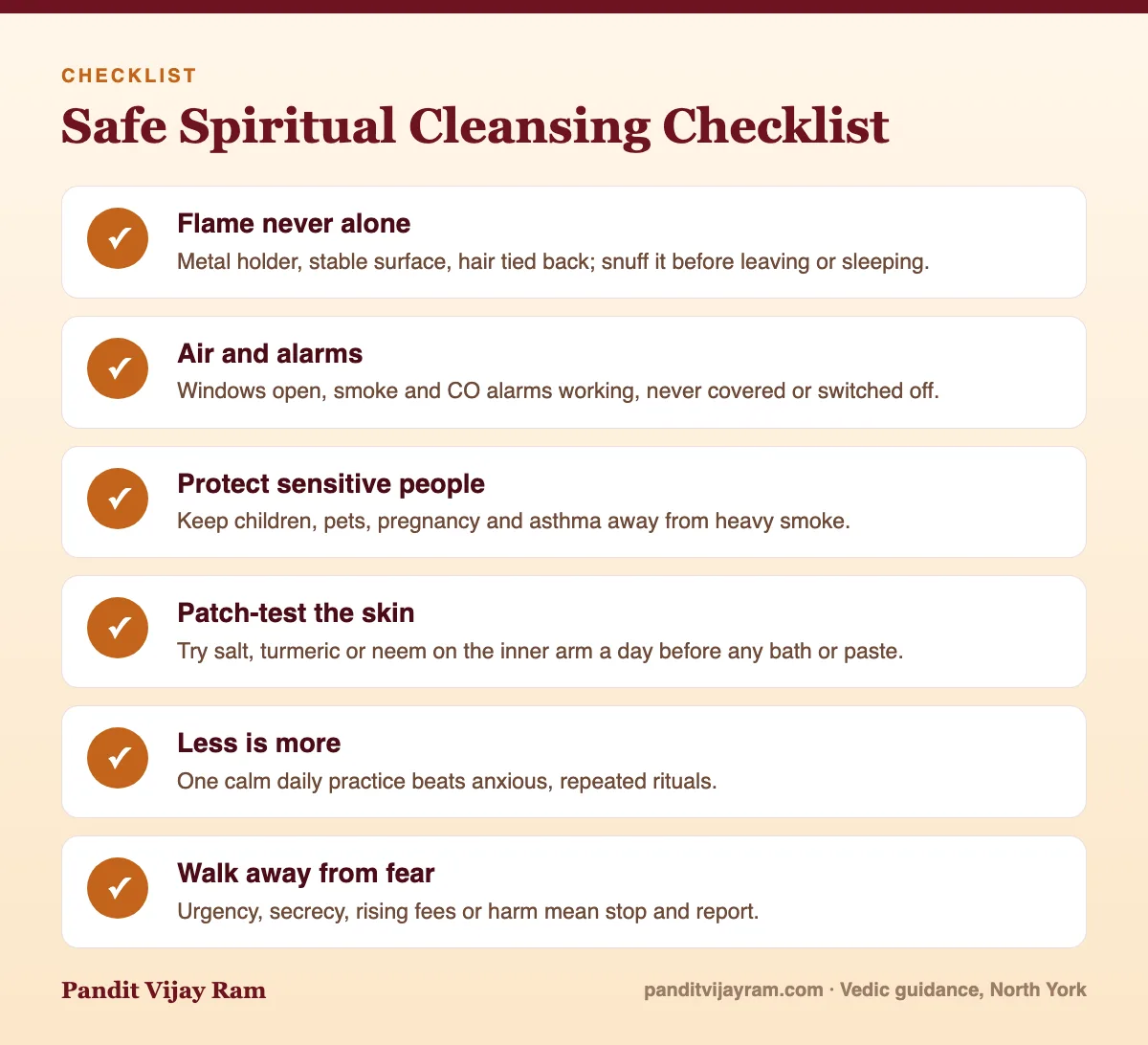
- Diyas and camphor. Use a metal holder on a stable surface away from curtains and paper. Tie back long hair and loose dupattas. Never leave a flame burning when you leave the room or go to sleep.
- Havan. Keep the fire small, the kund on a heat-proof base and an extinguisher or sand nearby.
- Guggul, loban, dhoop and dung cakes. These smoulder and release smoke and carbon monoxide. Open windows, keep a CO alarm on every floor, and never use them in a car, closet or windowless bathroom.
- Smoke-sensitive people. Anyone with asthma, COPD, a heart condition, pregnancy or a newborn should be in another room or near fresh air.
- Skin. Strong salt, turmeric, neem, lime or camphor oil can irritate skin. Patch-test on the inner arm a day ahead, and avoid broken skin and eyes.
- Swallowing. Camphor is poisonous if eaten. Some imported sindoor and kumkum powders have been found to contain lead. Keep all ritual materials away from children's mouths.
Smoke alarms: never cover, remove or disable one, even briefly. If your building is strict, choose sound, water and salt instead; our guide to cleansing a condo without smoke explains how.
For any burn that blisters, breathing trouble, chest pain or suspected poisoning, call 911 or Poison Control right away.
Why do some people feel worse after a spiritual cleansing?
Feeling worse for a short time usually reflects physical strain, smoke, fasting or emotions that surfaced during the ritual. A day or two of tiredness or tears is common. Feeling worse for longer usually points to something else, such as illness, depression, anxiety or poor sleep, which deserves a doctor's attention.
A ritual can open feelings people have held down for months. Speaking about a death, a betrayal or a fear in front of family can bring tears, a heavy chest or a restless night. That is a normal human response and often a healthy one.
What I watch for is the line between release and harm:
- Expected: tearfulness, tiredness and a wish for quiet for a day or two. Rest, eat simply and talk with someone you trust.
- Needs attention: low mood that deepens over the following week, panic attacks, inability to sleep for several nights, or thoughts of self-harm.
If you have thoughts of ending your life or feel unsafe, call or text 9-8-8, Canada's Suicide Crisis Helpline, at any hour. For persistent low mood or anxiety, see your family doctor. This is not a sign that the cleansing failed or that something is attacking you. It is a sign that you need care.
Be wary of the explanation that "feeling worse means it is working" if it comes with pressure to keep paying for more rituals. That idea can trap people in a cycle of fear. Our week-by-week guide to the first seven days after a cleansing describes normal settling, so you can tell the difference.
What is over-cleansing and how do you avoid it?
Over-cleansing is repeating rituals far more than needed, often driven by fear that something is still wrong. Signs include cleansing several times a day, feeling panic if a ritual is missed, spending money you need elsewhere and reading every small event as an attack. The answer is fewer, calmer practices and support.
Over-cleansing tends to creep in slowly. Someone has one unsettling experience, cleanses, feels a little better, then worries the next day and cleanses again. Before long the ritual is running the household.
Physical signs: sore skin from daily salt baths, stinging eyes and cough from constant smoke, cracked floors from strong salt mopping, scorch marks on shelves.
Mental signs: a sense that nothing is ever clean enough, needing to repeat a step if interrupted, avoiding rooms, and inability to rest until the ritual is done. Patterns like these can be part of anxiety or obsessive-compulsive disorder. They respond well to treatment, and a family doctor is a good first call.
How to step back:
- Choose one small daily practice, such as a lamp and a mantra, and stop the rest for two weeks.
- Air the home and do ordinary cleaning instead of ritual cleaning.
- Tell one trusted person what you are doing, so you are not alone with the worry.
- Notice whether the fear rises, then falls, when you do less.
Families sometimes worry that stopping will invite harm. In my experience the opposite is true. Calm, modest practice protects a home far better than anxious repetition. If you want an outside view, the health and wellbeing service works alongside your doctor, never instead.
How can you tell if a cleansing practitioner is unsafe?
An unsafe practitioner uses fear, urgency and secrecy. Warning signs include saying you or your family are in danger unless you pay now, demanding large sums up front, asking you to hide the ritual, offering to harm someone else, touching you without consent, or telling you to stop medicine. Walk away and seek a second view.
A genuine practitioner explains, asks questions and leaves you free to decide. An unsafe one does the opposite. Red flags include:
- Diagnosing a curse or attack within minutes, before asking about health, home or family.
- Warnings that someone will die or fall ill unless you act today.
- Fees that keep rising after each ritual "reveals" a bigger problem.
- Requests for jewellery, gold or large cash sums to be "cleansed" and returned later.
- Insisting you keep everything secret from family.
- Rituals that involve beating, burning, starving, isolating or restraining anyone, especially children or vulnerable adults.
- Advice to stop prescribed medicine or skip a doctor's appointment.
- Offers to send harm back to, or control, another person.
Any ritual involving physical harm or confinement is abuse, not spiritual work. Call the police. Financial pressure and fake rituals can be reported to the Canadian Anti-Fraud Centre.
We cover these patterns in more depth in our guides on choosing a genuine cleansing practitioner in Toronto and negative energy removal scams. Every guide in this series is listed on the cleansing and protection hub.
The bottom line
Spiritual cleansing side effects are mostly mild and short-lived, such as smoke irritation, tiredness or a day of tears. Real harm comes from avoidable mistakes: unattended flames, sealed rooms, harsh mixtures, obsessive repetition and practitioners who trade on fear. Keep the practice small and safe, see a doctor for symptoms that linger, and report exploitation.
Key takeaways
- Most side effects of cleansing are mild: smoke irritation, tiredness or brief tears.
- Fire, carbon monoxide, skin reactions and swallowed materials are the main physical risks.
- Feeling worse for more than a few days calls for a doctor, not more ritual.
- Over-cleansing driven by fear is common and eases with fewer, calmer practices.
- Fear, urgency, secrecy, rising fees or physical harm mark an unsafe practitioner.