
Mantras for Black Magic Removal and Bajrang Baan: Use and Cautions

When fear of jadu sets in, people often reach for the strongest prayer they have heard of, sometimes reciting it fifty times a day with a racing heart. Families from North York, Thornhill and Richmond Hill regularly ask me which mantra to remove black magic they should use, and whether the Bajrang Baan is safe to recite at home. These are good questions, because protective recitation is one of the oldest and most accessible remedies in the Hindu tradition, and also one of the most misunderstood. In this guide you will find the main protective recitations used for this purpose, what each one asks of the deity, how to pronounce and pace them, and the traditional cautions that keep the practice healthy. There is also a simple starter routine you can follow for three weeks. I have taught these recitations for more than forty years, and the people who benefit most are not those who chant the loudest, but those who chant with steadiness, humility and a calm mind.
Which mantra is used to remove black magic?
The recitations most often used are the Hanuman Chalisa, the Bajrang Baan, the Narasimha mantra and Durga's protective prayers such as the Devi Kavach. Each invokes a deity associated with fearless protection. Most households begin with the Hanuman Chalisa, then add others under guidance if a stronger discipline is needed.
Here are the recitations I discuss most often, with what each traditionally asks for.
- Hanuman Chalisa. Forty verses in Awadhi attributed to Goswami Tulsidas. It praises Hanuman's strength and devotion and includes the well-known line that ghosts and evil spirits do not come near when his name is recited. It suits everyone, including beginners and children.
- Bajrang Baan. A shorter, forceful hymn traditionally linked to Tulsidas, in which the devotee calls on Hanuman with urgency to destroy obstacles and fear. It is a plea for rescue, which is why tradition treats it with extra care.
- Narasimha mantra. The verse beginning Ugram viram maha-vishnum jvalantam sarvato mukham salutes Vishnu's fierce man-lion form, who protected the child devotee Prahlada. It is chanted for protection from fear and hostile forces.
- Om Dum Durgayei Namaha and the Devi Kavach. Durga is invoked as the shield that surrounds the devotee. The Kavach from the Durga Saptashati names the parts of the body to be guarded.
- Mahamrityunjaya mantra. Addressed to Shiva, it is recited for wellbeing and freedom from fear of death, often alongside medical care.
Gentler everyday mantras for clearing general heaviness are covered separately in mantras for negative energy removal. This article focuses on the stronger protective hymns.
Is it safe to recite Bajrang Baan at home?
Yes, for most people, if it is recited with respect and the right intention. Tradition advises reciting it after the Hanuman Chalisa, ideally on Tuesdays or Saturdays, with a clean body and calm mind. It should never be used to curse anyone, and it is not meant to be chanted fearfully dozens of times a day.
The Bajrang Baan has a reputation that makes people nervous. Some say it is too powerful for householders; others treat it as a magic bullet. The truth sits between.
The hymn opens with a doha stating that whoever offers prayer with firm faith, love and humility will have their work accomplished by Hanuman. Its heart is an intense appeal, repeatedly asking Hanuman to come quickly and remove the devotee's suffering. That intensity is why elders attach these cautions:
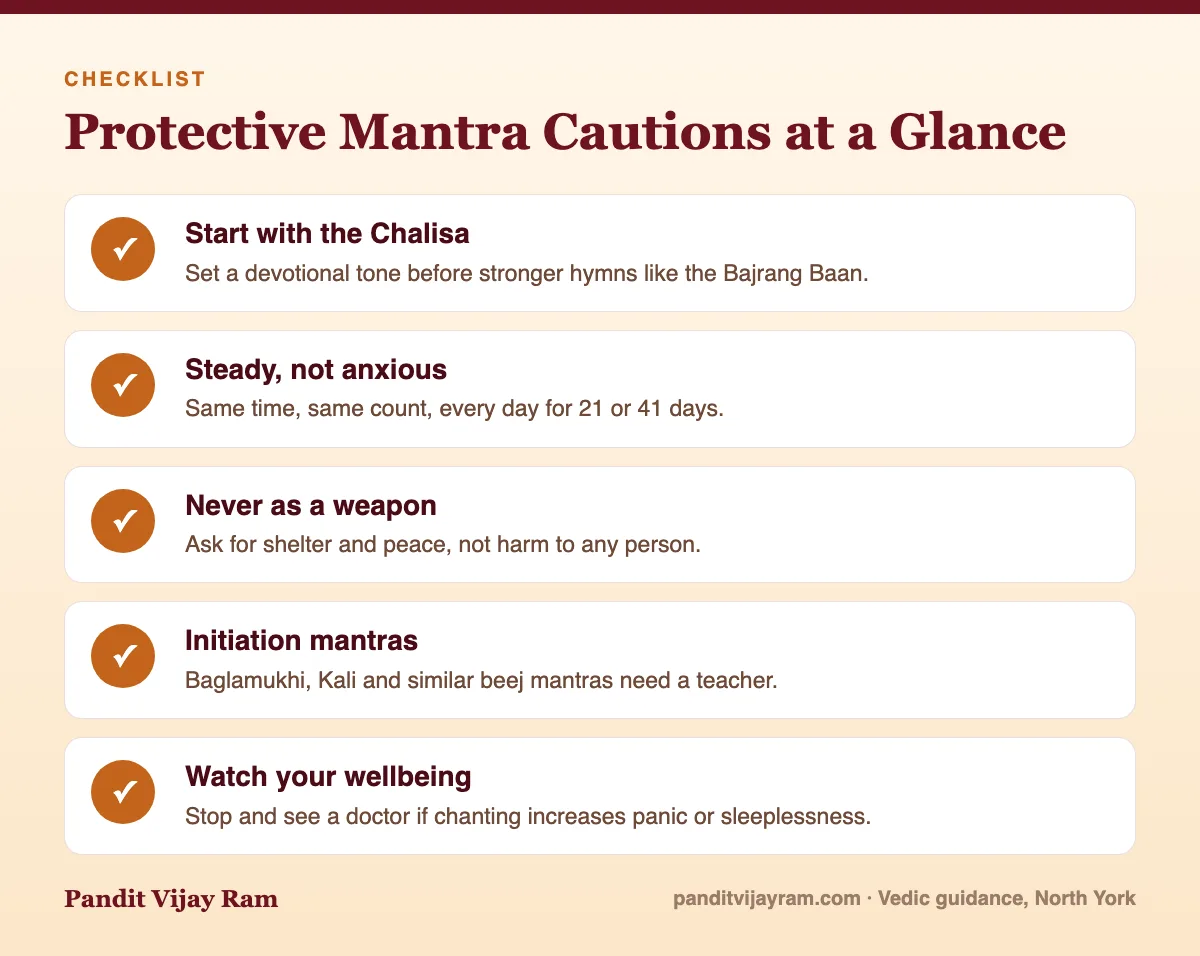
- Recite the Hanuman Chalisa first. It sets a devotional tone before the urgent appeal.
- Keep it for real need. Many families reserve it for times of genuine distress rather than casual daily use.
- Choose a steady count. Once a day, or a fixed number such as 7 or 11, is far better than an anxious, unlimited count.
- Purity matters. Bathe, wear clean clothes, avoid alcohol and meat on recitation days, and sit facing east or north.
- Never aim it at a person. Asking Hanuman to harm a relative or an ex goes against the spirit of a deity known for service and restraint.
If you are pregnant, unwell or very anxious, keep to the Chalisa and seek guidance before adding the Baan. For families who want to organise collective recitation, see home protection with Hanuman Chalisa and Sundarkand.
How many times should I chant a mantra for protection from black magic?
Consistency matters more than volume. A traditional starting point is one mala of 108 repetitions for short mantras, or one to eleven recitations of a longer hymn, at the same time each day for 21 or 41 days. Intensive jaap of tens of thousands of repetitions needs a teacher's guidance.
People often ask me for a magic number. Tradition does offer counts, but they serve discipline rather than arithmetic.
- Short mantras such as Om Dum Durgayei Namaha or Om Hum Hanumate Namah are counted on a mala of 108 beads. One to three malas a day is ample for a householder.
- Longer hymns such as the Hanuman Chalisa are recited 1, 3, 7 or 11 times. The Bajrang Baan is usually recited once.
- The Narasimha verse is often chanted 11 or 21 times, especially at dusk.
- Cycles of 21 or 41 days give shape to the practice, and a closing havan or offering marks the end.
A full purashcharana, where a mantra is chanted a large prescribed number of times with fasting rules and a concluding fire ceremony, is a serious undertaking. I do not recommend attempting one alone, because errors in pronunciation, overexertion and fasting without medical advice can do harm.
Overall timeframes for a full removal plan are discussed in how long black magic removal takes. A daily practice you can actually keep is worth more than an ambitious one you abandon in a week.
Which protective mantras should not be chanted without guidance?
Tantric and fierce-deity mantras, such as Baglamukhi, Kali or Pratyangira beej mantras, are traditionally given through initiation by a qualified teacher. The same applies to any mantra framed as stopping or binding an enemy. Devotional hymns like the Hanuman Chalisa are open to all and remain the safest starting point.
Online videos now offer mantras that, in tradition, were passed from teacher to student with careful instruction. A few cautions are worth knowing.
- Initiation mantras. Beej mantras of Baglamukhi, Kali, Chhinnamasta and Pratyangira are associated with the Dus Mahavidya and tantric lineages. Teachers usually require diksha, specific rules and a supervised count.
- Stambhan and maran language. Mantras promising to freeze, silence or destroy an opponent are exactly what I advise against. Even when framed as self-defence, they keep the mind fixed on an enemy.
- Midnight and cremation-ground rituals. These belong to specialised traditions and have no place in a family home.
- Pronunciation. Sanskrit sounds matter, but sincerity matters more. If you are unsure, listen to a trusted recording or ask a priest to chant slowly with you.
- Health and mind. If chanting raises panic, causes sleeplessness or becomes compulsive, stop and speak to your family doctor. Prayer should calm you.
A frequent question is whether a mantra can be sent back at the person who caused harm. The answer is no, and why return-to-sender rituals are refused explains the reasoning.
When do mantras need the support of a puja or practitioner?
Home recitation is often enough for mild unease. Consider a practitioner when troubles persist after a full cycle of steady practice, when several family members are affected, or when you feel too frightened to pray calmly. A Hanuman puja or a guided anushthan can carry the sankalp more formally.
Mantra is the backbone of most removal work, but it is not always the whole of it. Signs that it is time to seek support include:
- A full 21 or 41 day cycle has passed with no change in sleep, mood or home atmosphere.
- The whole household is affected, not just one person.
- You find yourself unable to sit through a single recitation because of fear.
- You are being pushed by others to chant harsher mantras or perform rituals you do not understand.
In these situations a formal Hanuman puja and havan can open a structured anushthan, with the priest reciting on your behalf and you continuing a lighter home practice. Where the concern is specifically jadu, the black magic removal service adds a chart review and cleansing.
Before either, rule out ordinary causes. Poor sleep, untreated anxiety or depression, money stress and conflict at home can all make prayer feel heavy. Your family doctor is the right first stop for physical or emotional symptoms, and in a crisis you can call or text 988 at any hour. Further reading on related protection is gathered in the magic and entities hub.
The bottom line
The Hanuman Chalisa, Bajrang Baan, Narasimha mantra and Durga's protective prayers are the main traditional choices when people look for a mantra to remove black magic. Steady daily recitation over a fixed cycle matters far more than large counts. The Bajrang Baan deserves respect, a clear purpose and a place after the Chalisa, and tantric or enemy-focused mantras need a qualified teacher. If home practice brings no peace after a full cycle, seek guidance and check ordinary causes first.
Key takeaways
- The Hanuman Chalisa is the safest starting point for protective recitation.
- Recite the Bajrang Baan after the Chalisa, with a clear and non-harmful intention.
- A steady daily count over 21 or 41 days beats anxious, unlimited chanting.
- Tantric beej mantras traditionally require initiation from a teacher.
- Stop and see a doctor if chanting increases panic or sleeplessness.