
How to Clear Negative Energy From Jewellery, Gifts and Second-Hand Items

A grandmother's bangle, a ring from an ex, a sofa from a marketplace listing, a sari bought at an estate sale. Objects carry memories, and some people feel uneasy wearing or keeping them. If you want to cleanse jewellery of negative energy, or settle your mind about a second-hand piece, the good news is that the traditional methods are simple. Clients in North York and Scarborough ask me this most often after an inheritance, a breakup, or a bargain find that suddenly feels wrong. The catch is that some popular online tips, like soaking everything in salt water overnight, can ruin pearls, crack opals and pit silver. This guide explains which cleansing method suits which material, how to treat gifts and furniture with respect, and when an object is better returned, donated or let go. In more than forty years of practice, I have learned that the material itself tells you the method. A careless ritual that damages an heirloom helps no one, least of all the family who loved it.
Can objects really hold negative energy?
In Vedic and many folk traditions, objects that are worn close to the body or used daily are believed to absorb the mood of their owner. That belief is a matter of faith, not proof. Practically, an object also carries memories for you, and that psychological weight is real and worth addressing.
Hindu practice treats objects in layers. A murti or yantra is consecrated through prana pratishtha and is understood to hold a living presence. A gemstone set for an astrological remedy is energised with a planet's mantra before it is worn. Ordinary jewellery and clothing are thought to take on samskara, the traces of the life lived around them.
Many other cultures share the instinct. Caribbean families may bless an inherited item with prayer and holy water. Some Muslim families recite ruqyah verses over a gifted object. Latino households sometimes pass a new item through smoke during a limpia. These are respectful ways of marking a change of ownership.
Before assuming anything subtle, check the ordinary reasons an object feels wrong:
- It reminds you of a painful person or event.
- It smells musty, which often means mould or old perfume in the fabric.
- It irritates your skin, which may be nickel in cheaper metal.
- It was expensive and you feel guilty about the purchase.
If one of those fits, address it directly. For pieces given by someone you suspect wishes you harm, read about negative energy from jealousy before doing anything dramatic. The broader set of household methods sits on the cleansing and protection hub.

Which cleansing methods damage jewellery and gemstones?
Salt, acidic liquids like lemon water, long soaks and direct flame are the main culprits. Pearls, coral, opal, turquoise, lapis and emerald are porous or brittle and should never be soaked or salted. Silver tarnishes in salt and sulphur. Gold and diamonds tolerate most gentle methods if you dry them well.
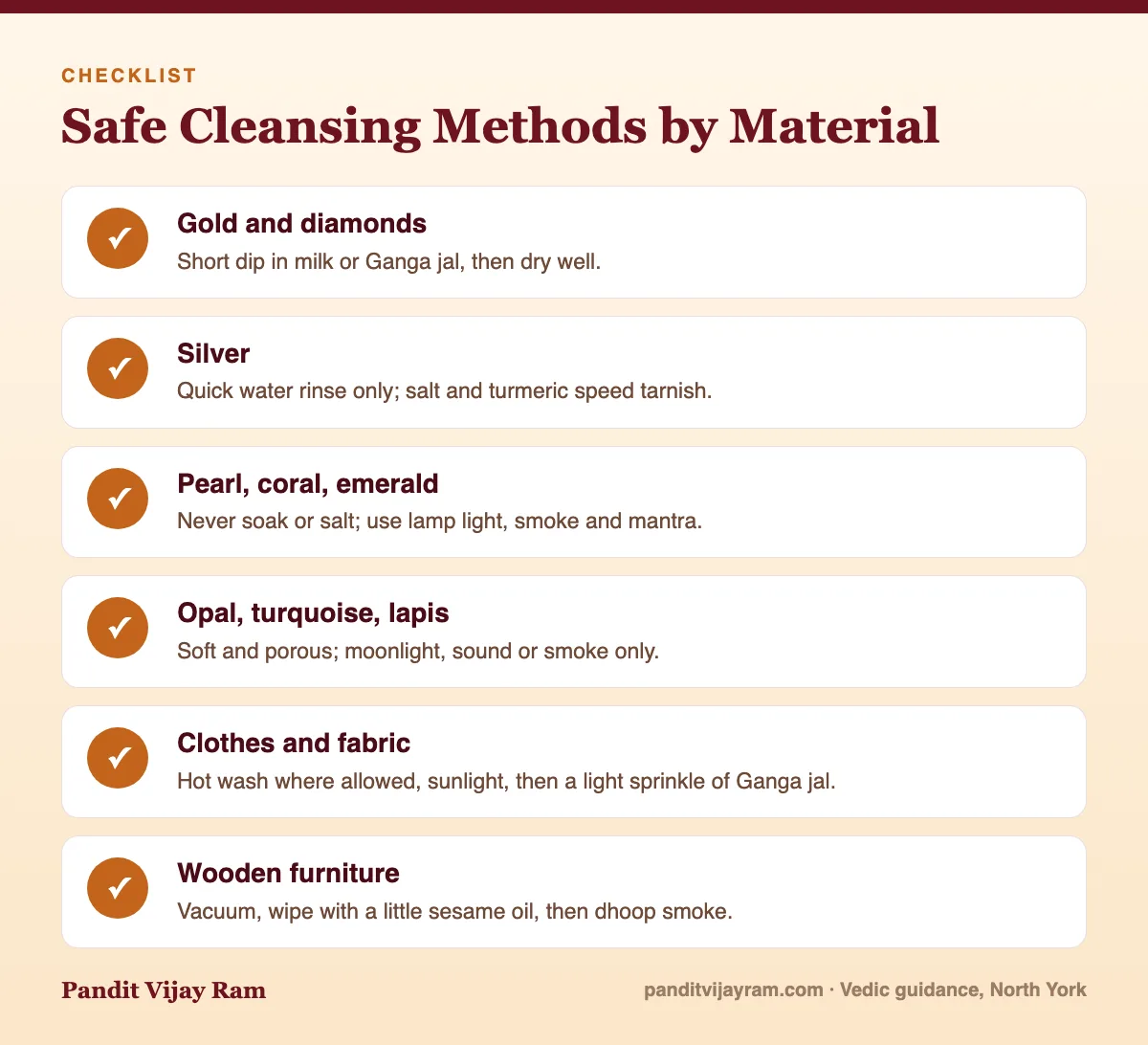
Use this material guide before trying any ritual. It is based on how jewellers clean these materials, matched to the traditional method that does no harm.
- Gold (22k, 18k) – Safe in raw milk, Ganga jal or clean water for a short dip. Pat dry. Avoid soaking if set with soft stones.
- Silver – A brief dip in clean water, then dry at once. Skip salt and turmeric, which speed tarnish and staining.
- Diamond, ruby, sapphire – Hard stones that tolerate water and milk. The setting is usually the weak point, so check prongs first.
- Pearl (moti) and coral (moonga) – Organic and porous. No soaking, no salt, no acid. Pass through incense smoke or lamp light instead.
- Emerald (panna) – Often oil-treated. Water and heat can lift the treatment. Use smoke and mantra only.
- Opal, turquoise, lapis – Soft and absorbent. Smoke, sound or moonlight only.
- Rudraksha and tulsi beads – Brush clean, then a light coat of oil. Avoid long soaking, which can crack them.
For gemstones worn as planetary remedies, the energising ritual is different and is tied to your chart. The gemstone and numerology service covers how stones are chosen and prepared. If you are unsure about the setting or a stone's treatment, ask a local jeweller before any ritual cleansing.
How do you cleanse gifted or inherited jewellery?
Start by cleaning it physically with mild soap or a jeweller's cloth. Then sit before your home altar, light a ghee lamp, hold the piece and say a short prayer of thanks to the previous owner. Offer it through incense smoke or a quick milk dip, depending on the material, and wear it after sunrise.
Inherited jewellery deserves a different tone from a bargain find. It came from someone who probably loved you. The ritual is less about removing anything and more about receiving it properly.
Many families do it like this. Place the piece on a clean cloth before your mandir or a picture of your ishta devata. Light a lamp. Speak the previous owner's name and thank them. For a grandparent who has passed, some families offer a little water with sesame seeds, the same gesture used in tarpan. Then offer the piece to the deity with a simple mantra, such as Om Namah Shivaya, eleven times.
For a gift from a living person you no longer trust, the approach changes. You are not cursing the giver. You are simply releasing their intention and claiming the object as yours. A short prayer, smoke from guggul or loban, and the words "I accept this only with goodwill" are enough for most people.
There are times to let an object go instead:
- You feel anxious every time you see it, even after cleansing.
- It belonged to an abusive ex and keeps the memory raw.
- Keeping it causes conflict in the family.
Gold and silver can be sold or melted down and remade. Many temples also accept jewellery as an offering. If the piece links to a broken relationship, our guide to cutting ties with a past relationship can help you release it with care.
How do I cleanse second-hand clothes and furniture spiritually?
Clean them thoroughly first: wash fabric hot where the label allows, air it in sunlight, and vacuum and wipe furniture. Then sprinkle Ganga jal or turmeric water, pass incense smoke over the item, and chant a short protective mantra. Sunlight is one of the oldest and safest purifiers for both.
Physical cleaning matters more with second-hand goods than with jewellery. Fabric can carry dust mites, mould and bed bugs, and these cause real discomfort that people sometimes mistake for something spiritual. Upholstered furniture from a curb or an online listing should be inspected seams first. Health Canada and city public-health pages offer guidance on bed bug checks.
Once clean, the traditional steps are simple:
- Lay clothes or cushions in direct sunlight for a few hours. Sun is honoured as Surya, a purifier in his own right.
- Sprinkle Ganga jal, or clean water with a pinch of turmeric, using a mango leaf. Skip turmeric on pale fabric; it stains.
- Pass dhoop smoke around wooden furniture, keeping embers well away from fabric.
- Chant the Gayatri mantra three times and state that the item now belongs to your home.
Antique wood can be wiped with a cloth moistened with a few drops of sesame or mustard oil, which also nourishes the finish. Do not spray salt water on wood, metal handles or electronics. For mirrors and old photographs, many families simply cover them with a cloth until they are cleansed.
If a large piece still feels heavy after this, the issue may be the room, not the object. The guide to vastu cleansing by room and direction may be more useful than another ritual.
When should I get help with an object instead of cleansing it myself?
Seek help if you found an unfamiliar object hidden in your home, if an item came with a threat or a strange instruction, or if cleansing has not settled your unease after several tries. Also speak to a professional if the worry is affecting your sleep or daily life, since anxiety deserves its own care.
Most objects need nothing more than the home steps above. A few situations call for a second opinion.
- Found objects – A lemon with pins, a knotted thread or a packet of powder hidden in a car or doorway. Do not burn it or throw it in the garbage in a panic. Photograph it, wear gloves and read the guidance on finding a suspicious object.
- Gifts with conditions – An item given with instructions such as "wear this and you will think of me". That points toward an attempt to influence you, and the ethics are covered on the taweez and kavach page.
- Threats or harassment – If someone is leaving objects to frighten you, keep evidence and report it to local police. That is a safety issue first.
When clients bring me an object, I ask where it came from, how long it has been with them, and what changed after it arrived. Often the timeline does not fit, and the real cause is elsewhere. When it does fit, a proper consecration or release ritual is usually short and does not require destroying the object. Be cautious of anyone who insists an item must be handed over to them, or that a large fee is needed to neutralise it.
The bottom line
To cleanse jewellery of negative energy, start with physical cleaning, then choose a method that suits the material rather than a one-size ritual. Soft and porous stones like pearl, coral and emerald need smoke, lamp light and mantra, while gold and hard stones can take a short milk or Ganga jal dip. Gifts and inheritances are received with gratitude, and second-hand goods are cleaned, sunned and blessed. When an object comes with threats or lasting anxiety, safety and proper support come before any ritual.
Key takeaways
- Clean every object physically before any spiritual cleansing.
- Never soak pearls, coral, emerald, opal or turquoise, and keep salt away from silver.
- Inherited jewellery is received with thanks, not treated as contaminated.
- Sunlight, smoke and mantra suit most clothes and furniture.
- Hidden objects or threatening gifts are a safety matter before a spiritual one.