
Vastu Home Cleansing: Which Rooms and Directions to Clear First

Many people try to cleanse their whole home in one go and end up exhausted, with nothing quite feeling different. Vastu shastra offers a better plan: an order of priority based on the directions of the house. If you are looking for vastu home cleansing advice, the starting point is not a ritual but a map. Families in North York, Willowdale and Brampton often show me floor plans of condos and semis that do not fit textbook layouts, and that is completely normal. This guide explains which zones matter most, why the northeast and the centre are cleared first, how the southwest and entrance follow, and what to do when your kitchen or bathroom sits in an awkward spot. You will also learn how clutter works in vastu terms and which simple remedies suit renters who cannot knock down walls. In more than forty years of vastu consultations, I have found that clearing the right corner often does more than cleansing every room twice. Order and attention, rather than effort alone, are what make a space feel settled.
What is vastu home cleansing and how is it different from regular cleaning?
Vastu home cleansing treats each part of the house according to its direction and ruling element. Regular cleaning removes dirt everywhere equally. Vastu cleansing removes dirt too, but it also decides the order, which zones must stay open or light, and which can hold heavy objects, so the home's layout supports calm and stability.
Vastu shastra is the traditional Indian science of space and architecture. Its core diagram is the Vastu Purusha Mandala, a grid laid over a plot with a cosmic figure lying face down, head in the northeast and feet in the southwest. Each square of the grid is assigned to a deity, and each direction to an element.
- Northeast (Ishanya) – water and the divine; kept lightest and cleanest.
- Southeast (Agneya) – fire; the natural kitchen zone.
- Southwest (Nairutya) – earth; heavy, stable, for the head of the household.
- Northwest (Vayavya) – air; movement, guests, storage that comes and goes.
- Centre (Brahmasthan) – space; kept open and uncluttered.
That is why a vastu approach to cleansing is selective. A heavy wardrobe is a problem in the northeast but a strength in the southwest. A cluttered centre is treated as more serious than a messy side room.
Vastu is a traditional system of belief, not engineering, and it was developed for houses built from scratch on open plots. Toronto condos rarely match. The goal is to apply its priorities sensibly to the space you have. For the full set of home methods, see the cleansing and protection hub, and for tailored layout advice, the vastu consultation service.

Why should you clean the northeast corner first?
The northeast, or Ishanya kona, is considered the most sacred zone of the home, linked with Shiva, water and spiritual clarity. Vastu teaches that clutter, heavy furniture, shoes or garbage here affect the whole household's peace. Clearing and brightening the northeast first gives every later step a clean foundation.
If you do only one thing from this guide, make it the northeast. Find it with a phone compass standing at the centre of your home. It may be a living room corner, a bedroom or even a balcony.
What to remove from the northeast:
- Shoe racks, garbage bins and recycling
- Heavy bookcases, safes or exercise machines
- Broken items, old newspapers and stacked boxes
- Dustbins and laundry baskets
What belongs there:
- A small mandir or prayer shelf, if possible
- A clean bowl of water, changed daily, or a small indoor water feature
- Light curtains and plenty of daylight
- Tulsi or a healthy green plant
To cleanse the corner, wipe it down, sprinkle Ganga jal, and light a ghee lamp there for a few evenings. Many families chant Om Namah Shivaya while doing this, since Ishanya is Shiva's direction.
A common difficulty in GTA homes is a bathroom or staircase in the northeast. You cannot move it, so keep it spotless, keep the toilet lid and door closed, and place a small bowl of sea salt on a high shelf inside, changed weekly. If the kitchen sits in the northeast, keep the stove as far south within the kitchen as you can. A vastu assessment can suggest specific remedies.
What is the brahmasthan and how do you keep it clear?
The brahmasthan is the centre of the home, governed by Brahma and the element of space. Vastu says it should be open, light and free of heavy furniture, pillars, toilets and clutter, so energy can move evenly to every direction. In a modern home, simply keeping the central floor area clear is the main remedy.
Traditional Indian homes had a central open courtyard, the aangan, which served as the brahmasthan. Light and air reached every room through it, and family life gathered around it. Modern homes rarely have this, so the idea is adapted.
To find the centre, draw diagonals across your floor plan from corner to corner. Where they meet is roughly the brahmasthan. In an open-plan condo, it may land in the living room or a hallway.
Practical steps for the centre:
- Clear the floor. Move heavy sofas, tables and storage units toward the edges of the room.
- Avoid a ceiling-heavy fixture such as a very low chandelier right over the centre, where possible.
- Keep it bright. Use a ceiling light or a lamp, and keep the space free of dark rugs piled with items.
- Cleanse it gently. Draw a simple rangoli or place a small brass bowl of water with a floating flower there on festival days.
If a staircase, pillar or bathroom sits at the centre, there is no need to panic. Keep the area very clean, add light, and avoid storing clutter under the stairs. Many vastu practitioners recommend a copper or brass vastu yantra placed nearby after proper energising.
For bedrooms that overlap the centre, the guide to cleansing a bedroom for peace covers bed position and clutter in detail.
How do you correct vastu in the southwest and the main entrance?
The southwest should feel heavy, stable and closed: a good place for the master bedroom, large wardrobes and the safe. Remove water, pits and clutter that has no use. The main entrance should be bright, clean and unobstructed, ideally facing north or east, with nothing broken near the door.
The southwest (Nairutya) is the zone of earth and of the household's stability. Vastu links weakness here with money worries and conflict between family members. Unlike the northeast, it welcomes weight. Correction usually means:
- Placing heavy furniture, bookshelves or the master bed in the southwest.
- Removing aquariums, indoor fountains or water storage from this corner.
- Fixing leaking taps or damp patches here promptly.
- Clearing unused junk, which is clutter rather than useful weight.
The main entrance is where everything enters, good and bad. It is cleansed last in the room order so that whatever is cleared leaves through it. Vastu prefers north- and east-facing doors, but south- and west-facing homes are common in the GTA and are not a disaster. Keep the threshold clean, the door hinges oiled, the light working and shoes in a closed cabinet to one side.
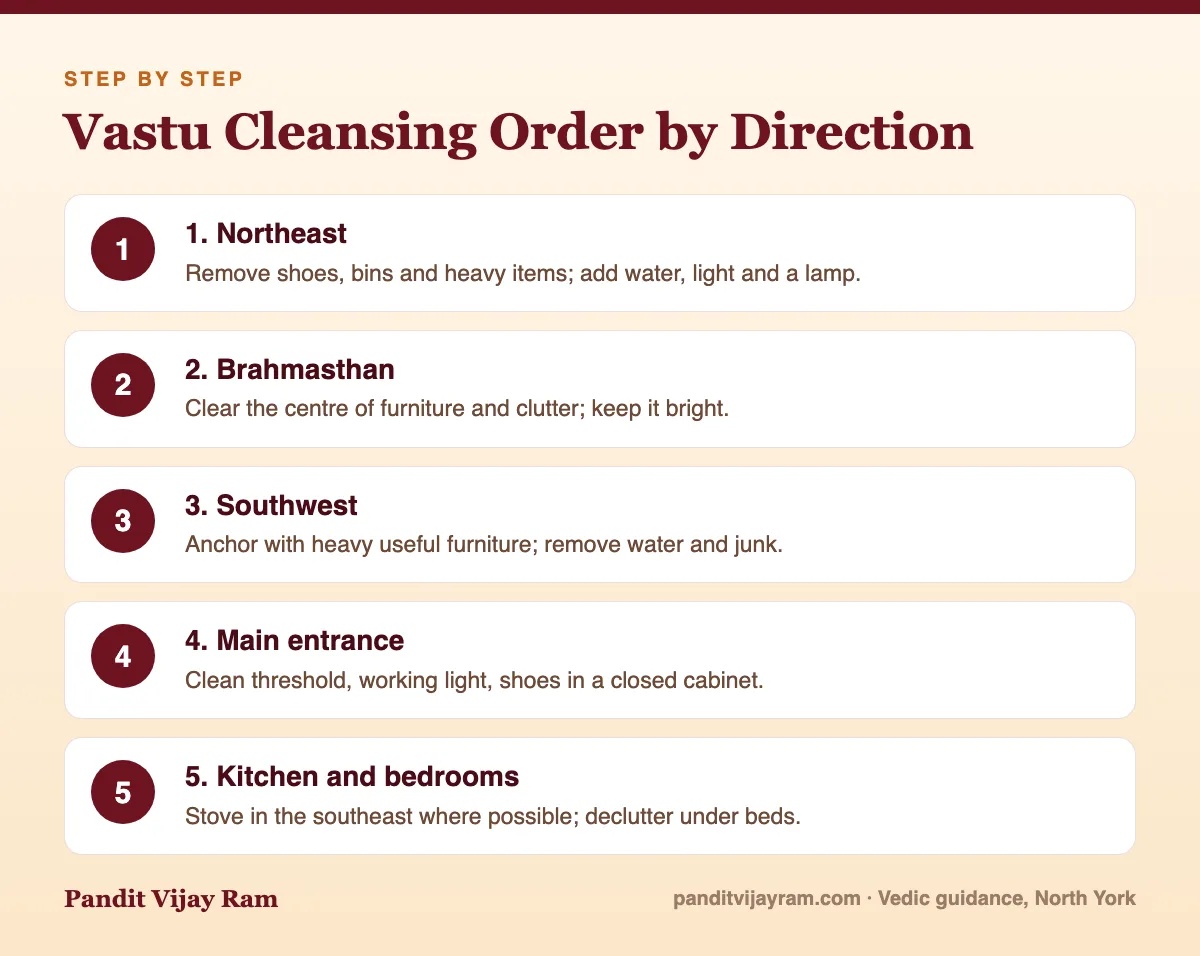
A practical priority order for the whole home:
- Northeast corner
- Brahmasthan (centre)
- Southwest corner
- Main entrance
- Kitchen (ideally southeast)
- Bedrooms, then bathrooms and storage
The entrance has its own set of rituals, from toran to rangoli. The guide to main door and threshold rituals covers those in full.
Can clutter cause vastu dosh, and what can renters do?
In vastu thinking, clutter blocks the movement of prana through the home and counts as a correctable dosh, especially in the northeast and centre. Renters can fix most issues without construction: declutter, move furniture, add light, use bowls of salt or water, and place yantras or mirrors with care.
Clutter is the most common vastu problem I see, and the easiest to solve. It is also the one with the most obvious ordinary explanation. A crowded room is harder to clean, collects dust, hides damp and makes people feel stressed. Vastu and common sense agree here.
A simple clutter rule by zone:
- Northeast and centre: remove everything that is not used weekly.
- East and north: keep light and open; store little here.
- Southwest and south: useful heavy storage is fine; junk is not.
- Northwest: good for items that move, such as guest bedding and seasonal clothes.
Renter-friendly vastu remedies:
- Rearrange beds, desks and sofas rather than walls.
- Use full-spectrum bulbs in dark northeast corners.
- Keep a covered bowl of sea salt in a problem bathroom, changed weekly.
- Place a small Ganesh image facing inward above the main door, if the landlord permits.
- Avoid adding mirrors facing the bed or the main door.
When should you get help? If you have made these changes, ruled out practical issues such as mould, noise or wiring, and the home still feels unsettled, a layout review with your chart can show which zone matters most for your family. You can book a vastu consultation in person or by video. If you have just bought a home, the guide to cleansing a new house before moving in fits naturally before any vastu changes.
The bottom line
Vastu home cleansing works best as an ordered plan rather than an all-at-once scrub. Clear and brighten the northeast first, open the brahmasthan at the centre, then steady the southwest and finish at the main entrance. Clutter in these zones is the most common and most fixable vastu dosh, and renters can correct most issues by moving furniture, adding light and using simple remedies. If problems persist after practical checks, a tailored vastu review is the sensible next step.
Key takeaways
- Vastu cleansing follows directions, not just rooms.
- The northeast is cleared first and kept light, clean and sacred.
- The centre of the home should stay open and uncluttered.
- The southwest welcomes heavy, useful furniture but not water or junk.
- Renters can fix most vastu issues by decluttering and rearranging.