
Blocked Energy: What It Means in Vedic Terms and How to Clear It
Blocked energy is one of the most common phrases I hear, and one of the least precise. A woman in North York uses it to mean she wakes exhausted. A shop owner in Scarborough uses it to mean three deals fell through in a row. A student uses it to mean he cannot focus. All three are describing something real, but they are not describing the same thing, and the remedy for one will not help the others. This article explains the vocabulary behind the word block in Vedic thought: prana and the five vayus, the nadis of yoga, graha obstructions in the chart, and karmic patterns that repeat. It then shows how a practitioner tells these apart through simple questions, and what each kind of clearing involves. In more than forty years of practice I have found that the sorting step is where most of the help happens. Once the type of block is named, the next step is usually modest and practical. Ordinary health and life causes always come first, and I will point out where a doctor should be your first call.
What does blocked energy mean in Vedic and yogic thought?
In Vedic and yogic thought, energy means prana, the breath-borne life force that moves through channels called nadis and is divided into five functions, the vayus. A block is any obstruction to that flow. The idea also extends beyond the body, to planetary influences and karmic patterns that obstruct a person's path.
The Upanishads and later yoga texts describe prana as the force that animates the body and mind. It is said to work through five functions, the pancha vayu:
- Prana vayu, centred in the chest, governing intake: breath, food, impressions.
- Apana vayu, in the lower abdomen, governing elimination and grounding.
- Samana vayu, at the navel, governing digestion and assimilation.
- Udana vayu, in the throat, governing speech, effort and upward movement.
- Vyana vayu, throughout the body, governing circulation and coordination.
These currents are said to travel along nadis, subtle channels. Hatha yoga texts speak of tens of thousands of them, with three principal ones: ida on the left, linked with cooling and rest; pingala on the right, linked with heat and activity; and sushumna in the centre.
A block, in this picture, is a place where the flow becomes sluggish, scattered or stuck. Traditional teachers describe signs such as shallow breathing, heaviness after meals, difficulty speaking up, or a restless mind that will not settle.
These are descriptions within a spiritual framework, not medical diagnoses. Fatigue, digestive trouble and breathlessness have many physical causes that a doctor should check first. The framework is useful because it points towards gentle practices, like breath work, that support daily wellbeing. The guide to pranayama for energetic cleansing covers those methods with their cautions.
What are the signs of an energy blockage?
People describe heaviness, low motivation, feeling stuck despite effort, the same setback repeating, or a part of life that never moves forward while others do. These signs are vague and overlap with stress, illness and depression, so they point to a question worth exploring, not to a confirmed spiritual problem.
It helps to sort reported signs by where they show up, because that already hints at the type of block.
Signs that sit in the body and mind:
- Waking unrefreshed, shallow breathing, tight chest or jaw.
- Feeling foggy, scattered or unable to finish tasks.
- Emotional flatness or irritability with no clear trigger.
Signs that sit in circumstances:
- Interviews that go well but never lead to an offer.
- Marriage proposals that stall at the last stage.
- Money that arrives and disappears in unplanned expenses.
Signs that sit in patterns across time or family:
- The same kind of relationship breaking in the same way.
- Siblings or parents who faced similar obstacles.
- A problem that began after a particular event and never settled.
Before treating any of these as spiritual, check the ordinary list: sleep, thyroid and iron levels, medications, mood, workload, finances, family conflict and the physical condition of your home. Persistent low mood or loss of interest in life should be discussed with your family doctor; it may be depression, which is common and treatable. The related article on negative energy or depression sets out that distinction carefully.
How does a practitioner tell prana blocks, graha obstructions and karmic patterns apart?
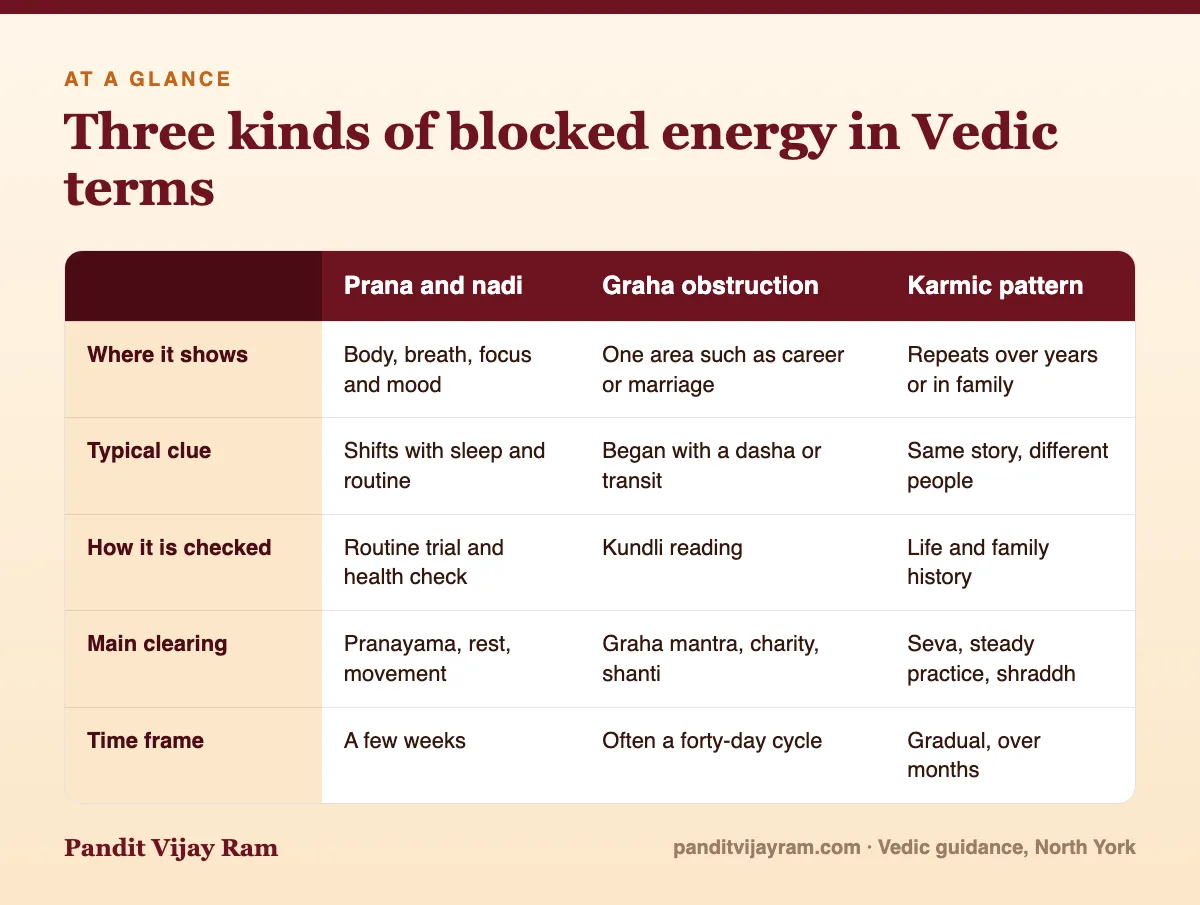
By asking where the problem lives and when it started. Body-and-mind signs that shift with breath and routine suggest a prana imbalance. Problems in one life area that began with a dasha or transit point to a graha obstruction. Patterns that repeat across years or generations suggest karmic or ancestral roots.
This is the sorting rule I use in a first conversation. The questions are simple, and you can try them on yourself.
- Does it change with sleep, food, breath or exercise? If a week of regular sleep and morning pranayama makes a clear difference, the issue is likely at the level of prana and lifestyle. Clearing means routine, breath work, diet and rest.
- Is it confined to one area of life, such as career, marriage or money? If so, the birth chart often shows a reason: a planet in a difficult house, a demanding dasha period, or Saturn's slow transit over the Moon. This is a graha badha, a planetary obstruction. Clearing means graha shanti, mantra and timing.
- Did it begin at a clear point? Dates of onset can be matched against the chart's periods, or against an event such as a move, a dispute or a loss.
- Has it repeated for years, or in parents and grandparents? Long, repeating patterns point to prarabdha karma or ancestral factors such as pitru dosh. Clearing means steady remedial practice and, where indicated, shraddh rites.
- Is it tied to one room or the whole home? Then vastu and home cleansing come into the picture.
Often more than one level is involved. A demanding Saturn period can be made worse by poor sleep and an untidy, dark home. In that case we work from the simplest level upward. A kundli and horoscope reading is how the chart level is checked.
Why the order matters
Fixing routine and home first is cheaper and safer, and it makes any chart remedy easier to judge afterwards.
How do you clear blocked energy at each level?
Clear body-level blocks with steady sleep, nadi shodhana breathing, movement and simple food. Clear graha obstructions with the relevant planetary mantra, charity and graha shanti. Approach karmic patterns with long-term practice, seva and, where ancestral factors appear, tarpan or shraddh. Vastu corrections and home cleansing address the space itself.
Each level has its own tools. Matching the tool to the level is the whole point.
- Prana and nadi level. Morning nadi shodhana, alternate-nostril breathing, for five to ten minutes. Bhramari, the humming breath, before sleep. A walk outdoors every day, even in winter. Regular mealtimes and lighter evening food. These are supportive habits, not treatments, and anyone pregnant or with heart or blood-pressure problems should check with a doctor before breath retention or forceful techniques.
- Graha level. Once a reading identifies the planet involved, a set count of its mantra over forty days, charity linked with that planet, and sometimes a graha shanti puja. For Saturn, for example, that might mean Saturday service and mustard oil offered at a Shani shrine.
- Karmic level. Here the work is slower: daily recitation, seva in the community, truthful repair of relationships, and fasting where health allows. For ancestral patterns, tarpan and shraddh, explained in the guide to pitru dosh and shraddh remedies.
- Space level. Decluttering, opening the northeast, repairing broken fixtures, and a weekly home cleansing routine.
A broader decision guide on clearing versus cleansing explains when to choose targeted work over maintenance.
When should you not treat feeling stuck as an energy block?
Do not treat it as an energy block when there is a clear medical, financial or relationship cause that has not been addressed, when the feeling is part of recent grief, or when it includes hopelessness or thoughts of self-harm. In those cases a doctor, counsellor or advisor is the first and right call.
The language of blocks can be comforting, because it suggests that something outside you is responsible and can be removed. Sometimes that is partly true. But the same language can also delay help that would work faster.
Step away from the energy explanation, at least for now, if:
- You have new or worsening physical symptoms, such as chest pain, breathlessness, weight change or persistent pain. See a doctor.
- You feel low most days for more than two weeks, or have lost interest in things you used to enjoy. Speak with your family doctor.
- You have thought about ending your life. Call or text 9-8-8 now.
- The problem is a debt, a legal dispute or a work conflict with a clear cause. A financial advisor, lawyer or union representative will help more directly.
- You recently lost someone, moved countries or ended a relationship. Adjustment takes time.
Spiritual practice is still welcome alongside this care. A daily lamp and mantra can steady you while the practical work goes on. What I discourage is paying for a large ritual to remove a block that is really an unpaid bill or an untreated illness.
When ordinary causes are covered and something still feels stuck, a measured negative energy assessment can help sort the layers. The cleansing and protection hub gathers the routines that follow.
The bottom line
Blocked energy is a broad phrase that covers three different things in Vedic terms: prana and nadi imbalance, graha obstruction and repeating karmic patterns. A few simple questions about where the problem lives and when it started usually separate them. Each level has its own clearing, from breath and routine to planetary mantra and ancestral rites. Ordinary health, money and life causes always come first.
Key takeaways
- Vedic thought links energy to prana, the five vayus and the nadis.
- Graha obstructions show in one life area and often match a dasha or transit.
- Karmic and ancestral patterns repeat across years or generations.
- Match the remedy to the level, starting with routine and home.
- Physical symptoms and persistent low mood need a doctor first.