
Energy Clearing vs Energy Cleansing: Why the Difference Matters

Energy clearing vs energy cleansing sounds like a question of wording, but the difference changes what you actually do. People in North York and across the GTA often tell me they have cleansed the house every week for months with salt water and dhoop, and nothing has shifted. Usually that is because they were using a maintenance tool for a repair job, or the reverse: booking an elaborate ritual when a steady home routine would have been enough. This article sets out the two terms in plain language, maps them to older Vedic words such as shuddhi and nivaran, and gives you a simple rule for deciding which one fits your situation. You will also see why ordinary causes still come first in either case. In more than forty years of practice I have found that naming the problem correctly saves people the most money, time and worry. A good diagnosis is often more useful than any single ritual, and it protects you from paying for work you do not need.
What is the difference between energy clearing and energy cleansing?
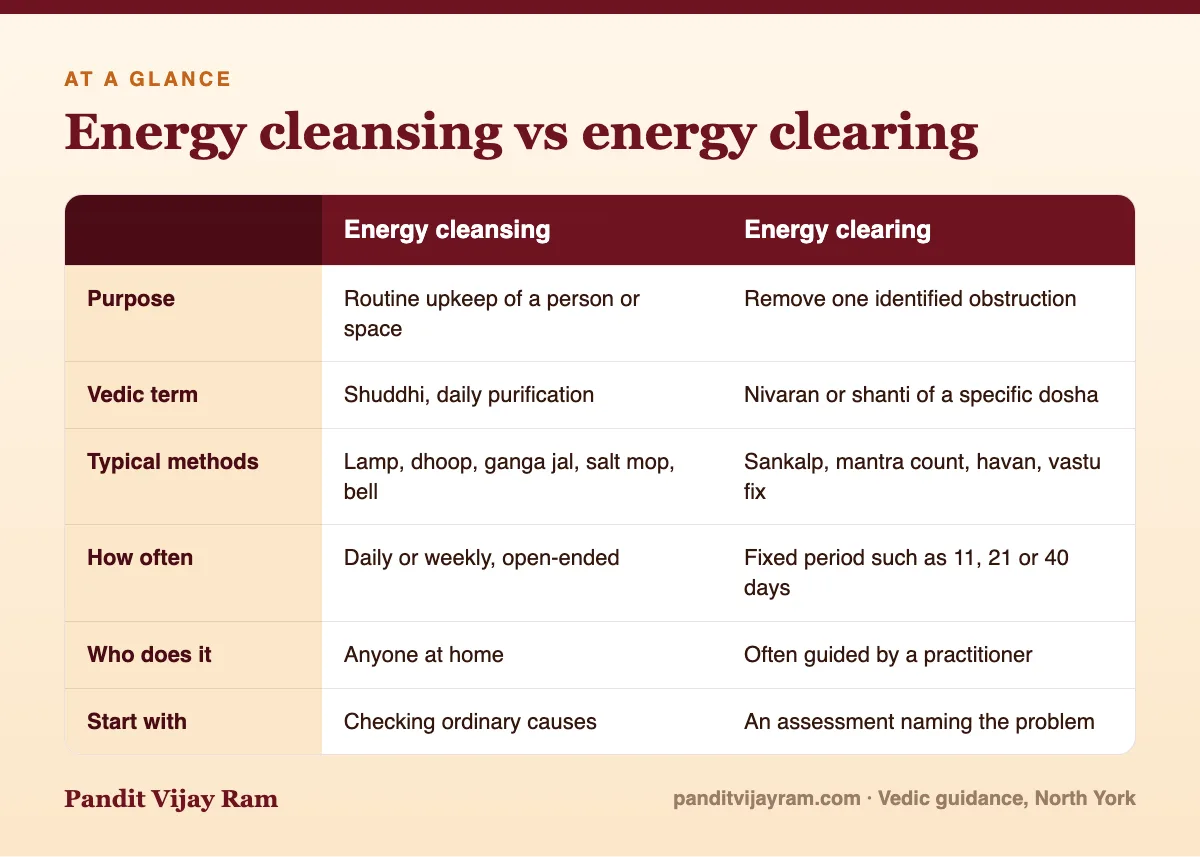
Cleansing is general and preventive: it refreshes a person or space after ordinary wear, much like daily bathing. Clearing is specific and corrective: it targets something that has stuck, recurs or resists routine practice. Cleansing can be done often by anyone; clearing usually follows an assessment and has a defined beginning and end.
Think of a kitchen. Wiping the counters every evening is cleansing. Calling someone because the drain is blocked and water will not go down is clearing. Both matter, but no amount of wiping fixes the drain.
In Vedic language the closest match for cleansing is shuddhi, purification. It covers achaman (sipping water with a mantra), prokshan (sprinkling ganga jal), the evening lamp, dhoop and the weekly salt-water mop. These practices assume nothing is seriously wrong. They simply keep a home and a mind from gathering dust.
Clearing corresponds more closely to nivaran or shanti, the removal or pacification of a particular obstruction. Examples include:
- A graha shanti for a planet that a reading shows is under strain.
- A nazar utaarna for evil eye that began after a specific event.
- A vastu correction where a blocked northeast corner is weighing on a home.
- A release practice for a lingering emotional tie to a former partner.
Because clearing targets something, it starts with a question: what exactly is being cleared, and how do we know? Cleansing needs no such question. The broader overview of spiritual cleansing describes the families of method in more depth.

How do I know if I need clearing or just cleansing?
Start with cleansing if the heaviness is general, recent and lifts at least a little with routine practice. Consider clearing if it is tied to one room, person, event or recurring pattern, if it returns quickly after cleansing, or if ordinary causes have been checked and ruled out. When unsure, ask for an assessment.
Use this decision rule. Work through the questions in order and stop at the first yes.
- Have you ruled out ordinary causes? Check sleep, health, money stress, mould, poor ventilation, flickering wiring and relationship strain. If not, address those first; neither cleansing nor clearing replaces them.
- Is the feeling general and mild? A tired house after a busy season, a low week, visitors who left the place unsettled. Use a cleansing routine for two to three weeks.
- Did a steady cleansing routine help, even partly? Then keep going. Maintenance is doing its job.
- Does it centre on something specific? One bedroom where nobody sleeps well, problems that started after a particular person visited, the same setback repeating in each job. That points towards clearing.
- Does it return within days of cleansing? Recurrence suggests a source that routine practice is not reaching.
- Is the pattern older than you? Similar difficulties across parents and grandparents may point to ancestral or chart factors.
Answers four to six do not prove anything spiritual is wrong. They mean a careful look is justified. A negative energy assessment begins with exactly these questions before any ritual is suggested.
A note on recent loss
After a death, a divorce or a move, heaviness is often grief or adjustment. Give it time and support before treating it as a block.
What methods are used for energy cleansing compared with energy clearing?
Cleansing uses simple, repeatable acts: lamp, incense, ganga jal, rock salt in mop water, a bell, and a short daily mantra. Clearing uses focused work: a sankalp naming the problem, a set count of a specific mantra, a havan with chosen samagri, a vastu correction or chart remedy, done over a fixed period.
The tools overlap, but the way they are used differs.
Cleansing practices are short, frequent and open-ended:
- An evening ghee lamp at the home shrine.
- Guggul or loban dhoop carried through the rooms, with windows open.
- A weekly mop with a handful of sendha namak in the water.
- Ringing a bell or blowing a conch in each corner.
- Sprinkling ganga jal at the main door.
- Reciting the Gayatri Mantra or Om Namah Shivaya a few times daily.
Clearing practices are deliberate and bounded:
- A sankalp, a spoken intention naming the person, place and obstruction.
- A mantra count, such as a fixed number of malas over eleven, twenty-one or forty days.
- A havan with samagri chosen for the purpose, often ending with a purnahuti.
- A physical correction: moving a heavy cupboard out of the northeast, fixing a broken main door, removing a mirror facing the bed.
- For person-related ties, prayer for release rather than any attempt to influence the other person.
Clearing is followed by cleansing, not the other way round. Once the obstruction is addressed, the routine keeps the space settled. For the aura and chakra side of this vocabulary, see the comparison of chakra clearing and aura clearing.
Can too much cleansing or clearing cause problems?
Yes. Constant cleansing can turn into anxious checking that keeps fear alive, and repeated clearing rituals without a clear reason can drain money and confidence. Smoke and fire also carry real risks indoors. If you feel you must cleanse every day or something terrible will happen, the issue may be anxiety rather than energy.
Spiritual practice should leave you calmer and more capable. When it begins to feel compulsive, something has gone off course. Signs to watch for:
- Cleansing the same room several times a day and still feeling unsafe.
- Booking one clearing after another, each promising to finish the job.
- Refusing visitors or avoiding family because they might bring negativity.
- Feeling panic if a lamp goes out or a ritual step is missed.
- Spending money on rituals that you would otherwise need for rent or food.
These patterns are common in people under stress, and they often respond well to a conversation with a family doctor or counsellor. Persistent fear and checking can be signs of an anxiety condition, which deserves proper care. Prayer can support that care but is not a substitute.
Physical safety matters too. Dhoop, camphor and havan smoke can irritate asthma, set off smoke alarms in condos and harm pets. Rotate in smoke-free methods such as sound, mantra and salt water. The safety-focused article on cleansing side effects covers these risks in detail.
Who should do energy clearing, and when can I do it myself?
You can do most cleansing yourself, and some simple clearing such as a vastu tidy, a mantra count you have been taught, or a release prayer. Seek a trained practitioner when the problem is tied to the chart, keeps returning, involves suspected black magic, or needs a havan with a formal sankalp.
A practical split looks like this:
- Do it yourself: daily lamp, weekly salt-water mop, dhoop with windows open, ganga jal at the door, decluttering, fixing broken objects, a regular mantra such as the Hanuman Chalisa.
- Do it yourself after guidance: a forty-day mantra count, a specific stotra for a planet, a simple release prayer after a break-up, moving furniture according to vastu advice.
- Ask a practitioner: graha shanti linked to a dasha period, pitru dosh rites, suspected black magic or sihr, an object you found that frightened you, or a home that still feels wrong after months of routine care.
Whoever does the work, the sequence stays the same: rule out ordinary causes, name the problem, choose the method, set a time frame, then return to maintenance. A practitioner who skips the naming step is guessing.
If you would like help deciding, the cleansing and protection hub gathers the home and personal methods, and the aura cleansing service explains how a personal assessment is structured.
The bottom line
Energy clearing vs energy cleansing comes down to maintenance versus repair. Cleansing is the steady, everyday shuddhi anyone can keep up, while clearing is bounded work aimed at one named obstruction. Rule out ordinary causes first, use the decision rule to choose, and return to simple maintenance once a clearing is complete. When practice starts to feel compulsive, step back and speak to a doctor or counsellor.
Key takeaways
- Cleansing is routine upkeep; clearing targets one identified obstruction.
- Shuddhi practices suit general heaviness that lifts with routine care.
- Recurrence, a specific room or a repeating pattern suggests clearing.
- Every clearing should be followed by ongoing cleansing.
- Compulsive cleansing is a signal to look at anxiety and stress.