
Zodiac Compatibility Myths That Hurt Relationships

A young woman once told me she was ending a happy relationship because a website called her sign and his sign a disaster. Zodiac compatibility myths travel fast on social media, and they can quietly damage couples who are actually doing well. I hear these worries from families in North York and across the GTA almost every week, usually from people who have never seen their full birth chart. In this guide you will learn where Sun-sign pairings come from, the most common myths and why they mislead, how Vedic astrology really approaches matching, and what deserves more attention than any sign label. In more than forty years of Vedic practice I have never judged a couple by their Sun signs alone, and I would gently ask you not to either. A chart is a detailed map of tendencies. Two names on a meme are not. If something is truly wrong in a relationship, it will show up in how you treat each other, and that is something you can see and talk about without any astrology at all.
Are zodiac compatibility charts accurate?
Zodiac compatibility charts are rough generalisations. They place everyone born in a month-long window into one of twelve boxes and score pairs by element. Real birth charts hold the Moon, the rising sign, seven or more planets and twelve houses. A Sun-sign chart ignores almost all of that, so it cannot describe two specific people.
The grids you see online usually come from Western popular astrology. They group the twelve signs into four elements: fire, earth, air and water. Fire and air are said to suit each other, as are earth and water. Signs of the same element are called easy; signs at awkward angles are called hard.
That is a neat system, but it describes millions of people at once. Everyone born in late July and most of August shares a Sun sign. Their Moon positions, ascendants, Venus and Mars placements can all be different. Two Leos may have very little in common.
There is also a technical gap. Western astrology mostly uses the tropical zodiac, tied to the seasons. Vedic astrology uses the sidereal zodiac, tied to the fixed stars. The two now sit roughly twenty-four degrees apart, so many people who call themselves a Libra are a Virgo in a Vedic chart. Our zodiac and sign tools let you compare both.
So when a chart calls your pairing a disaster, ask which zodiac it uses and which placements it read. Usually the honest answer is one placement out of dozens.

What are the most common zodiac compatibility myths?
The most repeated myths are that certain sign pairs are doomed, that opposite signs always attract, that two people of the same sign will clash or bore each other, and that a partner's sign explains their bad behaviour. None of these hold up when you look at a full chart or at real couples.
Here are the myths I hear most often, with a plain correction for each.
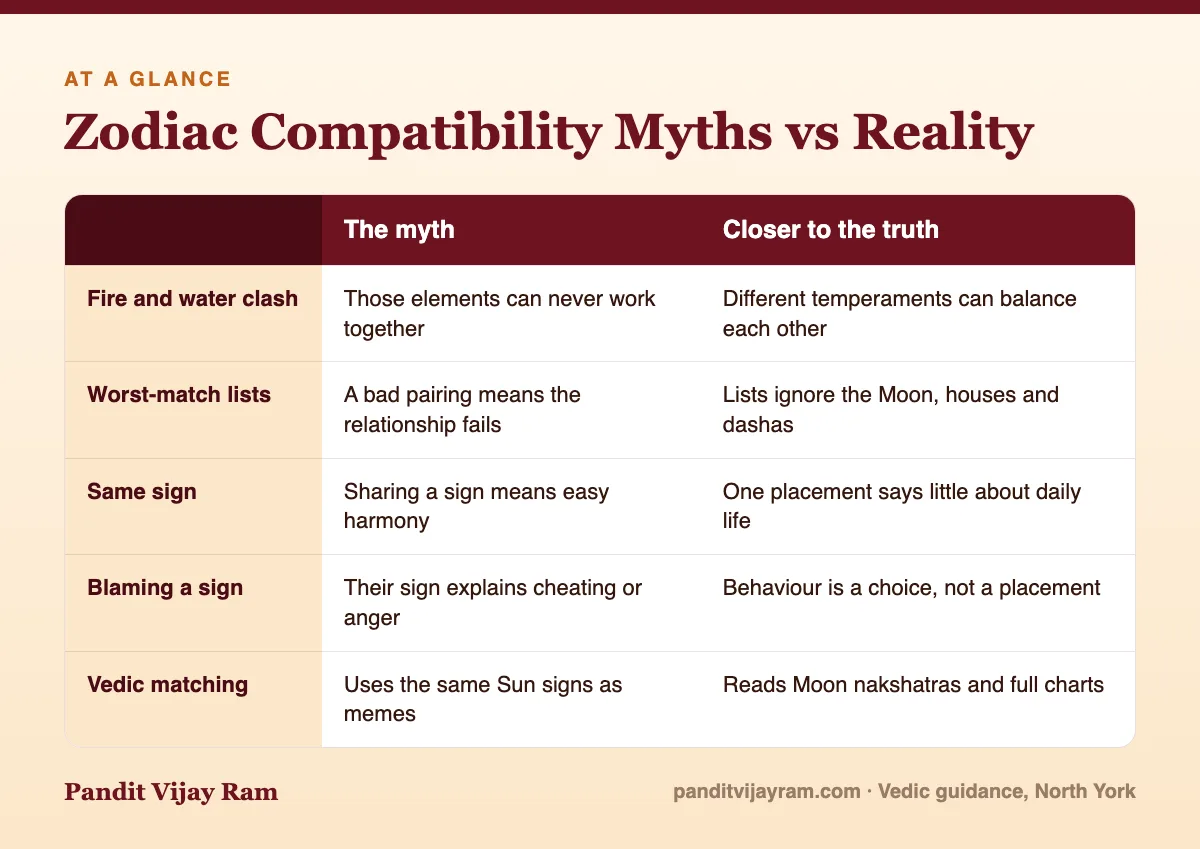
- "Fire and water signs can never work." Element contrast can mean different temperaments. Different temperaments can balance each other as easily as they clash.
- "We are the worst zodiac match, so it will fail." "Worst match" lists are written for entertainment. They do not read the Moon, the seventh house or the planetary periods running for either of you.
- "Same sign means perfect harmony." Sharing a Sun sign says little about how you handle money, anger or family.
- "His sign is why he cheats." No sign makes anyone dishonest. Choices belong to the person, not the planet.
- "Opposite signs are soulmates." Opposition in astrology describes attraction and tension together. It is not a promise.
- "If the signs clash, the kundli will too." Vedic matching uses Moon nakshatras, not Sun signs, so the two often disagree.
Many of these ideas mix up personality description with prediction. A sign can describe a style. It cannot forecast whether two adults will keep choosing kindness. If you want to see what date-of-birth shortcuts can and cannot show, read our guide to love compatibility by date of birth.
Why do worst zodiac matches lists hurt real relationships?
These lists plant a label before a couple has learned anything real about each other. Once you believe you are incompatible signs, ordinary arguments start to look like proof. People excuse bad behaviour as 'just their sign', or leave kind partners out of fear. The label does damage the stars never did.
Psychologists call the habit of noticing only what fits a belief confirmation bias. If you are told Scorpios are jealous, you will remember every jealous moment and forget the many trusting ones. Over time the story hardens.
I see three kinds of harm in my consultations:
- Leaving good partners. Someone ends a caring relationship because of a pairing score, then regrets it.
- Excusing real problems. A partner's controlling or cruel behaviour gets brushed off as "Aries temper". That excuse can keep someone in an unsafe situation. Our guide to toxic relationship signs lists what to watch for, whatever anyone's sign.
- Family pressure. Relatives sometimes repeat a sign myth to oppose a match they dislike for other reasons, such as caste or money.
There is also a quieter cost. When couples blame the zodiac, they stop asking what they could do differently. Astrology at its best should widen your choices, not shrink them to a verdict.
How does Vedic astrology actually look at compatibility?
Vedic astrology compares two full birth charts. Traditional matching, called ashtakoota or guna milan, scores eight factors from each person's Moon nakshatra out of 36 points. A careful astrologer then reads the seventh house, Venus, Mars, the planetary periods running for each partner and the overall strength of both charts.
The Moon, not the Sun, is central in traditional Vedic matching. Each person's Moon falls in one of twenty-seven nakshatras, or lunar mansions. The eight kootas compare these for temperament, attraction, health tendencies and family life. Our post on kundli matching for a love marriage explains each koota.
A guna score is only the first layer. I also look at:
- The seventh house and its lord, traditionally read for partnership.
- Venus for affection and Mars for drive and conflict style.
- Mangal dosha in both charts, and the classical cancellation rules. Our manglik and non-manglik marriage guide covers this without fear.
- The dashas each partner is moving through, which colour mood and priorities.
Different schools weigh these factors differently, and honest astrologers say so. Even a low score is read as a set of tendencies to understand, not a ban. If you would like both charts read together, Vijay Ram ji offers relationship compatibility readings that explain strengths and friction points in plain words.
What should couples rely on instead of sign stereotypes?
Rely on what you can observe: how you each handle conflict, money, family and stress, and whether respect holds when you disagree. Use astrology as a prompt for conversation, not a verdict. If there is fear, control or cruelty, that matters far more than any chart and deserves outside help.
A simple decision rule I share with couples:
- If the only worry is a sign label, set it aside. It is not evidence about your relationship.
- If a full chart shows friction, treat it as a topic. Ask: where do we actually clash, and what would help?
- If you see disrespect, threats or control, put safety first, whatever any reading says.
The things that predict a steady partnership are practical. Do you share core values? Can you repair after a fight? Do your plans for money, children and parents fit? Our companion guide on compatibility beyond the kundli turns these into a checklist you can work through together.
Spiritual practice can support this work. Some couples light a lamp together on Fridays, or say a short prayer for patience before a hard talk. That kind of shared practice is about the two of you choosing calm. It is not about changing what the stars supposedly decided.
The bottom line
Zodiac compatibility myths reduce two complex people to a pair of labels, and that can push couples apart for no real reason. Vedic matching works from full charts and the Moon's nakshatra, and even then it shows tendencies, not a fixed fate. What keeps a relationship healthy is respect, repair after conflict and shared plans, so let those guide you more than any sign pairing.
Key takeaways
- Sun-sign compatibility groups millions of people together and cannot describe one couple.
- Vedic and Western zodiacs differ, so your Vedic sign may not match your Western one.
- Worst-match lists feed confirmation bias and can excuse real mistreatment.
- Traditional Vedic matching reads Moon nakshatras, houses, planets and dashas together.
- Respect, values and repair after conflict matter more than any sign label.