
Vastu and Feng Shui: Differences and Overlaps

A friend gives you a feng shui book, your mother quotes vastu rules, and the two seem to disagree about where the bed should go. The vastu vs feng shui question comes up often in North York households where families from different backgrounds share a home or a condo building. It is a fair question, and it deserves a respectful answer rather than a contest. This guide explains where each tradition comes from, what each one means by elements and directions, how the feng shui bagua compares with the vastu grid, and where the two genuinely agree. It also covers why mixing rules at random causes confusion, and how to choose one framework for your own home without dismissing the other. I work only in the Vedic tradition, so I will not pretend to be a feng shui master. Over forty years of vastu consultations, though, I have met many clients who arrived with both sets of advice, and sorting the overlap from the contradiction usually brings them relief.
What is the difference between vastu and feng shui?
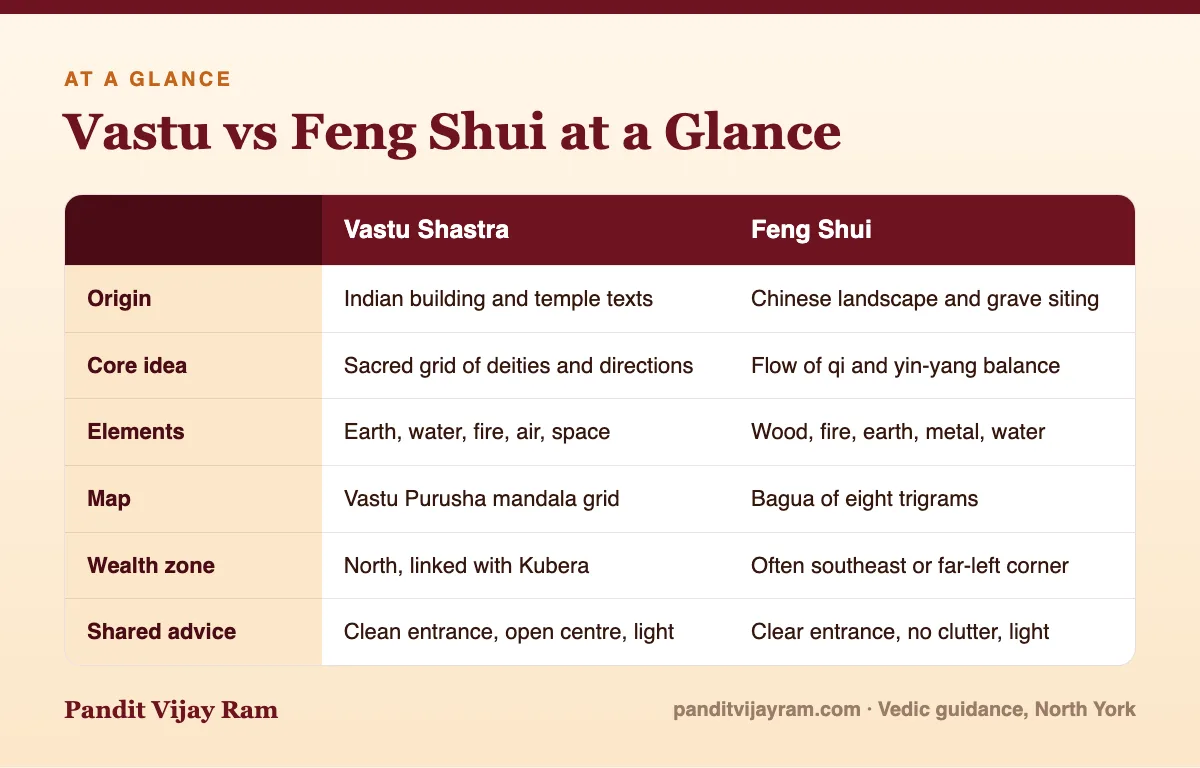
Vastu Shastra is an Indian architectural tradition that maps a building onto a square grid ruled by deities and five elements, with fixed meanings for each compass direction. Feng Shui is a Chinese tradition concerned with the flow of qi, the balance of yin and yang, and a five-phase cycle. Their goals overlap; their logic does not.
Vastu grew out of Indian building manuals known as Shilpa and Vastu texts, used for temples, towns and houses. Its core image is the Vastu Purusha, a cosmic figure lying across a square plot, head in the northeast. Each zone of the grid belongs to a deity and carries a purpose: water and prayer in the northeast, fire in the southeast, weight and stability in the southwest.
Feng Shui, which means "wind and water", developed in China around siting graves and homes in a good landscape. Its classical aim is to gather and guide qi, the vital breath of a place. Two broad approaches exist:
- Form school, which reads mountains, water, roads and the shape of the land.
- Compass school, which uses the luopan compass, the eight trigrams and time cycles.
So vastu begins with a fixed sacred geometry, while feng shui begins with the movement of energy through a landscape. That difference explains most of the disagreements people notice.
For the Vedic side of this, our vastu consultation page describes how a home is reviewed, and the guide to vastu priorities room by room shows the direction logic in practice.

Do vastu and feng shui use the same five elements?
No. Vastu works with the pancha bhuta: earth, water, fire, air and space. Feng Shui's five phases are wood, fire, earth, metal and water, which generate and control one another in cycles. Fire, earth and water appear in both lists, but air and space have no direct feng shui counterpart, and metal and wood have none in vastu.
The two lists look similar until you read them side by side. The Indian elements describe the building blocks of the physical world, from the densest to the subtlest. The Chinese phases describe processes of change: wood feeds fire, fire makes earth, earth bears metal, metal gathers water, water nourishes wood.
This changes how remedies are framed:
- In vastu, a problem is usually an element in the wrong zone, such as a stove in the northeast or a water tank in the southeast. The answer is to move, balance or honour the element where it belongs.
- In feng shui, a problem is often an imbalance in the cycle, answered by adding the phase that feeds or calms another. A metal object may be used to soften too much wood energy, for example.
- Space matters greatly in vastu. The centre of the home, the Brahmasthan, is kept open and light, which has no exact parallel in feng shui.
Colour advice follows the same split. Red belongs with fire in both systems, but other colour links differ. If you are choosing paint, the post on vastu colours for each room keeps to one consistent framework instead of blending two.
How does the feng shui bagua compare with the vastu grid?
The bagua is an eight-sided map based on the eight trigrams, with a ninth centre, linking areas of a home to life themes such as wealth or relationships. The vastu grid divides a plot into squares owned by deities. Both map life onto space, but they assign different meanings to the same corners.
Here is the clearest way I know to set the two maps side by side:
- Orientation. Vastu is always read from true compass directions. Classical feng shui also uses the compass, but a popular Western style lays the bagua from the front door, whatever direction that faces.
- Units. Vastu commonly uses a grid of sixty-four or eighty-one squares. The bagua uses eight sectors and a centre, close to a three-by-three square.
- Wealth. Many feng shui books put wealth in the far left corner from the door, or the southeast by compass. Vastu links wealth with the north, the direction of Kubera.
- Relationships. Feng shui often places partnership in the southwest. Vastu treats the southwest as the seat of the head of the household and stability, which also touches marriage.
- The centre. Both keep the middle balanced. Vastu insists it stay open and uncluttered.
Notice that the southwest carries weight in both maps, though for different reasons. That kind of partial agreement is common, and it is why people feel they are seeing one truth in two languages. Sometimes they are; sometimes the systems simply say different things.
Facing-direction questions are handled in detail in the guide to house facing directions.
Where do vastu and feng shui agree?
They agree on a surprising amount of everyday advice: a clean, well-lit entrance, no clutter in walkways, good natural light and fresh air, a bed with a solid wall behind it, care with mirrors facing the bed, and respect for water and fire. Much of this shared advice is also simply good household practice.
When clients bring me a feng shui list and a vastu list, I begin with the points where they match. These are worth acting on first, because they rarely conflict with anything:
- The entrance. Both treat the main door as the mouth of the home. Keep it clean, well lit and free of shoes piled high.
- Clutter. Feng shui speaks of blocked qi; vastu speaks of heavy, stagnant zones. Either way, a cleared hallway and a tidy corner make a room feel lighter.
- The bed. A solid wall behind the headboard, not a window, and a bed you can approach from both sides appear in both systems.
- Mirrors. Both caution against mirrors that face the bed directly.
- Kitchen care. Both honour the stove, keep it clean and avoid placing it directly against the sink.
- Plants and light. Healthy plants and daylight are welcome in both.
Much of this overlap reflects practical wisdom about comfort, safety and rest. That is not a criticism; good traditions often carry good sense. In a GTA winter, a bright, uncluttered entrance also lifts the mood when daylight is short.
The bedroom points are explored further in the post on a peaceful bedroom.
Which is better, vastu or feng shui, and can you mix them?
Neither is better in general. Each makes sense inside its own culture and logic. Choose the one that matches your faith, family and the person advising you, and apply it consistently. Mixing random rules from both usually produces contradictions, worry and needless purchases rather than a calmer home.
People sometimes ask me to declare a winner. I will not, because Chinese and Indian civilisations each developed thoughtful ways of relating buildings to the sky and land. A Hindu family that prays facing east and keeps a mandir in the northeast will naturally find vastu meaningful. A family with Chinese heritage may feel the same about feng shui.
A simple decision rule helps:
- Pick one framework as your guide for the home.
- Keep shared advice from the other where it agrees, such as clutter and light.
- Where they conflict, follow the framework you chose, and do not chase both.
- Ignore purchase pressure. Neither tradition requires expensive crystals, pyramids or gadgets.
- Let practical needs win when safety, a lease or a building code is involved.
In mixed households, such as a South-Asian spouse and a Chinese-Canadian spouse, I suggest honouring both in small ways: a lamp in the northeast and a well-kept entrance can sit happily together. Respect for each other matters more than the placement of a mirror.
For changes that do not involve renovation, see vastu remedies without demolition.
The bottom line
The vastu vs feng shui question has no single winner, because each system makes sense within its own heritage. Vastu reads fixed compass zones and five elements including space, while feng shui reads the flow of qi through a different five-phase cycle and the bagua. Their shared advice on light, entrances, clutter and bed placement is a sound place to start. Choose one framework, apply it consistently and respect the other.
Key takeaways
- Vastu comes from Indian building texts; feng shui comes from Chinese landscape siting.
- Their element lists overlap only partly, so remedies are framed differently.
- The bagua and the vastu grid assign different meanings to the same corners.
- Shared advice on light, clutter and entrances is a safe place to begin.
- Choose one system for your home rather than mixing contradictory rules.