
North-Facing and West-Facing Homes: Vastu Basics
Ask ten people which way a house should face and most will say north or east. Ask why, and the answers become vague. North facing house vastu does carry a strong reputation, but a west-facing home can be just as suitable, and an east-facing one can still have a poorly placed door. Buyers and owners in North York, Willowdale and Etobicoke often bring me two listings that face different directions and ask which is better. The honest answer depends on where each door sits along its wall, on the layout behind it, and on how the house handles light and weather. This guide explains the guardian deity and planet of each direction, lists the entrance padas usually praised or cautioned on the north and west walls, includes notes on east-facing homes for comparison, and suggests remedies suited to Canadian winters and summers. In more than forty years of practice I have learned that families are rarely helped by ranking directions. They are helped by understanding their own door, their own wall and the zones inside, which is what this guide sets out to show.
Is a north-facing house good according to vastu?
Yes, a north-facing house is traditionally one of the most favoured, because the north belongs to Kubera, guardian of wealth, and to the planet Mercury. It is linked with opportunity, income and steady growth. The benefit depends on the door sitting in a favoured pada, with the northeast kept light and the southwest heavy.
The reputation of north-facing homes comes from the dikpala scheme, where Kubera rules the north and Soma, the Moon, is also honoured there in some lists. The direction is associated with prosperity, commerce and new openings. Mercury, the planet of trade and communication, is assigned to the north in astrological vastu.
A north-facing house also tends to bring the entrance close to the northeast, the most revered zone of the home. That is generally welcomed, provided the northeast is not crowded with shoe racks, garbage bins or a cluttered porch.
Some important qualifications:
- A door at the far northwest end of the north wall is usually cautioned, despite the good direction.
- A north-facing house with a heavy, cluttered northeast and an open, empty southwest reverses the balance vastu wants.
- The kitchen and master bedroom still need to fall in suitable zones.
In a Canadian climate, a north-facing front receives little direct winter sun. Front steps and driveways can stay icy longer, and front rooms are dimmer in the cold months. The backyard, however, faces south and gets the most sun, which gardeners value. So the house that vastu praises also asks for good exterior lighting and careful salting in January. A vastu consultation can look at your specific door and layout.

Which entrance padas are good on a north-facing house?
In the common thirty-two-entrance system, the north wall is divided into eight padas counted from the northwest corner. The third, fourth and fifth, ruled by Mukhya, Bhallata and Soma, are widely favoured. The first two, Roga and Naga, are usually cautioned. Teachers differ more on the positions toward the northeast corner.
Here is the north wall from northwest to northeast as it is usually taught:
- N1 Roga – usually cautioned; linked with illness and weakness.
- N2 Naga – usually cautioned; linked with envy or enmity.
- N3 Mukhya – favoured; linked with progress and good standing.
- N4 Bhallata – favoured; linked with abundance.
- N5 Soma – favoured; the Kubera and Soma position, linked with wealth.
- N6 Bhujaga – mixed opinions.
- N7 Aditi – mixed; some teachers praise it, others link it with friction in the household.
- N8 Diti – mixed; some accept it for its closeness to the northeast.
These results are traditional associations, not predictions. Different books and schools describe the deities differently, and the classical texts use more than one grid, so do not treat a single pada as a verdict on your future.
Many modern north-facing GTA homes place the door near the middle of the front wall, which usually lands in the favoured N3 to N5 band. Townhouses and semis with an offset door may fall closer to a corner, which is worth measuring before you worry. The same eight-part logic applied to the south wall is explained in the guide to south-facing house vastu.
Is a west-facing house good or bad in vastu?
A west-facing house is not bad. The west belongs to Varuna, guardian of water and cosmic order, and to Saturn, linked with patience, discipline and lasting results. Doors in the third or fourth pada from the southwest, Sugriva and Pushpadanta, are favoured. Positions near the southwest and northwest corners are more often cautioned.
West-facing homes often suffer from comparison with north and east, but classical vastu does not reject them. Many teachers say they suit people in stable professions, business owners with long-term plans, and anyone for whom Saturn is a supportive planet in the chart.
The west wall, counted from southwest to northwest, usually reads:
- W1 Pitru – usually cautioned, being at the southwest corner.
- W2 Dauvarika – mixed.
- W3 Sugriva – favoured; linked with growth and gain.
- W4 Pushpadanta – favoured; linked with prosperity and fulfilment.
- W5 Varuna – acceptable in many schools.
- W6 Asura, W7 Shosha, W8 Papayakshma – usually cautioned.
In Canada, a west-facing front catches the late afternoon and evening sun. That is lovely on a spring evening and harsh in July, so blinds or a shade tree in the front yard are worth planning. In winter, the front steps get some afternoon melt, which helps compared with a north-facing entrance.
Remedies for a west door in a cautioned pada are similar to those for other walls: good light, a solid well-kept door, a protective image above the entrance and a clean threshold. The main door cleansing guide describes threshold practices that suit any facing.
Which facing house is best: north, east, west or south?
North and east are traditionally preferred, but no facing is best for everyone. Each direction has favoured and cautioned door positions. A west- or south-facing home with a well-placed door and a balanced layout often suits a family better than a north- or east-facing home with a poorly placed door. Compare whole houses, not directions.
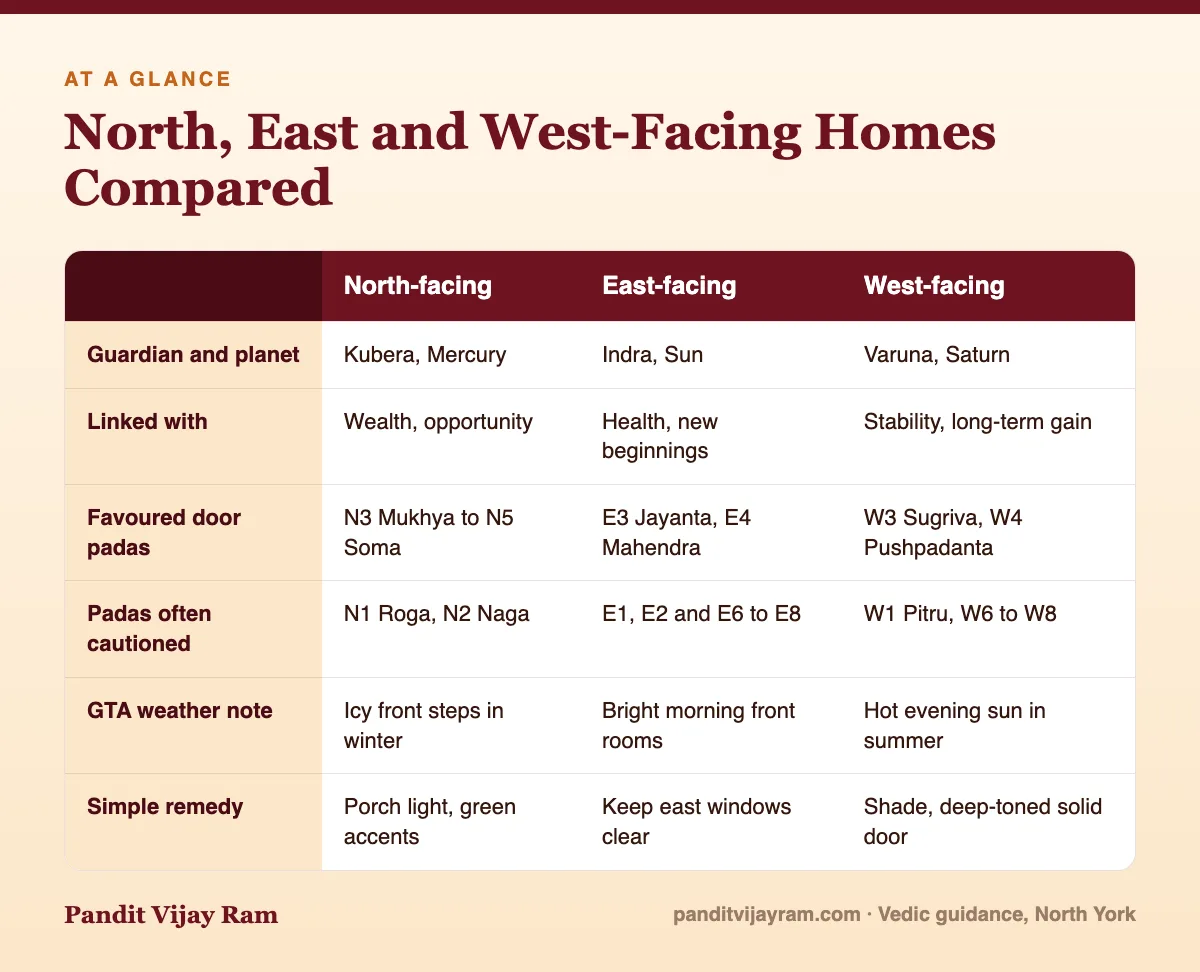
A quick comparison of the four facings helps put the rankings in perspective:
- East – Indra and the Sun; linked with health, reputation and new beginnings. Favoured doors: E3 Jayanta and E4 Mahendra, with E5 Surya accepted by many. Front rooms get morning light.
- North – Kubera and Mercury; linked with wealth and opportunity. Favoured doors: N3 to N5. Least winter sun on the front.
- West – Varuna and Saturn; linked with stability and long-term gain. Favoured doors: W3 and W4. Strong evening sun on the front.
- South – Yama and Mars; linked with energy and courage. Favoured doors: S3 and S4. Most winter sun on the front.
Some astrologers also match the facing to a person's chart, suggesting for example that someone with a strong, favourable Saturn may thrive in a west-facing house. That is an interpretive layer, and it should never outweigh practical factors.
If you are deciding between houses, the guide to vastu points when buying a house in Ontario shows how to weigh facing alongside inspection, price and layout. The choice that matters most is often the one inside: where the kitchen, bedrooms and prayer area fall.
How do you find the entrance pada of your own front door?
Measure the full length of the wall that holds the main door, from corner to corner along the outside. Divide it by eight, starting from the corner set by the pada sequence: northwest for a north wall, southwest for a west wall and northeast for an east wall. The segment holding the door's centre is its pada.
Most people can do this with a tape measure in about ten minutes. A few practical points make the result more reliable:
- Measure the whole wall. Include the full width of the house on that side, not just the porch or the section with the door. Some schools measure the plot boundary instead; ask your adviser which they use.
- Use the door's centre. If the door straddles two segments, read the one holding most of its width.
- Double doors. Treat the pair as one opening and use its centre.
- Garage entrances. A garage door is not the main entrance in most schools, even if the family uses it daily. The formal front door is read first.
- Side and back doors. These are secondary entrances. They matter less, but keep them clean and in good repair.
- Angled houses. If the wall faces between two directions, such as north-northeast, ask an adviser to help, since the sequence can shift.
Record your measurements, the door's distance from the starting corner and a compass reading taken at the threshold. With those three numbers, any vastu adviser can confirm the pada quickly. For condos, where you measure the unit's own entry wall rather than the building, the guide to vastu for apartments and condos explains the adjustments.
What remedies suit north- and west-facing homes in Canadian weather?
For a north-facing home, focus on light and safety: bright exterior lighting, a clear and salted path in winter, and green or blue accents linked with Mercury. For a west-facing home, add shade for summer evenings, a solid well-kept door and blue, grey or white accents linked with Saturn and Varuna.
Remedies work best when they also make the house easier to live in. A short list for each facing:
North-facing homes
- A warm porch light on a timer for the long, dark winter evenings.
- Ice melt and a clear path, since the front steps get little direct sun.
- Green planters or a green door accent for Mercury in summer.
- A clean, uncluttered northeast, both outside and inside the entrance.
- An image of Kubera or Lakshmi inside near the door, if that suits your family's practice.
West-facing homes
- Blinds, awnings or a deciduous tree to soften hot evening sun.
- A solid, well-maintained door in a deep shade such as navy, grey or natural wood.
- A small water element inside the northeast, not at the west entrance itself.
- A Hanuman or Ganesha image above the door if the entrance falls in a cautioned pada.
- Saturday lamp-lighting, a common practice for honouring Saturn.
Paint and textile choices for each zone are covered in the guide to vastu colours for each room. Keep any lamp outdoors safe from wind, snow and children, or use an LED version on the porch.
The bottom line
North facing house vastu links the home with Kubera and opportunity, and the favoured doors sit in the third to fifth pada from the northwest. West-facing homes, ruled by Varuna and Saturn, are good when the door falls in the third or fourth pada from the southwest, and east-facing homes favour the third and fourth from the northeast. Measuring your own wall tells you more than any ranking of directions. Combine that reading with practical remedies for light, ice and summer sun, and any facing can serve a family well.
Key takeaways
- North-facing homes are favoured, linked with Kubera, Mercury and opportunity.
- On a north wall, the third to fifth padas from the northwest are widely praised.
- West-facing homes are not bad; the third and fourth padas from the southwest are favoured.
- Measure the whole wall and divide by eight to find your door's pada.
- Plan for icy north steps and hot west evenings in a GTA climate.