
Is Vastu Shastra Scientific? An Honest Look

Many people ask me whether they should take vastu seriously or treat it as superstition. The question "is vastu scientific?" matters, because families in North York and across the GTA are sometimes told to break walls, move kitchens or buy costly devices on the strength of it. You deserve a straight answer from someone who practises it. This guide explains where vastu actually comes from, which of its rules make good sense as climate design, which modern claims have no evidence behind them, and why the rules written for an Indian plot behave differently in a Canadian house. It also covers how I think about vastu as faith and as a way of caring for a home, without pretending it is physics. In four decades of advising households, I have found that people relax once they hear an honest distinction between tradition, practical design and marketing. Vastu can still be meaningful to you, and that meaning does not depend on dressing it up as laboratory science.
Where does vastu shastra come from?
Vastu comes from a body of classical Indian texts on architecture and sculpture, including works such as the Mayamata and Manasara and building chapters in the Brihat Samhita. They give rules for temples, towns and homes, mixing measurement, ritual, cosmology and practical construction knowledge built up by master builders over many generations.
The word vastu refers to a dwelling or site, and shastra means a body of teaching. These texts belong to the wider Shilpa tradition, which also covers sculpture and icon-making. They were written for sthapatis, the master architects who built temples and royal towns.
Reading them, you find several kinds of material woven together:
- Measurement and proportion. Units, grid sizes and ratios that keep a structure harmonious and sound.
- Site selection. Soil tests, slope and drainage, and the presence of water.
- Ritual and cosmology. The Vastu Purusha, the deities of each zone and ceremonies before building.
- Orientation. Aligning a structure with the cardinal directions and the sun.
So vastu began as a craft manual inside a sacred worldview. It was never written as experimental science in the modern sense. That is not a weakness to hide; it is simply what it is. Temples built on these principles still stand and still move people.
Our vastu consultation draws on this tradition for homes today, and the comparison of vastu and feng shui places it beside its Chinese counterpart.
Is there any logic behind vastu rules?
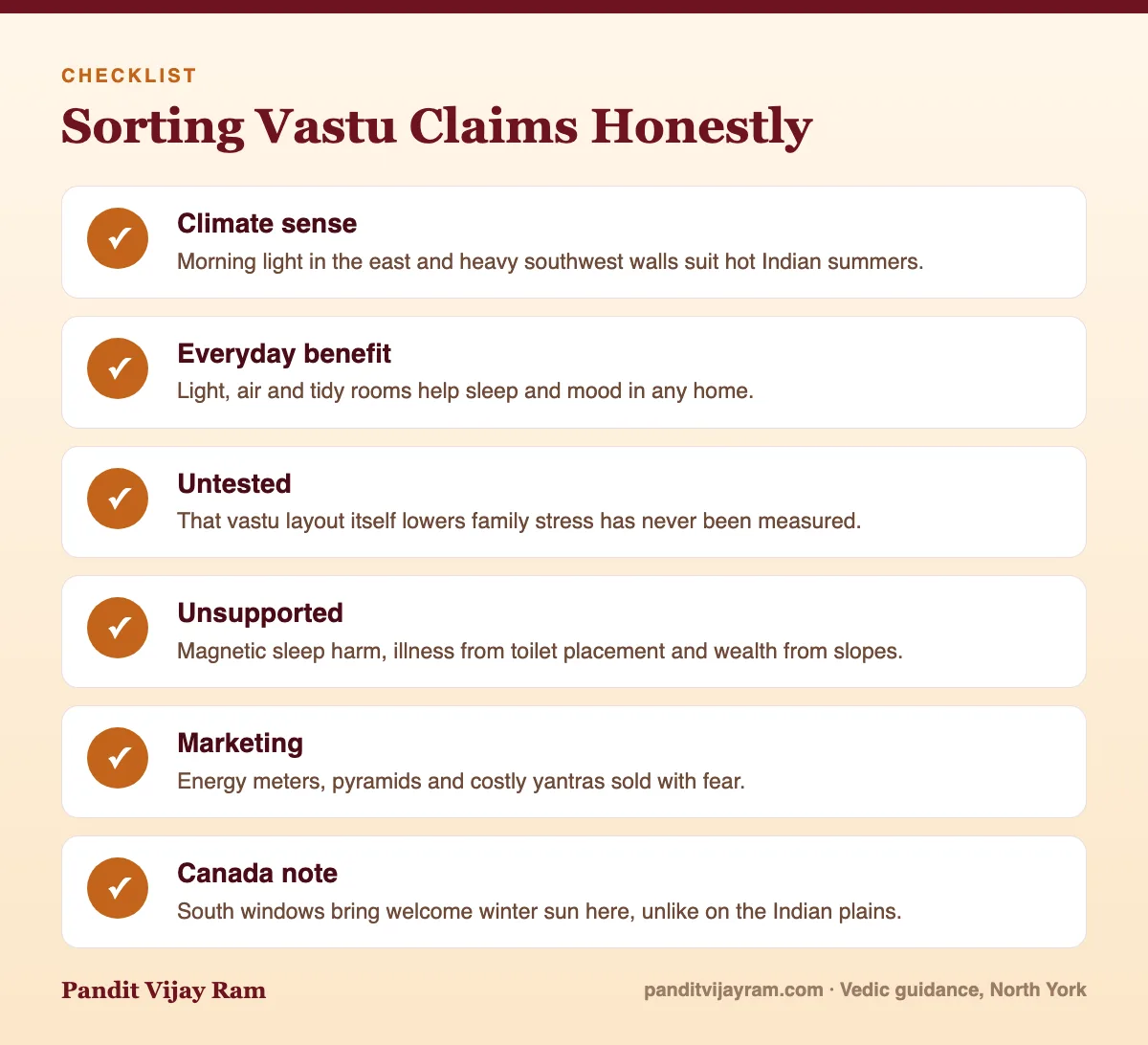
Yes, several rules match sensible climate design for hot regions of India. Open eastern sides catch gentle morning light, heavier southwestern walls shield against harsh afternoon heat, and a kitchen in the southeast suited daytime cooking with prevailing winds. These rules reflect local experience with sun, wind and rain rather than mysterious energy.
When I explain vastu to sceptical engineers, I start with the sun. On the plains of northern India, summer afternoons are fierce, and the sun sets in the west and northwest. A house with thick, heavy walls and fewer openings to the south and west stays cooler.
Some rules that make practical sense in that setting:
- Northeast kept open and light. Morning sun enters early and gently, and a prayer room there gets soft light at dawn.
- Southwest heavy. Storage, thick walls and the master bedroom act as a thermal buffer against hot afternoons.
- Southeast kitchen. Morning light for cooking, with smoke carried away by common winds in many regions.
- Open centre. The traditional courtyard, or Brahmasthan, drew light and air into the middle of the home.
- Water in the northeast. On many sites this matched natural drainage and kept wells away from waste.
None of this requires invisible forces. It shows careful builders learning from their climate and encoding that learning in a form people would respect and remember. Calling it sacred helped the knowledge survive.
Ritual orientation also had its own meaning, as worship facing the rising sun is ancient in Vedic practice. That is a matter of devotion, not engineering, and it is fine to hold it as such.
Is vastu a myth or does vastu work?
There is no reliable research showing that vastu placement changes health, income or relationships. Claims about vastu energy, cosmic rays or magnetic alignment are not supported by physics. Vastu can still help in ordinary ways, by encouraging light, order and calm, and it carries real meaning for people who practise it as faith.
I want to be honest here, because this is where many people are misled. Modern marketing often borrows scientific words, but the evidence does not follow. A simple way to sort what you hear:
- Supported by ordinary evidence: daylight, ventilation, reduced clutter, quiet bedrooms and a clean kitchen. These help sleep and mood in any home.
- Plausible but untested: that a clearly arranged home lowers family stress. It makes sense, but nobody has measured vastu specifically.
- Not supported: claims that a wrongly placed toilet causes illness, that a sloping plot causes bankruptcy, or that sleeping with your head to the north disturbs your blood through the earth's magnetic field. The geomagnetic field is far too weak for that.
- Marketing: devices said to "measure vastu energy", pyramids that "neutralise defects" and costly yantras sold with fear.
Vastu also has a placebo-like dimension, and I do not say that dismissively. When a family rearranges a home with care and prayer, they feel more settled, and that feeling is real. It simply should not be confused with a proven mechanism.
If a vastu worry is causing fear about your health, see your family doctor first. The post on vastu remedies without demolition explains why expensive gadgets are unnecessary.
Do vastu rules apply to houses in Canada?
The directional framework can be followed anywhere, but the climate reasons behind many rules change in Canada. Here, southern windows bring valuable winter sun and warmth, which passive solar design encourages. Basements, attached garages and long winters also have no parallel in classical texts, so rigid rules need thoughtful interpretation.
This is one of the most useful points I share with families buying homes in Ontario. In northern India, limiting southern exposure kept rooms cool. In the GTA, a south-facing living room is often the brightest and warmest place in the house during winter. Energy-efficient design actively welcomes southern glass for this reason.
Other differences to keep in mind:
- Latitude. Toronto sits well north of Delhi, so the sun is lower in winter and the seasons are more extreme.
- Basements. Classical texts say little about a full basement with a furnace and laundry, so modern practitioners disagree on how to read it.
- Garages and plumbing. Attached garages and stacked bathrooms in condos are fixed by building codes and cannot be moved.
- Snow and drainage. Grading for snowmelt matters more for a house's health than the direction a plot slopes in a vastu sense.
For these reasons I read vastu with flexibility in Canada. I keep its devotional heart, such as a clean prayer space in the northeast, and I let comfort, safety and building codes lead on structure. A south-facing house is not a defect; see the guide to south-facing homes in vastu.
If you are house-hunting, the post on buying a house in Ontario with vastu in mind puts the home inspection and lawyer first.
How should a sensible person use vastu today?
Treat vastu as a cultural and spiritual guide for arranging and honouring your home, not as a scientific law. Follow rules that improve light, order and prayer, ignore fear-based claims, never spend heavily on devices, and never let vastu override safety, building codes or professional advice about structure, health or money.
I give clients a short decision rule before they change anything:
- Is it cheap, reversible and pleasant? Moving a desk, clearing a corner or placing a lamp in the northeast. Try it freely.
- Is it costly or structural? Breaking a wall or moving a kitchen. Pause, get a builder's view, and ask whether the reason is evidence or fear.
- Is someone selling urgency? If a consultant says disaster will follow unless you buy something now, walk away.
- Is it about health? A doctor answers health questions. Vastu does not.
Within those limits, vastu can be a lovely discipline. It asks you to notice light, to keep the centre of your home open, and to give prayer a dedicated, clean place. Many families find that the act of caring for a home together steadies the household.
Faith and honesty can sit together. I believe in the devotional value of vastu, and I also say plainly that its modern scientific claims are unproven. If you want help choosing a few meaningful changes without fear, our full list of services shows how consultations work, and the guide to whether astrology is accurate takes the same candid approach to charts.
The bottom line
Is vastu scientific? In the strict sense it is not, because its modern claims about energy, health and wealth lack evidence. Its classical rules do contain real climate wisdom for Indian sites, and that wisdom needs adjusting for Canadian winters and building codes. Used as faith and as a guide to light, order and prayer, vastu can still bring calm to a home.
Key takeaways
- Vastu began as a sacred architectural craft, not an experimental science.
- Some rules reflect sensible climate design for hot Indian regions.
- Claims about vastu energy, magnetic sleep and illness are unsupported.
- In Canada, southern windows bring helpful winter sun and warmth.
- Never let vastu override safety, codes or professional advice.