
What Vashikaran Actually Means in Sanskrit Texts
Type the word into a search bar and the results look like advertisements: love on demand, a partner returned in days, a mantra that makes anyone obey. It is hard to know what the vashikaran meaning really is underneath all that noise. Many people who write to me from North York and across the GTA have the same question: is this an ancient science, a scam, or something in between? This article goes back to the language itself. You will learn where the word comes from, what the root vash meant to Sanskrit speakers, where vashikarana sits among the six acts listed in tantric manuals, and how the related word vashya turns up in ordinary marriage matching. We will also look at how the internet narrowed a broad term into a sales label. In more than forty years of practice, I have found that people become calmer once they understand the word. Fear shrinks when a term stops being mysterious. There are no instructions here, by design; understanding is the point.
What is the literal meaning of vashikaran in Sanskrit?
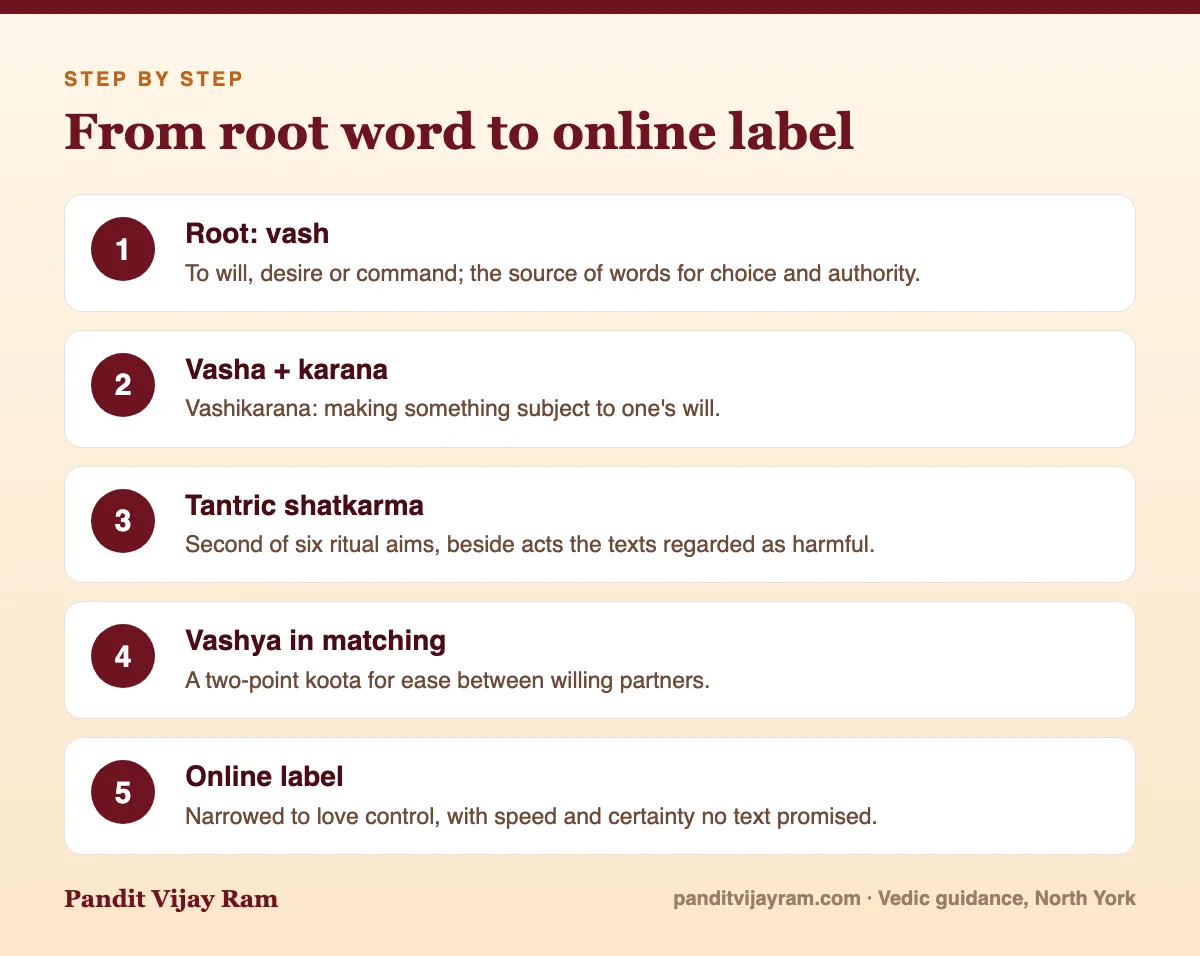
Vashikarana joins vasha, meaning will, control or influence, with karana, meaning making or doing. Read literally, it is 'making something subject to one's will'. The root verb vash means to wish, desire or command. The word describes an aim, not a single ritual, and it was used far more broadly than love.
Sanskrit builds words from roots, and this one is easy to unpack once you see the pieces.
- Vash: a verbal root meaning to will, to want, to have authority. Related words describe someone who acts by their own choice.
- Vasha: will, power or control. To be vasha of someone is to be under their sway; to be svavasha is to be self-governed.
- Kri / karana: to make or to do, the same root found in karma.
Put together, vashikarana means the making of control. Classical writers used the idea in many settings. A king brings a region under his authority. A yogi brings the senses under control. A host wins a difficult guest over with courtesy. Only some uses involved ritual at all.
That breadth matters. When a website says the word means 'love spell', it is giving one modern slice of a much wider term. The best-known spiritual use is actually inward. The Bhagavad Gita praises the person whose senses are vashe, under control, as steady in wisdom. Mastery of oneself is the oldest sense of the word.
For a side-by-side look at how this differs from chart-based love guidance, see our comparison of love spells, vashikaran and kundli remedies.
What are the six acts, or shatkarma, in tantra?
Medieval tantric manuals list six ritual aims called the shatkarma: shanti (pacifying harm), vashikarana (bringing under influence), stambhana (stopping or immobilising), vidveshana (causing division), uchchatana (driving away) and marana (destroying). Vashikarana sits second. The list was a classification of intentions, and several of the six were openly treated as harmful.
The table below summarises the traditional list. Texts vary in order and detail, and this is a description, not a recommendation.
- Shanti — pacification: calming illness, planetary trouble or misfortune. Considered the most benign.
- Vashikarana — subjugation or attraction: gaining influence over a person, group or situation.
- Stambhana — immobilisation: stopping an enemy, a fire, a flood or an argument.
- Vidveshana — sowing enmity between people.
- Uchchatana — eradication: making someone leave a place or lose stability.
- Marana — causing death.
Notice the company vashikarana keeps. Four of the six aim to act on another person against their wishes, and the tradition itself ranked them as lower, risky practices. Many teachers taught that only shanti is safe for a householder.
One caution about the word itself. In hatha yoga, shatkarma means something entirely different: six bodily cleansing practices such as neti and kapalabhati. Searching the term will bring up both meanings.
This is why Vijay Ram ji's vashikaran guidance is confined to prayer for attraction and harmony in your own life. Work that overrides another person's will belongs to the same family as vidveshana and marana, and he does not do it.
What does vashya mean in kundli matching?
Vashya is one of the eight kootas used in Ashtakoota guna milan. It is worth two points and compares the Moon signs of the couple to see how naturally they influence or respond to each other. Here the idea is mutual attraction and ease, not control, which shows the gentler everyday use of the same root.
Families who have had a kundli matched have usually met this word without noticing. In the thirty-six-point system, vashya is a small factor between varna and tara.
Each Moon sign is placed in a group:
- Manava (human): Gemini, Virgo, Libra, the first half of Sagittarius and Aquarius.
- Chatushpada (four-footed): Aries, Taurus, the second half of Sagittarius and the first half of Capricorn.
- Jalachara (water-dwelling): Cancer, Pisces and the second half of Capricorn.
- Vanachara (wild): Leo.
- Keeta (insect): Scorpio.
Signs in the same group, or in groups that traditionally get along, score well. The language is old and colourful, yet the question is reasonable: will these two people find each other easy to be around?
Vashya is minor in weight, and a low vashya score on its own is rarely a reason for concern. If your overall score worries you, read our guide on a low guna milan score before drawing conclusions.
The point for this article is simple. In the one place most families meet the root vash in daily life, it describes chemistry between willing people. Nobody is being made to do anything.
How did vashikaran come to mean love control online?
Over the last few decades, roadside advertising in South Asia and then search marketing turned vashikaran into a product label for love problems. Short words with mysterious appeal sell well. The commercial version dropped the word's inward and diplomatic meanings and kept only the promise of control over a partner, an ex or a spouse.
The shift happened in stages. Older printed manuals were read by a small number of specialists. Then posters, newspaper classifieds and later websites began offering 'vashikaran specialist' services alongside numbers to call. Each step made the word shorter in meaning and louder in promise.
What the online version usually adds:
- Speed: results in days or hours, which no classical text promised.
- Certainty: phrases like 'guaranteed' or 'never fails'.
- Targets: named exes, bosses, in-laws.
- Escalation: a small first fee followed by larger rituals.
What it usually removes: the ethics, the warnings about harm, and the older idea that the first thing to bring under control is your own mind.
None of this means everyone who uses the word is dishonest. Some practitioners use it loosely for attraction prayer. Still, the gap between the word's history and its advertising is wide. If you are comparing practitioners, the list of questions to ask a vashikaran specialist helps you test claims calmly. And if you have already been pressured for money, the warning signs in our guide to fake love spell casters online may look familiar.
Is vashikaran ethical, and what does Vijay Ram ji do instead?
Influencing your own mind, habits and presence is ethical and traditional. Trying to override another person's free will is not, and the tantric texts themselves class it among harmful acts. Vijay Ram ji offers prayer for attraction and harmony in your own life, kundli insight and honest counselling, but never rituals aimed at controlling someone.
A useful test is to ask who is being changed. If the answer is you, the practice is on safe ground. If the answer is another person who has not agreed, it has crossed a line that Hindu ethics, the law of karma and plain decency all recognise.
A simple decision rule many families find helpful:
- Acceptable: prayer for your own peace, confidence, charm and patience; prayer for harmony in a relationship both people want; chart guidance on timing and temperament.
- Not acceptable: anything that names a person who has said no, seeks to make someone leave a partner, or aims to make another person dependent on you.
When someone comes to Vijay Ram ji asking for vashikaran, the first conversation is usually about what has happened and what they are hoping for. Often the real need is grief after a breakup, fear of loneliness, or a marriage where communication has stopped. Those needs have honest answers. Our pillar article on why love binding is refused sets out the reasoning in more depth.
If a relationship has become frightening, or someone is following or threatening you, contact the police. Spiritual work is never a substitute for safety. Clients across Toronto can learn more on the vashikaran guidance in Toronto page.
The bottom line
The vashikaran meaning, read from the Sanskrit, is simply 'bringing under one's will', a broad idea that covered kings, guests and the yogi's own senses. In tantric manuals it is one of six ritual aims, sitting beside acts the tradition itself regarded as harmful. The online version narrowed it into a promise of love control, adding speed and certainty that no classical source offered. Understanding the word lets you choose prayer for your own heart and honest guidance over attempts to control another person.
Key takeaways
- Vashikarana means 'making subject to one's will', from the root vash.
- It is the second of the six tantric aims called shatkarma.
- Vashya in kundli matching describes ease between willing partners.
- Online advertising narrowed the word into love control and added false certainty.
- Changing yourself is ethical; overriding another person's will is not.