
Kundli Matching Without a Birth Time: What Can Still Be Read
Many families discover too late that nobody wrote down the exact minute of birth. A grandmother remembers it was early morning, a passport shows only the date, and a hospital file is far away. Couples in North York often ask me whether kundli matching without birth time is worth doing at all. It is, as long as everyone understands what is solid and what is a guess. This guide explains which parts of a match depend only on the date, which need the time, how name-based or naam matching fills the gap, how a careful astrologer narrows down a missing time through rectification, and where the honest limits sit. In more than forty years of practice I have matched many couples with incomplete details, and the most useful thing I can offer is clarity about confidence. A score is not a verdict even with perfect data. Without a birth time it deserves even more humility, and the conversation between the two people matters more than any number on a sheet.
Can kundli matching be done without birth time?
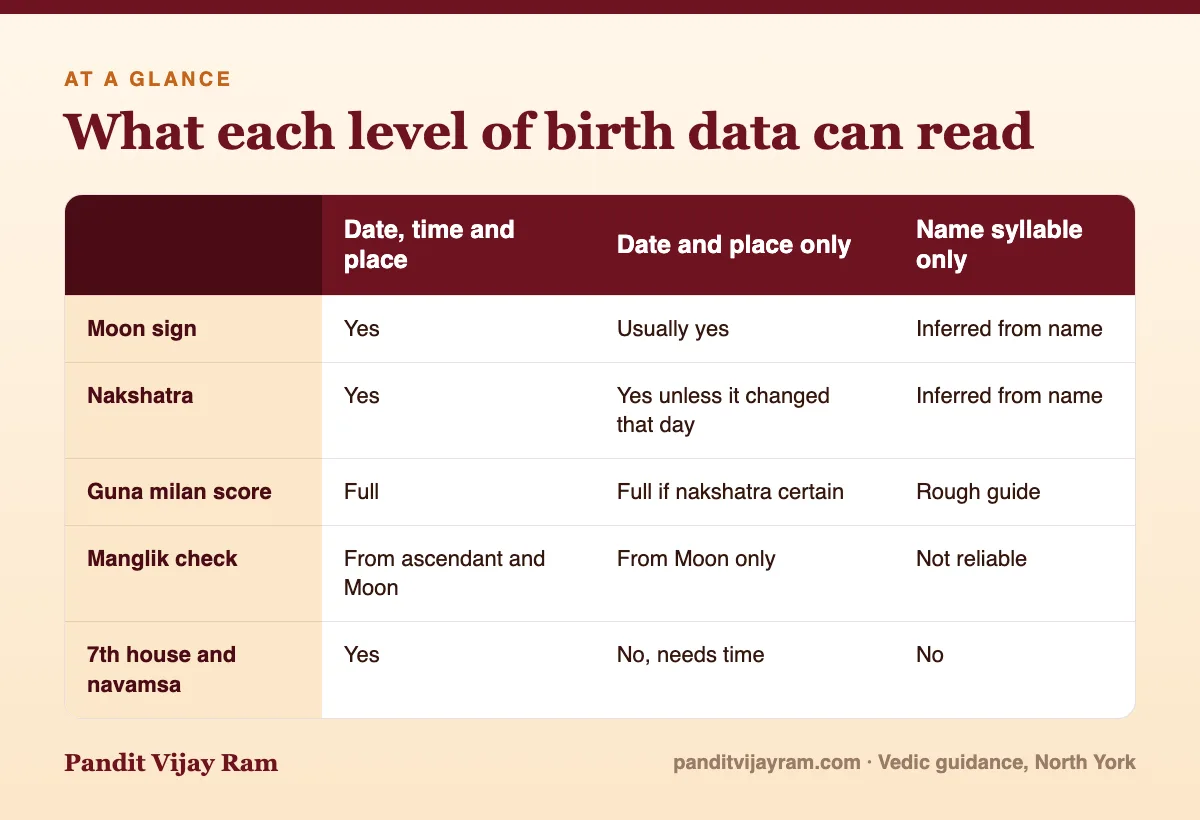
Yes, in part. With the date and place of birth an astrologer can usually find the Moon sign, and often the nakshatra, which are the basis of Ashtakoot guna milan. What cannot be read reliably is the ascendant, the seventh house, house-based Manglik checks and the navamsa chart, all of which change within hours.
A Vedic chart has layers that move at very different speeds. Understanding them explains what survives a missing time:
- The Moon sign (rashi) changes roughly every two and a quarter days, so a date usually fixes it, unless the Moon changed sign that day.
- The nakshatra changes about once a day. Many dates contain only one nakshatra for the Moon, but some contain two, and then a time is needed to choose.
- The ascendant (lagna) moves through all twelve signs in a day, around two hours each. Without a time it is unknown.
- The houses follow from the ascendant, so the seventh house of marriage, the eighth and the second all become uncertain.
- Divisional charts such as the navamsa change even faster and need a reliable time.
So guna milan, which is built mainly on the two Moon nakshatras, can often be done. A full reading of each person's marriage houses cannot. Vijay Ram ji's relationship compatibility service explains which parts of a match are being used whenever data is incomplete, so families know what they are relying on.

What can be read from date of birth alone?
From the date and place you can usually read the Moon sign, the nakshatra if it did not change that day, the positions of slower planets, and a Moon-based Manglik check. That is enough for most of the 36-point guna milan and for a general sense of temperament and current dashas.
When only the date is known, I build what I call a Moon chart. The Moon takes the place of the missing ascendant, and the chart is read from there. It is a recognised method in the tradition, called Chandra lagna, and it gives a fair amount:
- Guna milan. Varna, vashya, tara, yoni, graha maitri, gana, bhakoot and nadi are all based on the Moon, so the score can be calculated if the nakshatra is certain.
- Temperament. The Moon sign and nakshatra describe emotional style, which matters a great deal in daily married life.
- Slow planets. Jupiter, Saturn, Rahu and Ketu change sign over months or years, so their placement is clear.
- Manglik from the Moon. Mars can be checked from the Moon sign. It is a softer test than from the ascendant, and should be weighed lightly.
- Dasha period. The Vimshottari dasha starts from the Moon's nakshatra, so it can be estimated, though its exact turning points shift with time.
If the Moon changed nakshatra on the birth date, I calculate both options and show the family both scores. Where they differ sharply, I say so plainly. For more on what Moon-sign pairings mean, see our guide to Moon sign compatibility.
How does name-based kundli matching work?
Name-based or naam matching assigns each person a nakshatra pada from the first syllable of their name, using the traditional akshara table. Guna milan is then calculated from those two nakshatras. It is quick and widely used when no birth details exist, but it reflects the name, not the sky at birth.
In many Hindu families a child's name was chosen from the syllable linked to the birth nakshatra. For example, names beginning with certain sounds belong to Ashwini, others to Rohini or Revati. Naam matching runs that process backwards: it starts from the name and arrives at a nakshatra.
That works well when the name really was chosen this way. It works less well when:
- The person has a modern or family name not chosen by nakshatra.
- The everyday name differs from the formal one. Families then argue about which to use.
- The name was anglicised after moving to Canada, changing its first sound.
- One partner is from a tradition that does not use the syllable system at all.
My usual practice is to ask whether a naam rashi was set at a naming ceremony. If so, that syllable carries weight. If not, I treat a name-based score as a rough guide and lean on conversation and family knowledge instead.
Free calculators often hide which method they used. Our astrology tools page lets you try a match, and a careful reader can then tell you how much to trust the number. If a name match produces a worrying result, our explainer on nadi dosha and its cancellations shows why one koota rarely decides anything alone.
What is birth time rectification and how accurate is it?
Birth time rectification is the process of estimating an unknown or approximate birth time by testing candidate ascendants against known life events, such as marriage, children, moves and losses. A careful rectification can narrow a window considerably, but it remains an informed estimate rather than a recorded fact, and should be presented that way.
Before rectifying, it is worth one more search for the real time. Try these first:
- Ask the eldest relatives. Mothers and grandmothers often remember a prayer time, a meal or a sunrise.
- Check family papers. An old janam patri, a baby book, a hospital discharge card or a temple record may note it.
- Contact the birth hospital or registry. Some keep times in their files; rules for requesting records differ by country.
If nothing is found, rectification proceeds in steps:
- Set a window. "Before dawn" or "after lunch" already cuts the day down.
- List dated events. Marriage, the birth of children, a serious illness, a parent's death, major moves.
- Test each candidate ascendant. See which one's dashas and transits fit the events best.
- Check physical and personality descriptions. The tradition links ascendants with build and manner, used cautiously.
- Report a range. A good result says "most likely between these times", with a confidence level.
Rectification takes real time and two people can reach different answers. Treat a rectified chart as a working model. A full kundli and horoscope reading can include it when both families agree it is worth the effort.
How reliable is a match without birth time compared with a full kundli match?
It is less detailed, not worthless. The Moon-based score is usually as sound as in a full match, provided the nakshatra is certain. The parts that depend on houses, such as the seventh house, house-based Manglik and navamsa, are missing or estimated. Families should give the result proportionate weight.
A simple decision rule I share with families:
- Both birth times known: read everything, including houses, navamsa and Manglik from the ascendant.
- One time known: read that person's houses fully and use a Moon chart for the other. Do not judge Manglik compatibility from mismatched methods.
- No times, nakshatras certain: guna milan and temperament are reliable; treat house-based worries as unproven.
- No times, nakshatras uncertain or name-based: show all possible scores and let the couple's own understanding carry most of the weight.
I also remind families that the most important compatibility questions are not astrological at all: shared values, honesty, how each person handles money and conflict, and whether both truly consent. Our guide to kundli matching for a love marriage discusses using the chart as insight rather than a veto.
If anyone uses a missing birth time to declare a frightening dosh and sell an expensive remedy, that is a reason for caution. Uncertainty should make an astrologer more modest, not more alarming.
The bottom line
Kundli matching without birth time still offers real insight through the Moon sign, the nakshatra and guna milan. The ascendant, the seventh house and the navamsa remain uncertain unless the time is found or carefully rectified. Name-based matching is a useful fallback when the name was chosen by nakshatra, and every result should be weighed alongside the couple's own understanding and free choice.
Key takeaways
- The Moon sign and nakshatra can usually be found from the date and place of birth.
- Guna milan is Moon-based, so it often survives a missing birth time.
- Ascendant, houses, navamsa and ascendant-based Manglik checks need an accurate time.
- Rectification gives an estimated range, not a recorded fact.
- Uncertain data calls for modest conclusions, never frightening ones.