
Trust Issues in a Relationship: Where They Come From

You may have a kind, consistent partner and still feel a knot in your stomach when they are late home or slow to reply. Part of you knows the fear does not fit the facts, yet it keeps returning. Trust issues in relationship life are among the most common worries people bring me in North York, and they are rarely about one partner alone. This guide traces where suspicion comes from: early family life, attachment patterns, past betrayal, migration and the stories communities tell about love. It then sets out the healing work that genuinely helps, what partners can do to support it, where Vedic insight fits, and when a fear is actually a sensible warning. In more than forty years of practice I have found that the person with trust issues is often the most loyal person in the room, and the one who suffers most from the doubt. Understanding the root turns a vague dread into something you can work on.
What causes trust issues in a relationship?
Trust issues usually come from earlier experiences that taught a person closeness is unsafe or unreliable. Common roots include a parent who left or was unpredictable, being lied to or cheated on before, bullying, and family secrecy. Current stress and a partner's genuinely inconsistent behaviour can add to the problem.
Most people with deep mistrust can trace it to one or more of these sources:
- Early instability. A childhood with an absent, unpredictable or frightening parent can teach the nervous system to expect loss.
- Past betrayal. Infidelity, a broken engagement or a friend's deception can leave a lasting alarm that fires in new relationships.
- Family stories. Some households repeat warnings such as men always stray or never rely on anyone, and children absorb them.
- Migration and separation. Long periods apart from parents or spouses during immigration can make absence feel threatening.
- Present-day signals. A partner who often breaks promises or hides things gives the fear real material.
Many people carry more than one of these at once, and that is normal. Knowing which source fits you best matters, because each calls for different work. If your mistrust shows up mainly as jealousy about other people, our post on jealousy in a relationship looks closely at that narrower pattern.

How does attachment style affect trust?
Attachment theory suggests that early bonds shape how we expect partners to behave. People with an anxious style tend to fear abandonment and seek reassurance, while those with an avoidant style may distrust closeness itself. Neither is a fixed label, and secure ways of relating can be learned in adulthood.
Psychologists describe several broad patterns of adult attachment. They are tendencies, not diagnoses:
- Secure: comfortable with closeness and with time apart; trusts by default but notices genuine red flags.
- Anxious: worries about being left, reads small changes as signs of rejection, wants frequent reassurance.
- Avoidant: values independence, feels uneasy when a partner wants more closeness, may doubt that others will be there.
- Fearful or disorganised: wants closeness and fears it at the same time, often after a frightening early environment.
An anxious partner paired with an avoidant one can create a painful loop. One reaches out, the other pulls back, and each reaction confirms the other's fear. Our article on why couples fight so much explains that pursue and withdraw cycle in more detail.
The hopeful finding in this research is that attachment patterns can shift. A steady relationship, good therapy and conscious practice all help people move toward security over time.
Are my trust issues reasonable or is it me?
Ask whether your doubts are triggered by your partner's actual behaviour or by situations that would not worry most people. Repeated lies, hidden accounts and unexplained absences justify concern. Distress over ordinary things, such as a short delay in replying, points more to old wounds that need care.
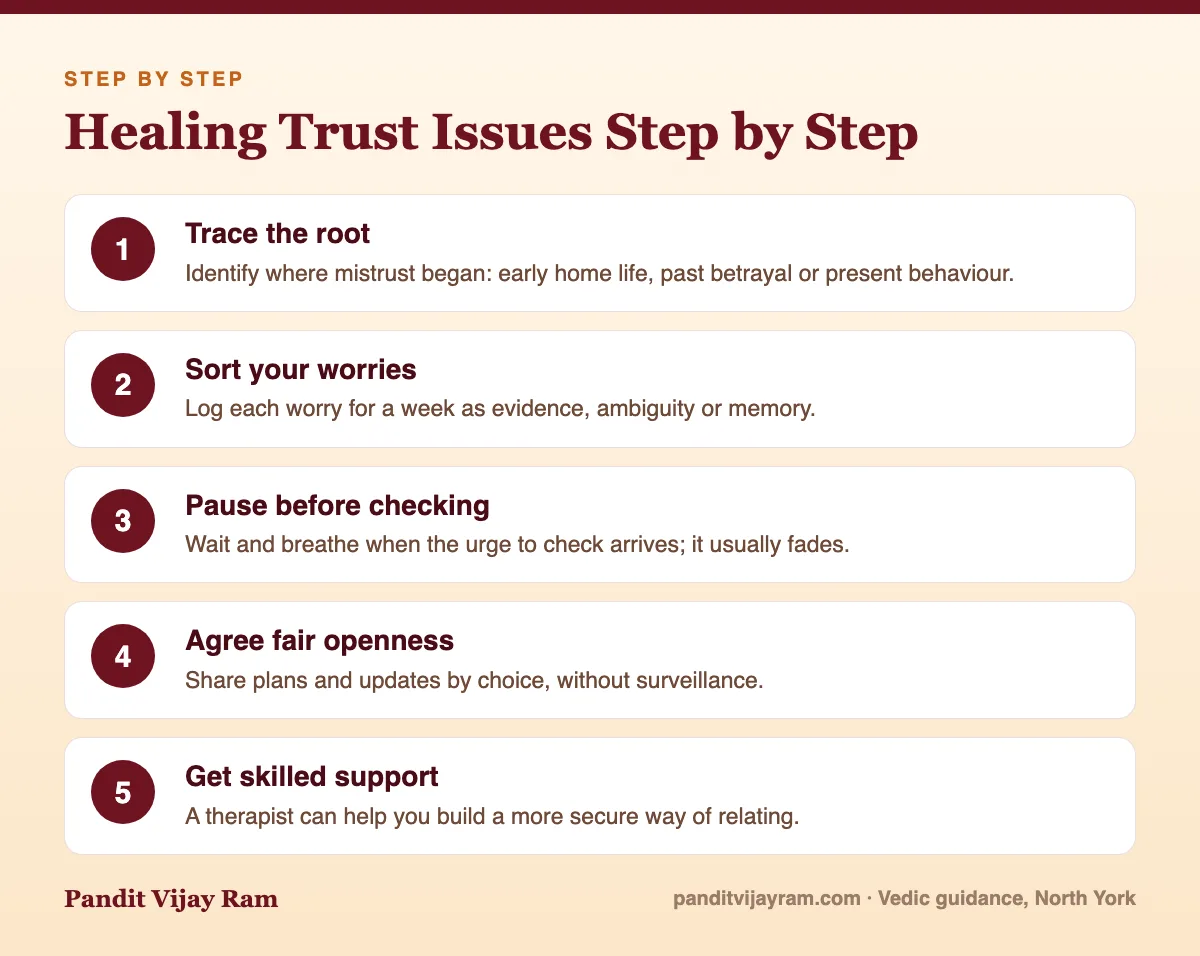
A simple sorting exercise helps. For one week, write down each moment of mistrust and what set it off. Then sort the entries into three columns:
- Evidence: something specific happened, such as a discovered lie or a broken promise.
- Ambiguity: something unclear happened, such as a late reply or a new colleague's name.
- Memory: nothing happened, but you remembered or imagined a past hurt.
If most entries sit in the first column, your fear may be a sensible warning, and the conversation needs to be about your partner's honesty. If most sit in the second and third, the main work is yours, supported by your partner. Neither result is a judgement on your character; it simply tells you where to start.
Some situations go beyond mistrust. If a partner monitors you, controls your money or makes you doubt your own memory, that is a different problem. Read our guides to gaslighting signs and controlling partner signs and put safety first.
How do you heal trust issues in a relationship?
Healing usually combines individual work and shared agreements. Individually, therapy, journalling and calming the body help you notice fear before acting on it. Together, couples can agree on clear, reasonable transparency and keep small promises consistently. Trust grows from repeated reliable experiences, not from a single dramatic reassurance.
Practical steps that tend to help:
- Name the trigger aloud. Saying I notice I'm anxious because you're late is calmer than an accusation.
- Delay the checking. When the urge to scroll their phone or demand proof arrives, wait twenty minutes and breathe slowly. The urge usually passes.
- Agree on fair transparency. Sharing plans and calling if delayed is reasonable. Constant surveillance is not, and it damages both people.
- Track kept promises. Note the times your partner did what they said. Anxious minds remember lapses and forget reliability.
- Work with a therapist. Approaches such as cognitive behavioural therapy and attachment-focused counselling are designed for exactly this. A family doctor can refer you.
If trust was broken by an affair, the repair process is different and more structured; see our guide to rebuilding trust after cheating. When the breach was neglect or broken promises rather than infidelity, the post on winning back trust after a breakup fits better.
Can prayer or astrology help with trust issues?
Prayer and Vedic insight can support the inner steadiness that trust needs. A reading may show a sensitive Moon or a Rahu influence that heightens worry, and daily practice can calm the mind. They work alongside therapy and honest agreements, and they should never be used to monitor or test a partner.
In Vedic astrology the Moon is linked with emotional security and the fourth house with early home life. A Moon under pressure from Saturn, Rahu or Ketu is traditionally read as a tendency toward worry, loneliness or fear of loss. Seeing that pattern on paper can feel relieving, because the fear has a shape rather than seeming like proof.
Gentle practices I often suggest:
- Chanting Om Namah Shivaya on Monday evenings, a traditional support for a restless Moon.
- Sitting with a lit diya for five quiet minutes before sleep, noticing thoughts without following them.
- Offering water to the sun in the morning as a small ritual of steadiness.
During a relationship compatibility consultation I read both charts to understand how each person handles closeness. I will not perform rituals to reveal a partner's secrets or bind their loyalty. Trust cannot be forced; it is built by two people acting honestly over time.
The bottom line
Trust issues in relationship life usually begin with earlier experiences such as instability, betrayal or an anxious attachment pattern. Sorting evidence from ambiguity and memory shows whether the work is mainly yours or a matter of your partner's honesty. Therapy, fair transparency, kept promises and calming practice together help trust grow again over time.
Key takeaways
- Most trust issues start before the current relationship, often in childhood or past betrayal.
- Attachment styles describe tendencies and can shift toward security with work.
- Sorting worries into evidence, ambiguity and memory clarifies what to address.
- Fair transparency helps; surveillance and phone checking damage trust further.
- Prayer can steady the mind but cannot replace therapy or honest behaviour.