
Shatru Nashak Remedies: Why We Reframe Them as Protection

Search online for shatru nashak and you will find bold promises: mantras to destroy an enemy, pujas to finish a rival, lemons and dolls posted for a fee. Behind every such search is a real person under pressure, perhaps a hostile boss, a relative in a property fight, a former partner who keeps causing trouble. I understand that pain, and I hear it often from families in North York and across the GTA. In more than forty years of Vedic practice, I have never performed a ritual to harm another person, and I will not start. This article explains what the words mean, where the idea of destroying enemies sits in the tradition, why harmful rites backfire on the person who orders them, and what I offer instead. You will learn how shatru shanti, the pacifying of enmity, works in practice, which deities and texts families use for protection, and how to spot a seller who is profiting from your anger.
What does shatru nashak mean?
Shatru means enemy or opponent, and nashak means one who destroys. The phrase appears in names of stotras and pujas asking a deity to remove hostility from a devotee's life. In devotional use the enemy removed is often the obstacle or the hostile situation, not a human being to be injured.
Read the old hymns carefully and a pattern appears. The so-called enemy is described in several layers, and the outer one is the least important.
- Inner enemies. The tradition names six, the shadripu: kama (craving), krodha (anger), lobha (greed), moha (delusion), mada (pride) and matsarya (envy). Most scriptural talk of destroying enemies points here first.
- Obstacles and misfortune. Illness, debt, fear and repeated setbacks are also called shatru in many stotras.
- Hostile people. When a human opponent is meant, devotional prayers ask for protection, for the opponent's hostility to cease, and for the devotee's victory in a just cause.
A useful example is the Aditya Hridayam, which the Valmiki Ramayana says the sage Agastya taught Rama before his final battle. It praises the Sun as the source of strength and clarity. It gives Rama courage and steadiness; it does not curse Ravana.
That is the spirit I keep. Where a client says enemy, I ask which layer we are dealing with. Very often the loudest enemy turns out to be fear or anger, and that is where the remedy starts. The hub on cleansing and protection gathers related practices.
Are enemy destruction mantras real, and are they safe?
Tantric texts do describe harmful rites, grouped among the six acts called shatkarma, and tradition itself treats the destructive ones as dangerous and ethically fraught. Mantras copied online with promises to destroy someone are rarely authentic and often scam bait. Using any rite to injure another person creates karmic and practical harm for you.
Classical tantric literature lists six ritual aims. Knowing them helps you see what is being sold.
- Shanti pacifies illness, conflict and misfortune.
- Vashikarana seeks influence over another.
- Stambhana seeks to stop or freeze an action.
- Vidveshana seeks to create hatred between people.
- Uchchatana seeks to drive a person away.
- Marana seeks death or ruin.
Only the first is my work. The others either override a person's will or aim to hurt, and the tradition's own teachers warn that such acts rebound on the performer. Practically, they also feed obsession: the person who orders them keeps checking whether the enemy has suffered yet, and their own life stalls.
Stambhana has a gentler devotional use, in Baglamukhi worship, as stilling harmful speech or action aimed at you. Our Baglamukhi puja guide explains why even that is offered only as protection. For the same reason we never send energy back at anyone, as set out in our piece on return-to-sender spells.
What is shatru shanti and how does it differ from shatru nashak?
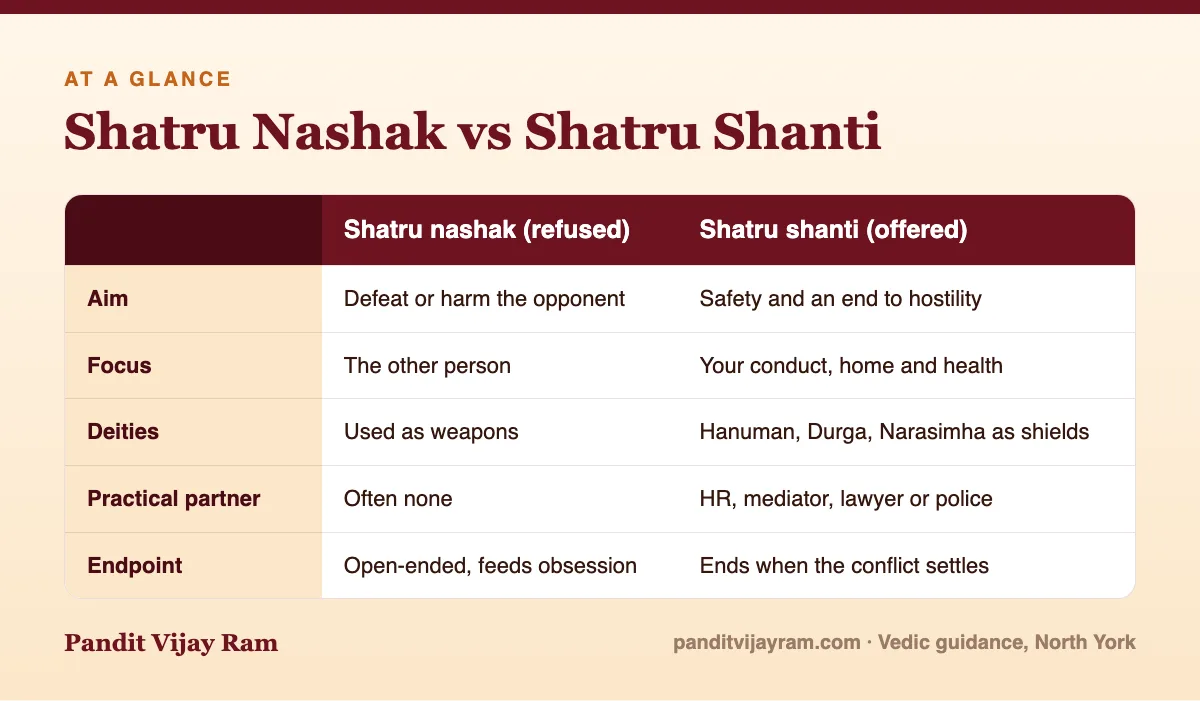
Shatru shanti means pacifying enmity. Instead of asking for an opponent's ruin, it asks for protection around you, an end to the hostility, and clear judgment in dealing with the conflict. It works on the situation and on your own reactions, which are the two things prayer can honestly influence.
The difference is easiest to see side by side.
- Aim. Nashak seeks the opponent's defeat or harm; shanti seeks safety and the end of the quarrel.
- Focus. Nashak keeps your attention on the other person; shanti brings it back to your own conduct, home and health.
- Deities invoked. Protective forms such as Hanuman, Durga, Narasimha and the Sudarshana chakra of Vishnu are approached as shields, not weapons.
- Exit point. A nashak mindset has no natural end. Shanti ends when the conflict settles or you have walked away from it.
- Practical partner. Shanti is always paired with real steps: HR, a mediator, a lawyer, or the police where there is a threat.
Picture a household that wants a puja to stop a cousin who is turning the extended family against them. A shanti sankalp would ask that the slander stop and that the family speak and act with dignity. The practical step might be one calm letter sent through a neutral elder. That pairing of prayer and action is what I mean by reframing.
Our wider guide to protection from enemies covers the practical side in more depth.
Which shatru shanti remedies can you do at home?
Simple, safe home remedies include the Hanuman Chalisa on Tuesdays and Saturdays, a mustard or sesame oil lamp for Shani on Saturday evenings, Durga Kavach recitation, and a daily sankalp asking for protection and peace. Pair each with one practical action toward resolving the conflict, and keep the practice free of anger.
Here is a modest weekly pattern that suits most households. Keep it small enough to sustain.
- Daily sankalp. Hold water in your right palm and state your intention: protection for my family, an end to this hostility, and wisdom in my own actions. Then pour the water into a plant pot.
- Tuesday and Saturday. Recite the Hanuman Chalisa once or seven times before a lamp. Our Hanuman Chalisa home protection guide explains counts and timing.
- Saturday evening. Many families light a sesame or mustard oil lamp for Shani Dev, associated with justice and fair consequences. See the Shani Saturday oil ritual for the method.
- Durga Kavach. The armour hymn read before the Durga Saptashati is widely recited for protection.
- Charity. Feeding someone in need, or donating to a food bank, turns anxious energy outward in a kind direction.
Keep lamps on a metal tray, away from curtains, and never leave a flame burning when you leave the room. If the opponent is a relative, avoid placing any item near their home or belongings. That is both a boundary and a legal precaution.
How do you spot a fake shatru nashak puja seller?
Warning signs include promises to destroy, punish or kill an opponent, demands for the enemy's photo or hair, deadlines and rising fees, claims that a curse will strike you if you stop paying, and confident promises of court or job victories. A genuine pandit asks about your safety and practical steps first.
Anger makes people easy to sell to, and some sellers know it. Use this decision rule before paying anyone for enemy work.
- Does the offer aim at harm? If the words destroy, finish, punish or ruin appear, walk away.
- Do they want the other person's belongings? Photos, hair or clothing are props for fear, not tools of honest prayer.
- Is there pressure? Countdown timers, midnight deadlines and fees that grow after each session are classic scam patterns.
- Do they threaten you? A seller who warns that the ritual will turn on you unless you pay more is extorting you.
- Do they ignore safety? If you mention threats and they do not tell you to contact police, they are not protecting you.
If you have already lost money, report it to the Canadian Anti-Fraud Centre and your bank. There is no shame in it; these schemes are built to catch people under strain.
When you want a properly conducted protective puja, ask what the sankalp will say, word for word. Vijay Ram ji's enemy and court case service writes every sankalp as a prayer for protection and peace, and the reasoning is shared openly before anything begins.
The bottom line
Shatru nashak sounds like a weapon, but the tradition's deeper meaning points to inner enemies and to obstacles in your path. Rites designed to harm people are refused here because they rebound on the performer and keep the conflict alive. Shatru shanti asks for protection, an end to hostility and wise conduct, always paired with practical steps. That is the honest way to bring peace to a hostile situation.
Key takeaways
- Shatru nashak literally means destroyer of enemies, but scripture often aims it at inner enemies.
- Vijay Ram ji does not perform rituals to harm, bind or punish any person.
- Shatru shanti asks for protection, peace and clear judgment instead.
- Every protective prayer should be paired with a real step such as HR, mediation, a lawyer or police.
- Promises to destroy an enemy, and rising fees, are signs of a scam.