
Baglamukhi Puja: What It Is For and Its Ethical Limits

Few names in Hindu tradition are searched with as much hope and fear as Baglamukhi. People facing a court case, a harassing neighbour or a vicious rumour often hear that Baglamukhi puja will silence their enemies. Some readers in North York and across the GTA arrive having been quoted large sums for a ritual to stop an opponent in their tracks. This guide explains who Bagalamukhi is among the Mahavidyas, why she wears yellow, what stambhana really means in tantric texts, and why her worship has been misused online as a weapon. It also sets out how I approach her puja: as a prayer for stillness, courage and protection, never as a way to damage another person's mind, voice or life. Over forty years of Vedic practice, I have found that the stillness devotees most need from her is usually their own, a quiet mind that stops replaying the conflict and makes wise choices with a lawyer or advisor.
Who is Baglamukhi devi?
Bagalamukhi is one of the ten Mahavidyas, the great wisdom goddesses of Shakta tantra, usually listed eighth. She is called Pitambara, the one dressed in yellow, and is often shown holding a club while pulling the tongue of a demon. She embodies the power to halt hostile speech and action, and devotees revere her as a fierce protector.
The ten Mahavidyas are forms of the Divine Mother worshipped in Shakta and tantric traditions: Kali, Tara, Tripura Sundari, Bhuvaneshvari, Bhairavi, Chhinnamasta, Dhumavati, Bagalamukhi, Matangi and Kamala. Lists and order vary somewhat between texts, but Bagalamukhi is consistently included.
Key features of her worship:
- Yellow everywhere. Her clothing, garland, seat and offerings are yellow. Turmeric, yellow flowers, yellow sweets and yellow cloth are traditional.
- Her image. She sits on a golden throne, raising a mace in one hand and seizing a demon's tongue with the other, an image of stopping harmful words at their source.
- Her name. Scholars connect bagala with the Sanskrit valga, a bridle, suggesting the power to restrain. Folk tradition links it with the crane, and some depictions show her crane-headed.
- A popular legend tells of a cosmic storm threatening creation, calmed when Vishnu prayed and the goddess arose from a turmeric-coloured lake.
Major shrines associated with her exist in India, notably at Datia in Madhya Pradesh and in the Kangra region of Himachal Pradesh, and devotees travel to them seeking protection.
Her fierce form is often misunderstood, much as Kali is. The post on Kali puja for protection explains why fierce goddesses are protectors rather than agents of black magic.
What does stambhan mean in Baglamukhi worship?
Stambhana means stopping, freezing or immobilising. In tantric literature it is one of the shatkarmas, six ritual aims ranging from pacification to destruction. With Bagalamukhi it refers to halting speech, movement or harmful intent. Devotional teachers also read it inwardly, as stilling one's own restless thoughts, anger and careless words.
I want to explain stambhana honestly, because it is the heart of why Bagalamukhi is both revered and misused.
Classical tantric texts describe six ritual acts, the shatkarma:
- Shanti, pacifying illness or misfortune.
- Vashikarana, bringing under influence.
- Stambhana, immobilising or halting.
- Vidveshana, creating enmity between people.
- Uchchatana, driving someone away.
- Marana, causing death.
That list makes clear that some tantric aims were aggressive, and the texts themselves record them. Respect for a tradition does not require pretending otherwise. Many teachers within the tradition warned that the harmful acts bring grave karmic consequences and should not be performed.
Bagalamukhi's traditional mantra asks her to stop the speech, movement and intellect of the wicked. Read literally, it can sound like a curse. Read devotionally, as many practitioners teach, it asks her to halt falsehood, slander and malice wherever they arise, including in oneself.
The inward reading is the one I follow. When I chant to her, I ask her to still my own anger, to quiet the urge to speak harshly, and to stop lies from gaining power, without naming any person as a target.
For context on how these tantric terms have been distorted online, see the explainers on the meaning of vashikaran and why tantra is not black magic.
Is Baglamukhi puja good for court cases?
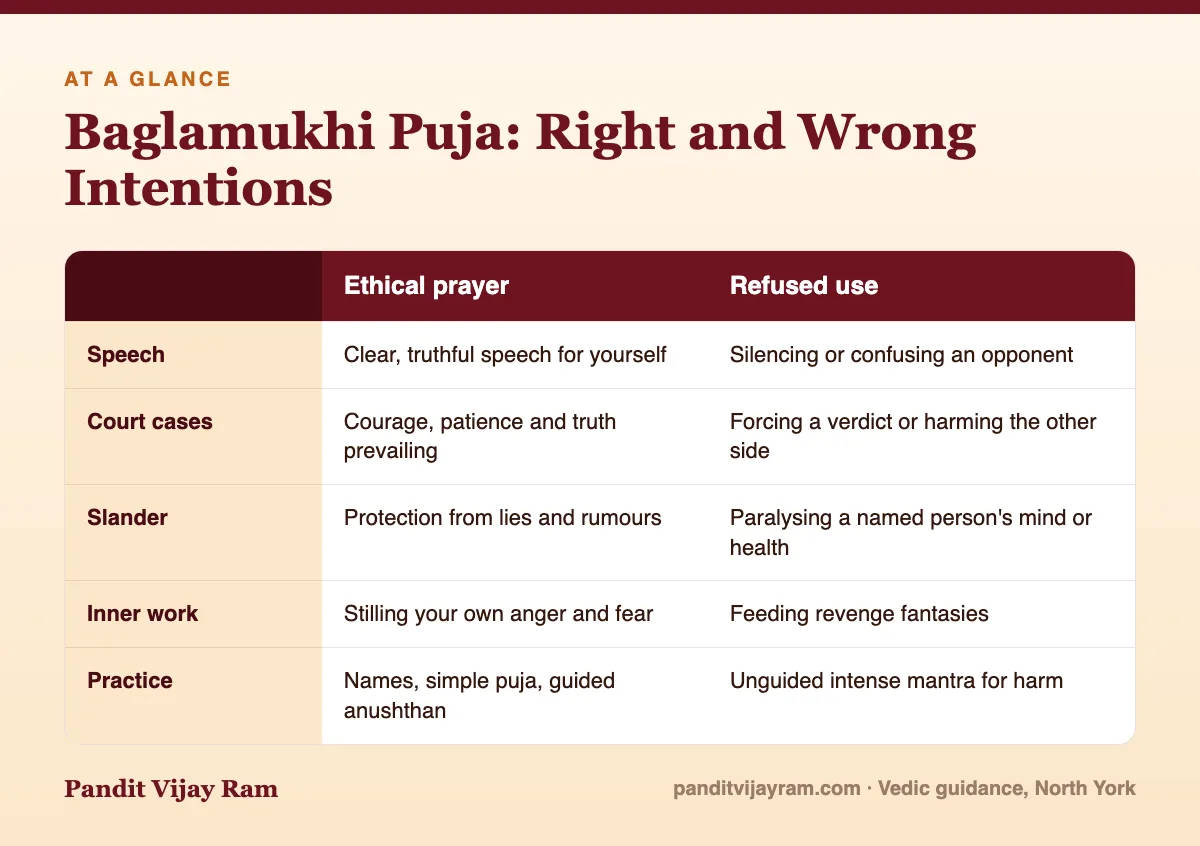
Many devotees pray to Bagalamukhi during legal disputes, because tradition links her with victory in debate and protection from false accusation. Ethical prayer asks for clear, truthful speech, courage and relief from slander. It does not ask her to silence or paralyse the other party. A lawyer remains essential, and no puja can promise a verdict.
The association between Bagalamukhi and lawsuits is old and widespread. People facing false charges, aggressive litigation or public slander have prayed to her for generations. I understand why: her image of stopping a hostile tongue speaks directly to someone who feels attacked by lies.
Here is how I frame a court-related prayer to her:
- Ask for truth to prevail, not for your side to win regardless of facts.
- Ask for your own clear speech in court and with your lawyer.
- Ask for protection from slander and false statements, without naming an opponent for harm.
- Ask for patience with delays and the strength to accept a fair settlement if it is offered.
What I will not do is perform a ritual intended to freeze an opponent's speech, confuse their lawyer or damage their health. That is using sacred power as a weapon, and it contradicts the dharma the goddess protects.
Before any puja, the practical steps come first: legal advice, documents, deadlines. Our article on court case astrology explains the order I recommend and why no chart or ritual decides a case. The enemy and court case guidance page describes the support I offer alongside a legal team.
Be wary of anyone who promises that a Baglamukhi anushthan will deliver court victory. No such promise is honest.
Why should Baglamukhi worship never be used to harm opponents?
Using Bagalamukhi's power to harm someone turns protection into aggression, which the tradition itself warns against. In karmic terms it rebounds on the one who wishes harm. It also escalates conflict, may target an innocent person, and keeps you bound to resentment. Her worship is meant to stop evil, not to become it.
People sometimes tell me that their enemy deserves to be stopped, and that the goddess exists for exactly that. I respond with a few considerations I ask them to weigh:
- Who decides who is wicked? In a bitter dispute, each side sees the other as the villain. A prayer that harms an opponent assumes you are certainly right.
- Karma does not exempt devotees. Texts that describe aggressive rites also describe their heavy consequences for the person who commissions them.
- Harm escalates. When people believe they have been targeted spiritually, they often retaliate, and families or communities split further.
- It distracts from real protection. Money and hope poured into a destructive ritual are not spent on a lawyer, documentation or police reports.
- It keeps you tied. Wishing someone harm daily keeps them at the centre of your life.
The deeper lesson of stambhana, as I understand it, is that the most dangerous tongue is often one's own. Anger, gossip and revenge fantasies do more damage to a devotee than any outside enemy.
If you feel someone has already targeted you with harmful ritual, the article on shatru nashak remedies explains how protection works without destruction. Threats to your safety belong with the police.
How is Baglamukhi puja performed respectfully?
Traditional Baglamukhi puja uses yellow clothing, a yellow seat, turmeric, yellow flowers and sweets, a ghee lamp, and recitation of her mantra on a turmeric mala. Full sadhana traditionally requires initiation from a qualified guru. Laypeople can offer simple devotional prayer and her names safely; formal anushthan is best done by an experienced priest.
Mahavidya worship is traditionally guarded. Many lineages hold that the full mantra and sadhana should be received through diksha, initiation, from a teacher. I respect that, and I advise against copying an intense mantra from a video and chanting it thousands of times without guidance.
For a respectful home devotion without initiation:
- Prepare a clean space with a yellow cloth and an image of the goddess.
- Wear yellow if you can, and sit on a yellow mat facing east or north.
- Offer turmeric, yellow flowers and a yellow sweet, such as besan laddoo.
- Light a ghee lamp on a stable metal plate away from curtains, with a smoke alarm working and children supervised.
- Recite her names or a short devotional hymn, asking for calm, truth and protection.
- Close with a prayer for everyone in the dispute, including the person you struggle with.
Thursdays are often favoured, and her jayanti falls on the eighth lunar day of the bright half of Vaishakha; check a Toronto panchang for timing. Fasting is optional, and anyone with diabetes, pregnancy or medical conditions should speak to a doctor first.
A formal anushthan with havan and a set count of mantra is a serious undertaking. Our puja and anushthan page explains how such rites are arranged, always with protective and peaceful intention.
The bottom line
Baglamukhi puja honours Bagalamukhi, the yellow-clad Mahavidya whose power of stambhana halts hostile speech and action. Honest teaching admits that tantric texts describe aggressive aims, and equally honest ethics refuse them. Devotees can rightly ask her for truth, clear speech, protection from slander and an inner stillness that calms their own anger. Practical help from a lawyer or police comes first, and no ritual should be used to harm another person.
Key takeaways
- Bagalamukhi is one of the ten Mahavidyas, known as Pitambara for her yellow.
- Stambhana means stopping or stilling, one of the six tantric ritual aims.
- Ethical prayer asks for truth and protection, not silencing an opponent.
- Full sadhana traditionally requires initiation from a qualified teacher.
- No puja can promise a court result; legal advice comes first.