
Return to Sender Spells: Why a Vedic Healer Won't Do Them

When you believe someone has deliberately harmed you, the wish to hit back is human. Online sellers know this, and many advertise return to sender spells, mirror boxes and "karma reversal" packages that promise the sender will suffer what they sent. People in North York ask me about this more often than they ask about almost anything else connected to black magic. The answer is no, and this article explains why in plain terms. You will read how Vedic texts view rituals of harm, why retaliation tends to deepen the conflict rather than end it, how often the suspected sender turns out to be innocent, and what genuine protection does instead. I will also cover the practical steps, including police, when the threat is a living person behaving badly. In more than forty years of this work I have watched anger keep people tied to the very conflict they wanted to escape. Protection, done steadily, lets them walk away from it.
What is a return to sender spell?
A return to sender spell is a ritual, common in modern Western witchcraft and some folk-magic markets, intended to bounce a curse or spell back to its source. Methods include mirror boxes, reversing candles and written petitions. The stated aim is that whoever sent harm receives it, sometimes multiplied.
The idea appears in several forms. Some versions are framed as purely defensive, a mirror that simply reflects anything negative away. Others are openly punitive: a black candle burned upside down, a doll bound in thread, a petition asking that the sender suffer illness or ruin. Online shops frequently blur the two, selling a "protection" product whose description promises revenge.
In South-Asian markets the equivalent is often sold as ulta work, literally turning the magic around. Some sellers claim to send it back "three times stronger", which is a sign of how far the practice has drifted from any protective purpose.
It helps to separate three things that are often confused:
- Shielding keeps harm from reaching you.
- Removal lifts an influence already present.
- Retaliation sends harm toward another person.
The first two are part of sincere Vedic practice. The third is not. If you are unsure which word applies to what you have been offered, our guide to spell, curse and hex removal sorts out the terminology across traditions.

Why won't a Vedic healer send black magic back?
Vedic ethics classify ritual intended to harm another as abhichara, a practice the dharma texts treat as wrongdoing. The principle of karma means the intention to injure attaches to the one who performs or commissions it. Ahimsa, non-harm, is a core value, so a healer who sends harm back abandons the very discipline that gives protection its strength.
Several reasons sit behind the refusal, and they reinforce one another.
- Karma does not distinguish revenge from attack. An act meant to hurt carries the same weight whether it is the first blow or the second. Commissioning it does not move that weight onto the healer.
- Ahimsa. Non-harm runs through Hindu, Jain and Buddhist ethics. Prayer offered in anger contradicts the devotion it relies on.
- Protection comes from the divine, not from force. Hanuman, Durga and Narasimha are invoked as guardians. In the stories, they protect devotees; the devotee does not command them to punish.
- The healer's own practice. A practitioner who performs harmful rites weakens the discipline that makes his protective work meaningful.
None of this asks you to like or excuse the person who hurt you. Forgiveness in the Vedic sense means releasing your mind from the grip of that person, not pretending the harm was acceptable. Our article on negative energy from someone's jealousy shows how boundaries and protection work together without any counter-attack.
Vijay Ram ji's spiritual protection work is built on this foundation: strengthen the person, cleanse the space, and leave the other party's fate to a power greater than either of you.
Can sending a spell back make things worse?
Yes, in several practical ways. Retaliation keeps your attention fixed on the conflict, feeds fear and suspicion within families, and can provoke a real-world response from the person you target. If the suspected sender was never involved, you have harmed an innocent person and left the true cause unaddressed.
Here is what I see happen when people pursue revenge rituals, whether or not one believes they have any spiritual force.
- Escalation. Word travels in close communities. A cousin hears that a mirror ritual was done against her and commissions her own. Two households end up locked in fear for years.
- Wrong target. Most suspicion falls on relatives or in-laws already in conflict. Many times the chart or a plain conversation shows the troubles had another source entirely.
- Mental cost. Waiting to see the other person suffer is exhausting. Sleep, appetite and patience with children all suffer.
- Financial drain. Sellers often say the return failed because the sender is "too strong" and ask for a larger payment. Our article on removal scams and warning signs describes this loop.
- Legal exposure. Leaving ritual objects at someone's door or sending threats about what will befall them may be treated as harassment.
The kinder and sturdier path is to close the door rather than throw something through it. That is what the next section describes.
What does spiritual protection do instead of revenge?
Protection builds a boundary around you, your home and your family so that ill will finds no foothold. It uses daily prayer, mantra, home cleansing, a blessed kavach and, where needed, a puja or havan. Nothing is aimed at anyone else. The goal is your peace, not their punishment.
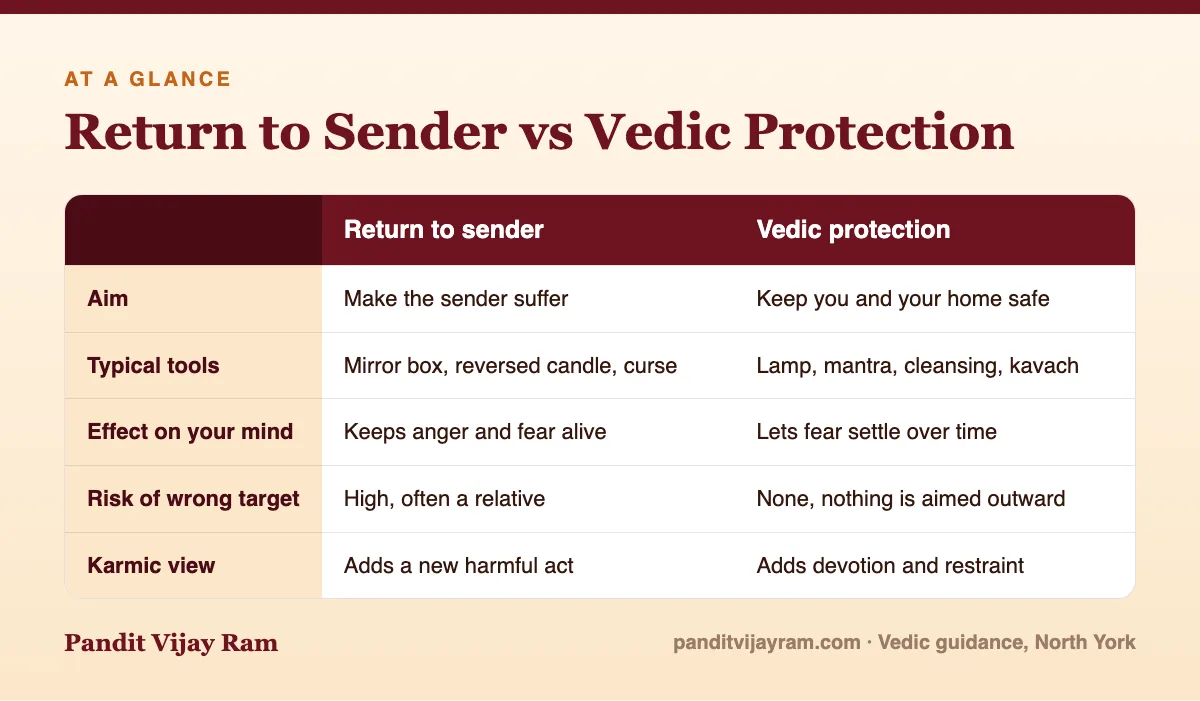
Compare what each approach asks of you and what it leaves behind.
- Focus: retaliation watches the enemy; protection looks after your own household.
- Tools: retaliation uses mirrors, reversed candles and curses; protection uses a lamp, the Hanuman Chalisa or Durga Kavach, salt-water cleansing and a raksha sutra.
- Effect on the mind: retaliation feeds anger; protection gradually lets fear settle.
- Effect on family: retaliation spreads suspicion; protection can be shared by everyone at home.
- Karmic view: retaliation adds a new harmful act; protection adds devotion.
A traditional protective programme might include a forty-day recitation, a cleansing of the home, a Hanuman or Durga puja and a kavach worn afterwards. Where the chart shows a hard planetary period, graha shanti is added. Each element faces inward.
Some people worry that if they do nothing to the sender, the harm will keep coming. Tradition answers that a person well protected by devotion is not an easy target, and that whatever the sender has set in motion will meet its own consequences without your help. For help with removal itself, see Vijay Ram ji's curse and hex removal service. The wider protective framework lives in our magic and entities guides.
What should I do if someone is actively trying to harm me?
If a living person is threatening, stalking or harassing you, treat it as a safety matter first. Keep records, tell people you trust, and contact police. Spiritual protection runs alongside these steps; it never replaces them. A ritual cannot stop someone from turning up at your door or sending abusive messages.
Many people who ask for return to sender work are really describing a person, not a spell: an ex who keeps contacting them, a relative making threats, a neighbour leaving things on the step. These situations need practical action.
- Document everything. Dates, screenshots, photos of objects left at your home, names of witnesses.
- Avoid confrontation. Do not reply in anger or threaten spiritual consequences; it can be used against you.
- Tell someone. A trusted friend, elder or community leader can support you and act as a witness.
- Contact police if there are threats, repeated unwanted contact or damage to property. In an emergency, call 911.
- Seek advice from a lawyer or a victim services organisation about peace bonds or restraining orders.
Spiritually, keep your practice protective and steady. If objects have been left at your home, our guide to a suspicious object found at home explains safe handling. And if fear is eating into sleep and work, speak to your family doctor; anxiety after a threat is a normal response that deserves care.
The bottom line
Return to sender spells promise justice but ask you to take on the very harm you are trying to escape. Vedic ethics, through karma and ahimsa, steer the healer away from retaliation and toward protection that faces inward. When a living person is the real threat, records, support and police come first, with steady prayer and a kavach alongside.
Key takeaways
- Return to sender rituals aim harm at another person, which Vedic ethics call abhichara.
- Karma attaches to the intention to harm, whoever strikes first.
- Retaliation often targets the wrong person and escalates family conflict.
- Protection shields you, your home and family without aiming at anyone.
- Threats or harassment by a real person are police matters first.