
Rudrabhishek: What It Is and Why Families Book It

Rudrabhishek is one of the pujas people hear named at the temple and then struggle to picture. Is it a havan, a chant, or a milk offering poured over a lingam? It is mostly the last two working together. Families in North York, Markham and Vaughan often call me during Shravan wanting to book one, yet unsure what actually happens or which version suits a home. Some have an elder in hospital and want to pray. Others simply feel drawn to Shiva on Mondays and want to honour that pull properly. In over four decades of conducting Vedic rites, I have found that once people understand the chant, they experience the ritual very differently. This article explains what the abhishek involves, what Sri Rudram says, the materials and their traditional associations, the scale from a single Ekadasha Rudra to Ati Rudra, the occasions families choose, and how to prepare for one in a home or condo.
What is Rudrabhishek and what does it mean?
Rudrabhishek joins two words: Rudra, a Vedic name of Shiva, and abhishek, a ritual bathing. A Shiva lingam is bathed in a continuous stream of sacred liquids while the Rudram hymn is chanted. The bathing honours Shiva, and devotees understand it as asking his fierce energy to become gentle and protective.
In the Vedas, Rudra is the storm-like, untamed aspect of the divine. The hymn chanted during the ritual repeatedly bows to that power and asks it to turn kindly, which is why the name Shiva, meaning the auspicious one, sits at its heart.
The abhishek itself is an act of cooling and care. Shiva is traditionally described as fond of abhishek, just as Vishnu is fond of ornament, so pouring water or milk in a slow stream is considered one of the most loved offerings to him.
Two regional styles are common in the GTA:
- South Indian style uses Sri Rudram and Chamakam from the Krishna Yajurveda, often chanted by several priests together.
- North Indian style commonly uses the Rudrashtadhyayi, a collection of eight chapters drawn from the Shukla Yajurveda, which includes the Rudra hymn.
Both are authentic. The choice usually follows the family's own tradition or the priest's training. Abhishek differs from a havan because no offerings go into fire; if a family wants both, a short havan can follow. Our page on puja, havan and anushthan explains how the two are combined.
What is Sri Rudram and why is it chanted during abhishek?
Sri Rudram is a Vedic hymn in two parts. The Namakam, eleven sections built on the word namah, bows to Shiva in every form and place. The Chamakam asks for blessings, each line ending in cha me, meaning and for me. Chanting it during abhishek turns the bathing into a prayer of surrender and request.
The Namakam salutes Rudra as present in forests and rivers, in the archer and the traveller, in the high and the humble. Its famous line contains namah shivaya, the origin of the Panchakshara mantra Om Namah Shivaya that many people chant daily.
The Chamakam then lists what the worshipper hopes for: food, strength, long life, knowledge, harmony and the right use of wealth. It reads almost like a Vedic household inventory, which many listeners find touching.
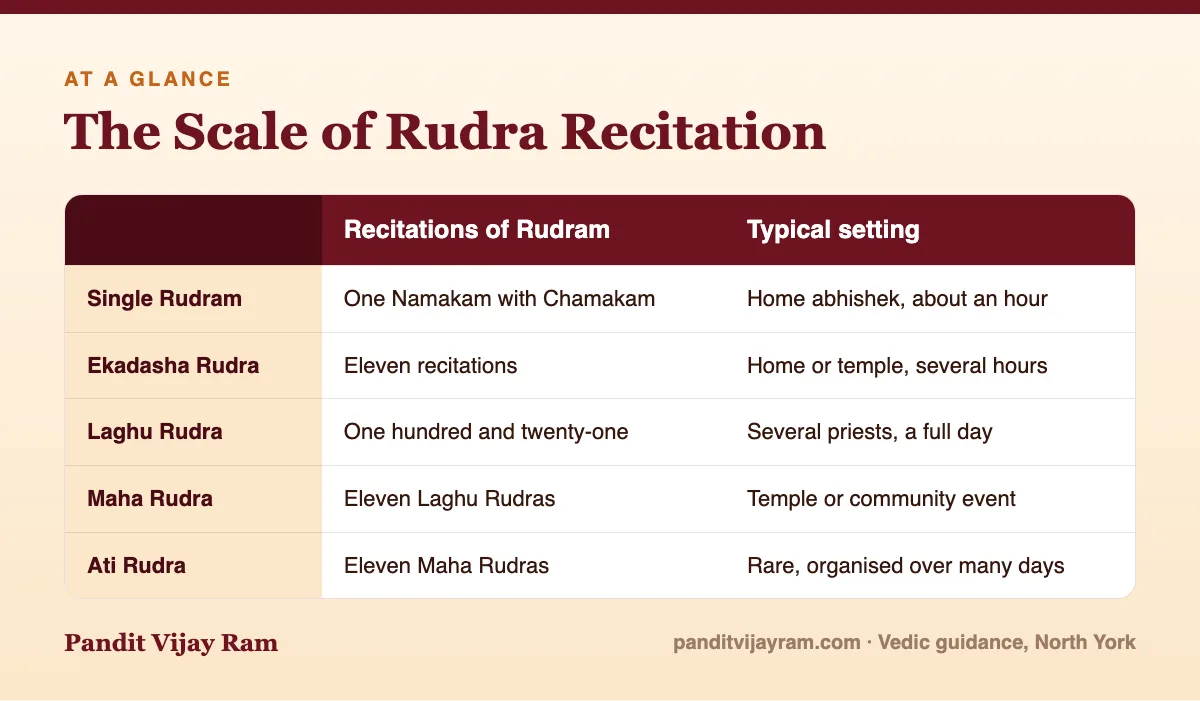
The number of recitations sets the scale of the ritual:
- Ekadasha Rudra: the Namakam chanted eleven times, with a section of Chamakam after each.
- Laghu Rudra: eleven Ekadasha Rudras, so one hundred and twenty-one recitations, usually shared among several priests.
- Maha Rudra: eleven Laghu Rudras, a large temple or community event.
- Ati Rudra: eleven Maha Rudras, rare and organised over many days.
For a home, a single recitation or an Ekadasha Rudra is the usual choice. Pronunciation and Vedic accent matter in this hymn, which is why trained chanters lead it. Families who wish to recite a shorter prayer themselves often chant Om Namah Shivaya or the Mahamrityunjaya mantra while the water flows.
What materials are used in Rudrabhishek?
The core materials are clean water or Ganga jal, milk, curd, ghee, honey and sugar, often followed by sugarcane juice, coconut water and sandal water. Bilva leaves, white flowers, bhasma, rudraksha and a lamp complete the offering. Tradition links some liquids with particular wishes, though texts and families differ on the details.
A practical list for a home abhishek:
- A lingam: a small stone Narmadeshwar, crystal or metal lingam on a yoni base set in a deep plate or tray.
- Liquids, in order: water, milk, curd, ghee, honey, sugar water, then water again to rinse. Many families add sugarcane juice or coconut water.
- Leaves and flowers: bilva leaves with three leaflets, white flowers, dhatura flowers where available.
- Finishing items: sandal paste, vibhuti, unbroken rice, a fresh cloth, a ghee lamp and incense.
Customs that families commonly follow:
- Tulsi is usually not offered to Shiva, and many traditions avoid kumkum and turmeric on the lingam.
- The ketaki flower is traditionally excluded, linked to a Purana story.
- Use only as much milk as the ritual needs. Some families offer a small symbolic amount and donate the rest to a food bank, which many find in keeping with Shiva's simplicity.
After the ritual, the diluted abhishek water is usually poured into garden soil or a potted plant, not down a drain. For broader advice, see our guide to disposing of puja items respectfully.
Why do families book a Rudrabhishek?
Families book Rudrabhishek during Shravan, on Mondays, Pradosh and Maha Shivratri, and around life events such as a birthday, a housewarming or a new venture. Many also ask for it when a family member is ill, alongside medical treatment, or when a chart shows a demanding period they want to meet with steadiness and prayer.
The reasons I hear most often fall into a few groups.
- Devotion in sacred time. The month of Shravan, every Monday within it, and the night of Maha Shivratri are the traditional peaks. Pradosh, the twilight of the thirteenth lunar day, is another favoured window.
- Health worries. When a parent is unwell, families want something to do. A Rudrabhishek can be a comfort and a focus for prayer, but it sits beside the doctor's care and never replaces it.
- Planetary periods. Some families request it during a difficult Saturn or Rahu period, or for a Moon placement that leaves a person anxious. A kundli reading can show whether that framing applies to you at all.
- Thanksgiving and beginnings. Birthdays, new homes, a business start, or the return of a family member from abroad.
- Family peace. Shiva and Parvati are prayed to together for harmony in a marriage and household.
None of these needs fear as a motive. If anyone tells you a Rudrabhishek is urgently required to avert disaster, take it as a reason to slow down and ask questions, not to pay quickly.
Can you do Rudrabhishek at home or in a condo?
Yes. A small lingam set in a deep tray contains all the liquid, so a home or condo abhishek is simple and clean. You need a quiet hour, a towel underneath, the materials laid out in order, and either a recorded or live Rudram chant. Lamps should be small, and nothing is burned except a diya and incense.
Preparation makes the difference between a calm abhishek and a messy one.
- Set the tray. Place the lingam in a rimmed steel plate on a folded towel. The spout of the yoni base traditionally points north.
- Line up the liquids in small bowls in the order they will be poured.
- Begin with Ganesh and a short sankalp in your name.
- Pour slowly from a copper or steel vessel with a narrow spout, letting the chant set the pace.
- Rinse and decorate. Finish with clean water, wipe the lingam, apply sandal paste, place bilva leaves and offer the lamp.
- Aarti and prasad. Close with aarti and share a little of the panchamrit.
In many temples devotees walk only half-way around a lingam so as not to cross the channel that carries abhishek water. At home, just keep the tray where nobody steps over it.
Fire safety still applies: one small diya on a metal plate, away from curtains, and never left unattended. If you cannot gather a team of chanters, Vijay Ram ji can conduct the Rudrabhishek with a sankalp in your name while you join by video, as described in our guide to how online puja works. Many devotees also wear a rudraksha mala for the chanting.
The bottom line
Rudrabhishek is the bathing of a Shiva lingam with sacred liquids while Sri Rudram or the Rudrashtadhyayi is chanted. Its materials are simple, from water and milk to honey and bilva leaves, and its scale runs from one recitation to the rare Ati Rudra. Families book a Rudrabhishek in Shravan, on Mondays and Maha Shivratri, or when they want prayerful steadiness through illness and change, always alongside practical care.
Key takeaways
- Rudrabhishek is a ritual bathing of the Shiva lingam during Vedic chanting.
- Sri Rudram has two parts, the Namakam of salutations and the Chamakam of requests.
- Ekadasha, Laghu, Maha and Ati Rudra grow by multiples of eleven.
- Shravan, Mondays, Pradosh and Maha Shivratri are traditional times.
- Prayer for a sick relative belongs beside medical care, never in place of it.